
Disparities in Covid-19 Testing Are Highly Problematic
Long wait times and backlogs are crippling the U.S. response
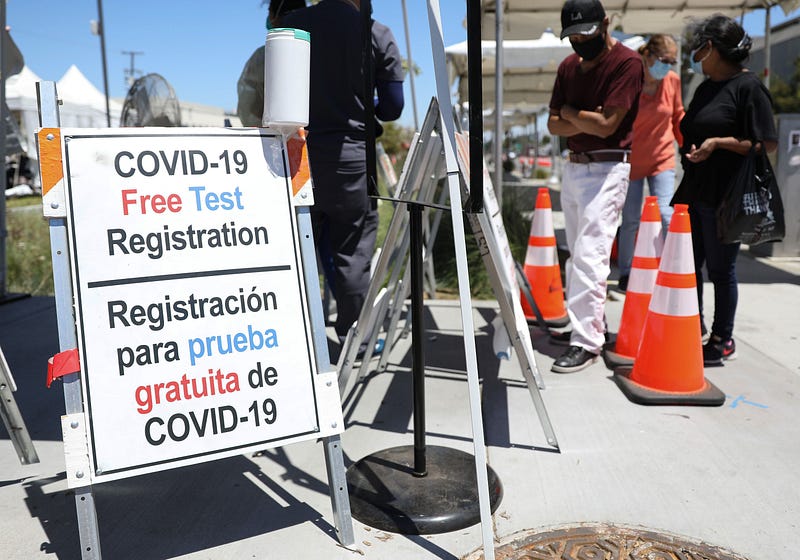
Despite the fact that the United States is in its sixth month of dealing with the coronavirus pandemic (and other countries began combatting the virus months before that), the country is still dealing with testing backlogs. In some cases, people are waiting two weeks or longer to get their results.
As Ashish K. Jha, MD, MPH, the incoming dean of the Brown University School of Public Health shared on Twitter on Tuesday, testing is down in 24 states and is lower now than it was two weeks ago. A decline in testing is okay for states that have high testing rates and a low test positivity rate. For example, New York currently has around a 1% positivity rate that puts its transmission rates at South Korea levels (if these numbers are accurate of course — testing delays make it harder to get a clear picture).
But a decline in tests in states that are hard hit by the virus is problematic. As Jha shares, in 24 states where testing is down, the test positivity rate is 12.6%. “This is abysmal,” he said.
“These states need to be doing a lot more than they are,” Jha added in his thread. “They are likely missing 70–80% of cases. They are not over-testing — they are under-testing. Yet their test numbers are declining Why? Long wait times and long turn around times means people are just giving up.”
Health experts are also questioning whether the country is doing enough to test the right people. “We could test lots of low risk people and have low positivity, but we’re failing if high risk groups can’t access testing,” Natalie Dean, PhD, assistant professor of Biostatistics at the University of Florida, recently shared on Twitter.
The long wait times are a barrier to getting tested, and data is showing that these wait times are not distributed evenly. A recent analysis of testing sites by ABC News, FiveThirtyEight, and ABC-owned television stations found that white neighborhoods have more access to testing sites and that testing sites in communities of color in many U.S. cities face higher demand. “The result of this disparity is clear: People of color, especially Blacks and Latinos, are more likely to experience longer wait times and understaffed testing centers,” reports ABC News.
The analysis also found economic disparities in testing, with testing resources being more scarce in lower income neighborhoods where there are fewer sites and the sites available are located further away. “And the disparity could be even higher in real life, considering wealthier people could also get tested by private practitioners who are less likely to be reflected in our analysis,” reports ABC.
Testing lots of people at low risk for the virus isn’t the best approach. “When access to testing is divorced from risk, the numbers lose their meaning and can mask failure,” Dean shared. “This is why disaggregating even further (race, neighborhood, occupation, symptom status, etc) is needed.”
While positivity rates may suggest improvements — for some states or cities — a better understanding is needed of what spread is like among groups or communities that are at a higher risk of getting the virus or of having severe outcomes from the infection. This kind of data is difficult to come by for both logistical and privacy reasons.
Increasing testing capacity overall is a critical need. A growing group of health experts are pushing for the use of rapid, at-home tests that may not be as effective, but can more quickly identify people with the virus at their most infectious stage. Earlier this week seven governors formed a compact to pressure test makers to ramp up test production. Specifically, the states are pursuing a deal with the Rockefeller Foundation to obtain 3.5 million coronavirus antigen tests. It’s the nation’s first coordinated testing strategy plan.


