
RACISM IN POLITICS
On the Inquisition of America's First Black Woman Supreme Court Nominee
The more they accuse Ketanji Brown Jackson of misconduct, the more they expose their racist intentions
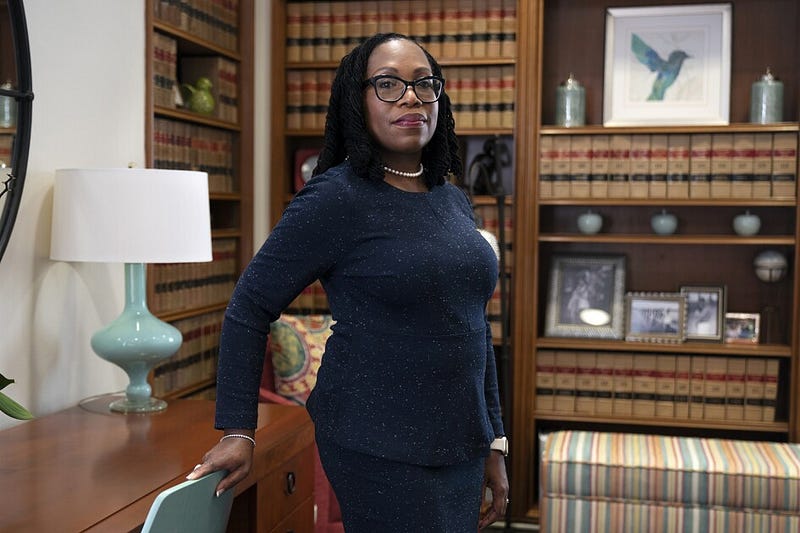
Soon, Ketanji Brown Jackson will be confirmed as America's first Black woman Supreme Court Justice. And given the support of the Democratic Party, Republicans cannot stop her ascension. But that hasn't stopped conservative White senators from throwing a series of baseless critiques against the wall to see what could stick.
The American Bar Association called Jackson "well qualified," giving her their highest ranking, based on her "qualities of integrity, professional competence, and judicial temperament." Yet, conservatives tried to portray Jackson as "soft on crime," criticizing her work as a federal public defender and accusing her of using Critical Race Theory in sentencing decisions.
Their line of questioning felt more like an inquisition than a traditional senate confirmation hearing. White senators continuously asked Ketanji Brown Jackson to describe her faith and disavow Critical Race Theory and other literature from Black scholars, like Ibram X. Kendi and Nikole Hannah-Jones. They might as well have asked Jackson, "Do you denounce Black scholars and all their anti-racism work?" Guess folks like Cruz didn't realize their line of questioning exposed just how little they understand about applying a theory. Not to mention, Cruz took issue with President Biden nominating a Black woman nominee before we knew who he'd pick.
Critical Race Theory considers the role race played in shaping America's legal and cultural landscape. Opponents of the theory say race plays no role in our lived experiences, even though statistics indicate widespread racial disparities. But, what does Critical Race Theory have to do with sentencing someone? Absolutely nothing. Throughout the hearing, conservatives made it clear they consider anyone who discusses racism a heretic.
Ketanji Brown Jackson responded to their critiques by saying, "I have not used critical race theory to determine the outcome of cases." But, why would she? That's not how the theory works. There is no aspect of Critical Race Theory designed to help judges make sentencing determinations. Theories help to explain behaviors, not force-feed solutions. Yet their foolhardy inquisition continued.
Senator Blackburn asked, "Is it your personal hidden agenda to incorporate CRT into our legal system?" Ironically, the only ones who seemed to have an agenda in this session were conservatives, clearly motivated by racial animosity. Also, since critical race theory is a way of understanding America's legal system, incorporating the theory into the legal system doesn't make dollars or sense — it’s a semantic conundrum.
Attacking Black women is as American as apple pie and freedom fries.
White conservative Americans tried to use Critical Race Theory as a weapon against Ketanji Brown Jackson without understanding what it is or how people use the theory. As Jackson eloquently pointed out, judges use sentencing guidelines written and passed into law by Congress. Within those guidelines, there is some flexibility, but Blackburn did not present any evidence that Jackson provided preferential treatment to Black defendants. Nor were her sentences outside of the range of those other judges dished out. So, what was her point exactly? Senator Blackburn, a White woman, wanted Ketanji Brown Jackson to disavow prominent Black scholars and to villanize Black people for discussing personal and systemic racism. Like her colleagues, Blackburn attacked Black intellectualism and fed red meat to the Trumpian and QAnon base.
Senator Ted Cruz ushered in another line of attack, besmirched Ketanji Brown Jackson for mentioning Nikole Hannah-Jones’ 1619 Project in one of her speeches. But, after having read the book, it's become increasingly unclear which chapter or verse has White Americans so riled up. And the more they talk about Hannah-Jones, the more they make it clear they didn't read the project, which includes a wide assortment of authors. Nikole Hannah-Jones wrote only two of the 18 essays. The first is called "Democracy," and her second essay, the last in the book, is called "Justice." Bet some of you didn't realize some of the authors are White men and women. But, the whole point of White Senators bringing up Nikole Hannah-Jones like she's a boogie man waiting in the bushes with a chainsaw is because she's a Black woman, and attacking Black women is as American as apple pie and freedom fries.
Then, of course, no inquisition would be complete without the age-old "soft-on-crime" accusation. On the first day of the confirmation hearing, Senator Marsha Blackburn's line of attack relied on misquoting Jackson, accusing her of advocating for the release of "dangerous criminals," even though she cited a brief where Jackson declined the release of someone considered dangerous. Their bad faith arguments continued to ignore Jackson's sentencing which consistently fell within the standard range.
Senator Booker took to Jackson's defense in an emotionally resonant line of questioning. Unlike White conservatives who berated the Harvard alumni, Booker discussed Jackson's role as a mother and leader. Booker’s temperament provided a much-needed break from the hostile line of questioning Jackson experienced during the day. Booker commented that "when you add the endorsements that you've gotten from folks that deal with victim advocacy groups, it is to me, just a line of attack that doesn't hold, in no way for me."
By the end of the second day of questioning, Republicans, who knew they could not stop Jackson from becoming this country's first Black woman to serve on the Supreme Court, used their time to grandstand, preserving their hyperbolic soundbites to use in their political advertisements.
Republicans can make a lot of noise and throw around dirt, but they don’t have the votes to block her — Los Angeles Times
Ketanji Brown Jackson's time as a federal public defender makes her a unique addition to the court, which generally consists of nominees with a prosecutorial background. But, in America, our legal system could not hope to provide equal justice for defendants without the hard work of public defenders. My mom worked as a public defender, so I grew up knowing that everyone accused of a crime isn't guilty. And even those who are guilty deserve a competent defense attorney. But when some Americans hear the term "defendant," they assume guilt and view defense attorneys negatively.
Yesterday, Jackson noted, "Federal public defenders do not get to pick their clients. It's a 'core constitutional value' that even those accused of the most heinous crimes get to be represented by a lawyer." Senator Graham asked if the federal government should be able to hold accused terrorists indefinitely. But once again, legislators make the laws, and the judiciary interprets them. So her view on whether or not something should be legal is irrelevant since she’s not running for office. Personally, I find it appalling that the United States is holding "39 men at Guantanamo," and most have never been charged with a crime. But, regardless of how Jackson feels about her former clients, conservatives tried to discredit her, simply for working as a public defender, which is an essential role within a democracy.
Despite Ketanji Brown Jackson's stellar resume and experiences she will bring to the highest court in the land, White conservatives continue to admonish the judge, pushing false narratives about Jackson's record as a former Harvard student, a federal public defender, and judge. And as the nation will soon celebrate Jackson becoming this nation's first Black woman Supreme Court Justice, history will remember those who took great glee in trying to stop the court from becoming more representative of American values.
🌹Learn more about the author here. 🖊Sign up to read all my stories and thousands more.