
What It’s Like To Stop Using Google Search
Most of the time I don’t notice a single difference
For almost twenty years, I used Google as my main search engine.
When it first appeared in 1997, Google was wildly better than the competition. You young’uns don’t remember this — shakes cane — but back in the ‘90s, search engines were a hot mess. You’d type your query into AltaVista or Lycos or HotBot, and behold! — a jumbled list of marginally relevant junk. Infoseek was slightly better because you could do a search, then do another search inside those results, and so on and so on (a cool technique that I wish someone would reboot today, tbh). But mostly you just waded through a swamp of irrelevant search results. You’d type in “best pizza in Toronto” and get, like, three web sites devoted to rollerblades, the CIA World Factbook entry for Albania, and a GeoCities page devoted to the German fansubbed rip of Battle of the Planets. They called it “surfing” the web because honestly, you might drown.
Then Google arrived, and the seas parted. It had a brilliant social insight powering its “PageRank” ranking algorithm (i.e. that a page with lots of links pointing to it was more noteworthy than a mere keyword match). Google did a bigger, huger “crawl” of the web than any other search engine, so they had the most complete results. If you searched for something on Google, you mostly likely found it. No need to go elsewhere.
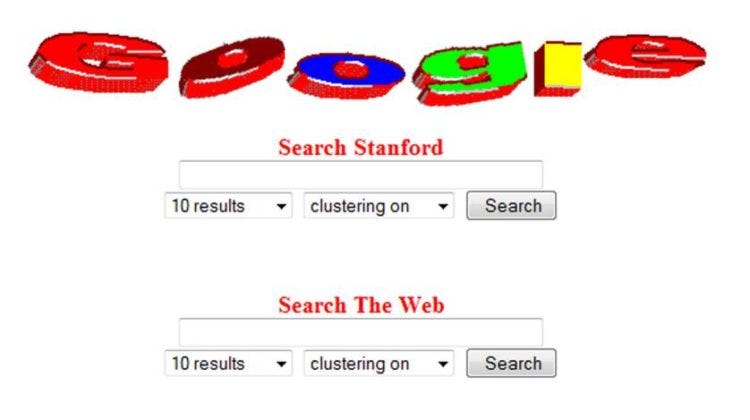
And it stayed that way for years, well into the 2010s. Google was my default, and society’s default. Google blasted their competition out of low Earth orbit and littered their charred remains across the landscape. Soon they’d become the metonymic stand-in for the act of searching itself: “Did you google it?”
But things changed.
In the last decade or so, Google’s search results began to grow mold. They started running more and more ad-results at the top of the search results. They began to minimize how obvious the ads were, to confuse people into clicking on them. These days, if I search for a product, the top of the results are chock-a-block with products. Even if I don’t search for a product, the rest of the first page is clotted with stuff I don’t want — like info-boxes trying to answer my question directly so I don’t actually leave Google search, YouTube videos (even if I have no interest in getting a video answer), or a section with “people also asked”, the lost ghost of Yahoo Answers.
And the results I’m actually looking for? Like, you know, a list of useful web sites? It’s pushed far down, and sometimes doesn’t even get started until the second full page of results.
Information dies in a casino of rabid upselling and misguided AI assistance. Google, once a beautifully spare tool designed to rapidly point me to the perfect site, now feels like the unholy spawn of Clippy and a pop-up window. I’ve received 419-scam emails that were more direct and to the point.
I’m not even gonna talk about Google’s invasive tracking technology, the digital tick of the Internet attached to our upper thighs, enjoying its blood feast. For the moment, let’s leave privacy aside.
The point is, judging Google’s search merely in terms of its ability to do search itself? The UI too often seems broken. It’s a slog.
All along these last two decades, I’d used alternate search engines, like Bing or DuckDuckGo. (Hell, I’d even use Lycos every once in a while, just to marvel at its sheer results. It’s still out there, people!)
But in recent years there’s been an intriguing renaissance in search, with new entrants like Neeva, You, and even a search engine from the browser firm Brave. The market for new search is lately heating up, which is probably itself a signal that Google has lost the tune. This creates a situation where it’s easier than ever to experiment with alternative search engines.
So about six months ago I decided I was sick enough of Google’s jumbled UI that I’d switch full-time. I began using DuckDuckGo as my default search engine, occasionally dipping into Brave, Neeva, and others as needed.
What’s it been like?
A few observations…
1) Most alternative search results are nearly the same as Google’s — but with less useless cruft
Most of the time, the alternative search engines got me exactly what I needed on the first page. Their performance was awfully close, and sometimes almost identical, to Google’s.
That’s partly because they’re often using a very similar “crawl” of the Internet. As this story notes, Google’s index of the web is a) huger than its rivals and b) incredibly expensive to do, so many rival search engines don’t always do their own full crawl — they just license results from Bing or Google.
The difference is, these rivals track you less often (and/or they more easily allow you to opt out of personalization). But more importantly for my UI angst, their interfaces are less arterially clogged than Google’s. They more briskly show me what I want, which is just a list of sites for me to go and check for myself. They’re somewhat less jammed with ads. They’re much less obsessed with trying to automagically present me the answer so I don’t need to leave the search engine.
DuckDuckGo was usually the best at this latter aspect, I found. It also has a “searches related to” box — their version of the exquisitely useless “people also asked” feature on Google — but DuckDuckGo puts it at the bottom of the first page, so I’m not forced to scroll past that nonsense before I get the list of links.
And look, if I can’t find something on DuckDuckGo or Neeva or Brave? If I’ve got a really complex search that requires direct access to Google’s massive crawl? I can just try Google. The cost of hopping around between engines is incredibly low. In fact, the Vivaldi browser (my main one) has hotkeys for instantly changing search engines, so switching from one search to another doesn’t even require me to touch my damn trackpad.
Yet here’s the thing: In practice, I often simply don’t need Google’s super-deep crawl of the web to find a site.
That’s because…
2) Most web searches are pretty damn simple
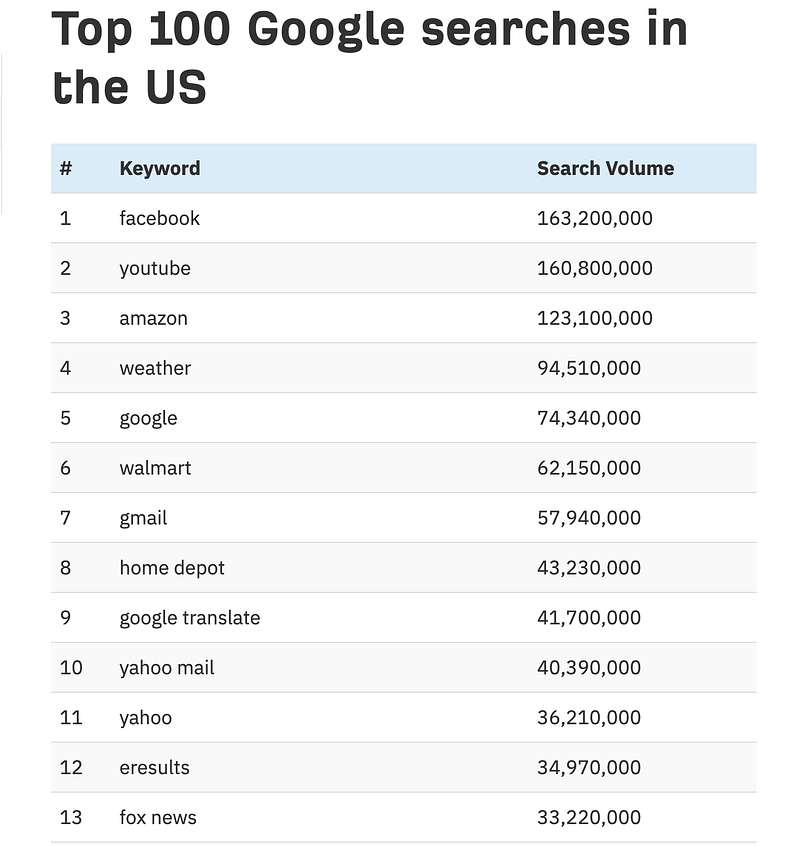
See that list above? Those are the most common searches on Google, as calculated by Ahrefs, an SEO firm.
They’re not complex, bank-shot quests for hidden data. Quite the opposite: They’re mostly navigational. Someone is just trying to go to, y’know, the main page of a common web site.
This is the dirty secret of the search market right now, which is: A lot of searches are for hilariously obvious stuff. “Facebook”? “Yahoo mail”? A search engine doesn’t need to have indexed the secret depths of the darknet to satisfy these sorts of queries. You can use any damn engine you want. Hell, go use AOL Search. It’ll do.
Sure, Google has the best crawl of the Internet’s hidden nooks and crannies, but who cares when you’re just trying to go to Home Depot’s homepage?
I’m a “power user” of the Internet (<pops collar>), but even so, a lot of my searches are also just as brutally simple. I’m just trying to find an obvious site to give me obvious information. This is true even in my job as a science and tech writer: Often I’m just navigating to the research page for a scholar, or to find a corporate lab. It’s bog-simple. Any search engine can find it for me.
And if I do need to really complex search? Then…
3) There are speciality search engines
Again, I’m a science writer, so I’m frequently searching for obscure white papers and scholarly literature.
But when I’m in that mode, I’m not using Google’s main search. I’m not using the main search of any engine. Instead, I’m using services designed specifically to find academic info, like Semantic Scholar or JSTOR. For historical research, I might use the scans of public-domain info on the Internet Archive or at Google Books.
So again, this makes my choice of a daily search engine less weighty. When I’m trying to find out if my pizza joint is open or how to convert pounds to kilograms or what the largest city is in Chile, I can just keysmash literally whatever search engine. Then when the time comes for me to roll up my sleeves and do some serious science research, I use a custom-designed tool.
And even if I’m using a regular search engine like DuckDuckGo…
4) …there are specialty search techniques
Most search engines have various tricks that let you hyperfocus a search query. One of my favorites on Google was to search within a domain — i.e. if you add “site:nytimes.com” it’ll search only pages that are at the New York Times. This turns up search gold, particularly when applied to forums like Reddit, which can be filled with amazing info but which don’t have natively great search.
And whaddya know, these tricks all work just as well on DuckDuckGo. Even better, really, because DuckDuckGo has its own turbocharged version of this search trick: “bangs”. (It’s even got a searchable directory of useful bangs here. Go check it out; you’ll get addicted.)
5) Video search is broader in sites other than Google
When I’m looking for a video, Google’s search is terrific, but it seems — for obvious reasons — heavily weighted in favor of YouTube.
But the universe of online video isn’t just YouTube. So for years — long before I stopped using Google as my main search engine — I’d been relying on the video search at Bing and DuckDuckGo, which seemed more often to offer results outside of YouTube’s magisteria. This is still true for me today.
The upshot is, I’ve stopped using Google as my main search, and it hasn’t caused any problems at all. In fact, it’s made my online life marginally less annoying, because I’m less often slogging through a cluttered search interface.
That said, even DuckDuckGo isn’t quite as spare and clean as I’d like. I’d still prefer a search engine that just completely got rid of nudgy, “hey maybe I can help you formulate a better search result” crap. I’d like one that doesn’t try to answer my question for me, but focuses instead on just showing me the sites that might contain an answer, so I can find the answer myself. And I want one that offers me only a list of links: No “people also searched for” fungus, no video results unless I’ve actually asked for video results.
If anyone’s working on that? Hit me up.
Clive Thompson publishes on Medium three times a week; follow him here to get each post in your email — and if you’re not a Medium member, you can join here.
Clive is a contributing writer for the New York Times Magazine, a columnist for Wired and Smithsonian magazines, and a regular contributor to Mother Jones. He’s the author of Coders: The Making of a New Tribe and the Remaking of the World, and Smarter Than You Think: How Technology is Changing our Minds for the Better. He’s @pomeranian99 on Twitter and Instagram.


