
How to Win Friends and Influence People — a Life Changing Read
A book that will turbocharge your relationships with people by teaching you how to make long-lasting and mutually beneficial connections
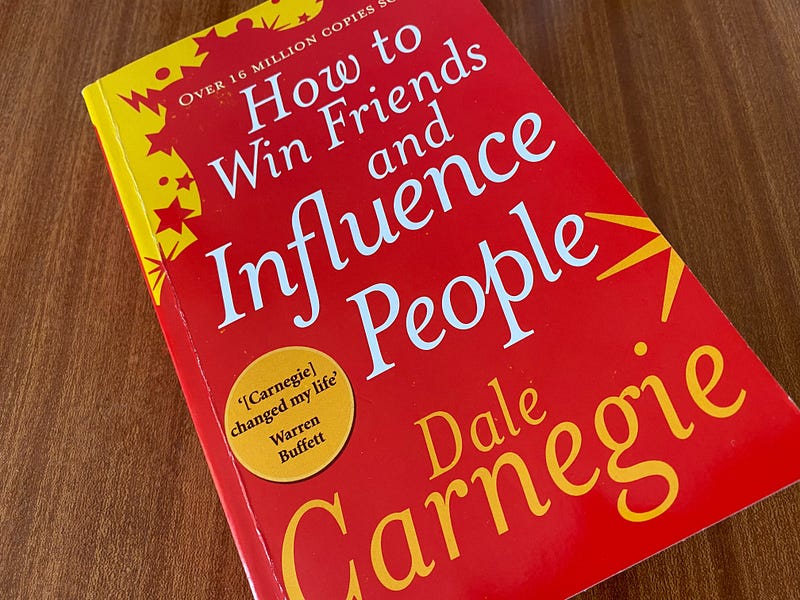
Since first being published back in 1936, over 30 million copies of this book have been sold worldwide, making it one of the best-selling books of all time. In 2011, it was number 19 on Time Magazine’s list of the 100 most influential books. And for good reason, this book by Dale Carnegie is plain and simply one of the best self-improvement books I’ve ever read.
Reading this book will literally change the way you interact with people, and most definitely for the better, more than just that it will change the way you see people and will change the way you see even yourself. It certainly did with me.
In terms of what this book is about, it is a self-help book that aims to teach you how to build stronger relationships with people from all walks of life. The premise basically is that the more you understand the true motives of both others and yourself, the better you will be able to interact with others, and so the stronger the relationships you will be able to build with others.
And Carnegie, using countless real-world examples from his time as a lecturer and educator in both public speaking and interpersonal relationships, does a brilliant job at helping you to understand what both your own and other people’s true motivations are, as well as giving you ideas for how to navigate those motivations and merge them.
My personal favourite is how he highlights that every person in the world wants to feel important, and the vast majority of what we do is designed to make us feel important.
At first glance this may seem like the exact type of thing that we as humans hate to acknowledge, one of those facts that everybody deep down knows is true but in which there is no benefit to acknowledging as such, but the way he teaches this reality makes you want to acknowledge it because it makes so much sense and makes everything make so much sense.
For example, a brilliant paragraph from the text is the following:
The unvarnished truth is that almost all the people you meet feel themselves superior to you in some way, and a sure way to their hearts is to let them realise in some social way that you realise their importance, and recognise it sincerely.
Out of context, there will be some who will argue that this is a very cold way of looking at things, there will be some who will say that they disagree with this, there will be some who will say that they would never feel like this, but within the context of the text I guarantee you this will in all probability make perfect sense and you will likely relate to it.
For example, how many times do we think we are right about a certain matter without truly considering whether perhaps the other person involved, who perhaps thinks that they are right, may actually be right and not us? And I mean truly consider whether they may be the ones who are right.
One of my personal favourite examples in the book is a story of how a customer relations officer had to deal with a person’s complaint. Carnegie writes that a customer believed that he had been screwed over and that he had been overcharged for the repair of his car.
Rather than the complaints officer telling him that he was wrong, instead he went over there and he listened, and he didn’t just listen, he listened sympathetically and considered truly whether perhaps the customer could be right. And doing so helped him not only just bring an end to the matter, but to retain the guy as a customer.
The complaints officer could have just gone over there and told the customer that he was wrong about his complaint — which they truly believed that he was. But he didn’t, he went over there and tried to find out if he was right about the complaint. And simply because he did that not only was the matter resolved, but the customer ended up accepting the complaint was a mistake (because it was) and yet because it had been handled so brilliantly ended up becoming an even bigger customer.
So just to emphasise the point Carnegie is making with this example. Even though the complaints officer knew the customer to be wrong in his complaint, he respected the customer enough to truly consider whether he may not be. And in doing so he allowed the customer to retain his feeling of importance, because he was taken seriously. And because he was taken seriously he was able to acknowledge that he had made a mistake.
Other things that Carnegie superbly helps you understand is how your own motivations and the motivations of others can so easily be made to complement each other if only the right attitude is taken into the conversation, and he fills the book with brilliant examples for how you can actually do this in real world situations.
For example, he shows quite superbly using a letter that is sent to a business how beginning with talking about how the recipient of the letter will be benefited rather than starting with what they want from the recipient, can lead to a far more accommodating response than if it was written the other way round.
And this brings me to perhaps the most profound lesson I think this book teaches, and that is the power of actually listening. Reading this book made me realise just how often even when we think we are listening that we are actually not. We are just waiting for our turn to speak.
It is so easy to do this without realising it, and it was only when I read this book that I truly realised just how easy it was. In all honesty, before reading this book I had thought myself to be a good listener, but after reading it I became an actual good listener. Or at least I hope so.
I could go on and on about this book, another example is how I told a friend of mine a story from this book and it led to him improving his relationship with his young son.
Without going into detail, Carnegie says you should never tell a person why you want them to do a task, you should tell them why doing that task will benefit them because then they will want to do it on their own accord. And he says that doing this can save a lot of drama, and that the way to do this is to actually think about what the other person wants. So don’t ask why you want them to do this, ask why they would want to do this.
Now my friend’s son did not like maths, like at all. But my friend kept telling him that he needed to do maths, and kept telling him why he wanted him to do it, but his son kept putting up a fight.
But on telling him about some of the examples in this book, my friend decided to try a different tactic, in the past he had always given his son adult reasons for why he should learn maths, things like you’ll be able to do your accounts when you’re older, along with statements like people who are good at maths get better jobs et cetera et cetera.
None of this had worked. So instead of this he asked himself what did his son like. The answer was puzzles. His son loved puzzles, absolutely loved them and was always doing puzzles, just not ones involving numbers. But then that was because nobody had ever bought him one’s involving numbers.
With this in mind my friend bought his son a puzzle book which couldn’t be solved without a basic understanding of maths. And when his son realised he couldn’t solve the problems without a basic understanding of maths, he suddenly became very interested in learning maths. And in fact he became so interested that my friend no longer needed to even tell him to do his maths homework because he did it on his own accord.
I wish to be clear at this point, this is not a book about how to manipulate people or coerce people into doing things, it is a book about how to build strong relationships with people, strong and mutually beneficial relationships. For example, a common theme in this book is how throughout Carnegie highlights the power of being genuine, and a brilliant line that captures this is the following:
If we are so contemptibly selfish that we can’t radiate a little happiness and pass on a bit of honest appreciation without trying to get something out of the other person in return — if our souls are no bigger than sour crab apples, we shall meet with the failure we so richly deserve.
Literally I cannot recommend this book highly enough, it is a treasure trove of life advice, and if you are looking for a self-improvement book of the sort that will help you build stronger relationships with people, stronger connections with people, if you are looking for a book that will help you understand people, understand yourself, then if there is a better book out there than this one I’d be surprised.
I’ll finish with the following lines which when added together in my view really encapsulate the essence of this book:
The deepest principle in human nature is the craving to be appreciated.
And:
So let’s obey the golden rule, and give unto others that we would have others give unto us.
Final words
Those who appreciate others will be appreciated themselves by others. Self-explanatory perhaps, but what Carnegie does so well in this book is highlight how easy and frequently all of us, to the detriment of our relationships, forget that fact. And at the same time he gives us simple and easily implementable ideas for how to make certain we don’t forget.
So whether you’re a relationship genius or a relationship dunce, in my view this book has the power to help you build stronger relationships and connections with people. And that’s why it’s a book that in my view is worth reading.
Thanks for reading and if you wish to support me the book can be purchased from this link at no extra cost to yourself.
Note: I would recommend if you do read this book, that you read one chapter at a time, that means do not read it all in one go, read one chapter, allow yourself a day or two to let that chapter sink in, then read the next, give yourself a day or two to allow the lesson to sink in, and on and on until the end. That’s what I did and I found that the lessons stuck more when doing it that way.
If you found this post interesting you may also enjoy the following:
Outliers — A Mind-Blowing Read That Will Teach You How Successful People Truly Become Successful
Five Of The Best Books That Teach You How to Succeed
To learn more about me see this link, to support me click the link below:


