
Fascism and Communism Have More in Common Than You May Realize
Part 2 of A Discussion of Thomas D. Simpson’s Capitalism versus Socialism Chapter 4 “Communism and Fascism”

After detailing communism at length, Simpson takes a briefer approach to fascism.
Fascism and communism do not share much in common when you define them by the four pillars.
What this chapter reveals, however, is both systems are authoritarian in nature, which erodes personal freedoms, even though they have different economics.
Fascism does allow for private ownership of property and for private individuals to decide how things are made. But the State decides what is made and plays a large role in deciding who gets what is made.
As noted, communist and fascist systems differ importantly on private ownership of property. In a fascist system, much of the property used in production of goods and services is privately owned. But, unlike a market-based system, producers in a fascist system don’t have much control over their property and what and how much they produce. Under communism, property is collectively (state) owned. In both, a state-planning agency plays a key role in directing production. (p. 86)
What is Fascism?
A clear definition seems hard to find. It does seem to be some sort of melding of state power and business.
Unlike communism, fascism doesn’t have a very coherent ideology. The systems that developed in Fascist Italy and Nazi Germany saw themselves as a third way — highly distinct from both capitalism and Marxism. They held this view despite their leaders having been socialists or heavily influenced by socialist thinking. (p. 96)
Fascism is most often used as an insult today, and it seems important for it to be a synonym for right-wing.
However, this is where the political compass would be better. Instead of reducing us all to either right or left, there can also be a divide across authoritarian or libertarian.
The Political Compass is a two-axis model: Left/Right and Authoritarian/Libertarian.
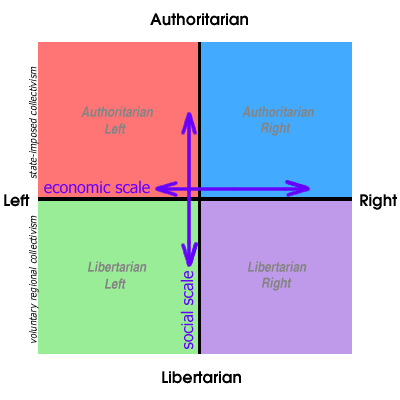
Essentially, the right/left divide is more about economics. Do you want the free market to be the main determinant? Then you are right wing.
Or, would you prefer the state to be more involved with the economy? Then you are more left-wing.
But how do you want to go about your vision for the economy? Do you want it to be enforced from above? Or are you more concerned about personal freedom not being abridged?
The political dimension spans between authoritarians who believe authority should be followed and libertarians who think personal freedom should be protected.
Fascism is definitely authoritarian. The state commands what is going to be made and how it will be distributed, and its authority should be respected even if it is at the cost of the personal freedom of some.
However, it does allow for private property and for businesses to decide on their own how to produce their products. That puts it to the right of center on the right/left axis.
Somewhere along the way, right-wing and authoritarian got conflated. But that ignores right-wing libertarians: people who prefer the free market get free reign and they have a lot of personal freedom.
It also ignores the authoritarian left. Stalin is a good example. He clearly believes in a strong role for the communist state to rule over the free market. He also ruled with a strong hand that demanded authority be obeyed.
A study on left-wing authoritarianism, Clarifying the structure and nature of left-wing authoritarianism, came to some interesting conclusions.
One of the authors, Thomas Costello, commented, “We found that ideology becomes secondary. Psychologically speaking, you’re an authoritarian first, and an ideologue only as it serves the power structure that you support.”
Essentially those who are authoritarian are interested in power and enforcing their view of the economy, whether it be right or left.
The authoritarian left would resemble communism.
The authoritarian right would resemble fascism. There is room for some free market concepts, but much of it is controlled by the state.
These systems were based on private ownership of property, but collectivist direction from the state — so-called corporatism. The interests of the collective (the state) were to dominate those of individuals and businesses. (p. 96)
Simpson quotes the Italian fascist dictator, Benito Mussolini.
“The citizen in the Fascist State with its corporate conception puts men and their possibilities into productive work and interprets for them the duties they have to fulfill.” (p. 96)
You see here the domination of the state over the personal freedom of the individual so this is clearly authoritarian. However, he still envisions a market economy though one run by corporations, not small businesses.
Simpson describes Mussolini’s plan as a “government-business partnership,” or syndicate, where economic activity is happening in business structures even as the government is the dominant partner. (p. 97)
However, like communism, Mussolini’s fascism used a planning agency to set prices, leading to the same problems of misallocation of resources without prices to serve as signals. (p. 97)
Thus, it was hobbled by shortages, waste, lack of innovation, and unemployment. The strong state would initiate public works projects to put the unemployed to work doing infrastructure projects. Simpson notes this was how the German autobahn system was built. (p. 98)
Taxes were high, which is not very right-wing because they had to pay for the big government and the military. However, there was no desire to have equality of income for the people as a left wing system would.
However, considerable income inequality was tolerated, and loyalty to the regime carried substantial benefits. Moreover, differing social classes were also tolerated, if not encouraged. (p 98)
Fascist Society
The authoritarian nature of fascism and its low value of personal freedom meant a low value for democracies.
Fascists viewed the state, in the right hands, as being able to do a much better job than individuals acting collectively through the ballot box. This included the belief that they could better achieve social justice by overcoming the social and economic chaos that they believed inevitably accompanies democracies and market systems. (p. 98)
As such, having a common goal, or a common enemy, is a good way for a fascist system to coalesce around the government. There is a lot of nationalism as they strive to build pride of being a member of the nation. It creates a natural out-group dynamic, that would lead to their persecution. Hitler is the worst example, of course.
What Does the Bible Have to Say?
There’s so much wrong here! The idea of racial superiority is not supported. Each individual is made in the image of God making each person valuable.
The emphasis on ethnic and racial superiority flies in the face of biblical teaching that all persons are created in the image of God and are greatly and equally loved by God. As such, all persons have comparable dignity, regardless of background or ability. There’s not hierarchy among peoples. (p. 99)
Another problem is the state, or the collective, is supposed to hold the highest claim on its people. The state sits above God. (p. 99)
In Exodus 20:3 we are commanded to have no other God before him. Jesus restates this when asked to pick the most important commandment.
Mark 12:30–31 (ESV) “…‘And you shall love the Lord your God with all your heart and with all your soul and with all your mind and with all your strength.’ The second is this: ‘You shall love your neighbor as yourself.’ There is no other commandment greater than these.”
While fascism does allow private property, which is in alignment with the Bible, the owner is not really the steward of the property since he has to do with it what the state wants.
Conclusion
Fascism and communism do answer the four pillars quite differently, but they are both authoritarian systems that do not value individuals so now I understand why Simpson put them in the same chapter.
That puts both of them against the Bible which sees each person as valuable because we are all made in God’s image.
Fascism does allow some features of the market system in it, but the dominating state intrudes so much it overrides the price system, thus sharing similar economic problems with communism.
We have one more economic system to consider: the Welfare State. It is really quite similar to the market based system, but it calls for a large state role in deciding how the output is distributed.
Reference: Simpson, Thomas. D., 2020. “Communism and Fascism,” Chapter 4 of Capitalism versus Socialism, Thomasdsimpson.