avatarCappelli, MFA, JD, PhD

Summary

An Italian scientific team has launched a micro garden into space to explore sustainable plant life in extreme conditions, marking a significant step in space farming.

Abstract

The Italian National Agency for New Technologies, Energy and Sustainable Economic Development, along with two universities, has sent a hydroponic micro garden called the Green Cube into orbit. This initiative aims to investigate bio-regenerative systems for sustaining life in space by using hydroponic cultivation without soil. The Green Cube is equipped with advanced sensors and communication technology to monitor the environment and transmit data back to Earth. This development is particularly relevant given the challenges posed by climate change on Earth's food production and the potential need for space-based agriculture to support long-duration space missions.

Opinions

  • The project is seen as a viable solution for providing astronauts with fresh produce, which could be crucial for their nutritional sustenance and psychological well-being during extended space travel.
  • Scientists involved in the project believe that the ability to grow food in space could help mitigate the impact of global warming on Earth's agriculture, as it may lead to a thirty percent decline in global yield by 2050.
  • The use of watercress as the test plant suggests a focus on high-yield crops that could be ideal for space farming due to their resilience and nutritional value.
  • The initiative reflects a broader perspective that space might be the next agricultural frontier, necessitated by the extreme weather patterns and other challenges affecting traditional farming methods.

Farming in Outer Space

Not as farfetched as you think
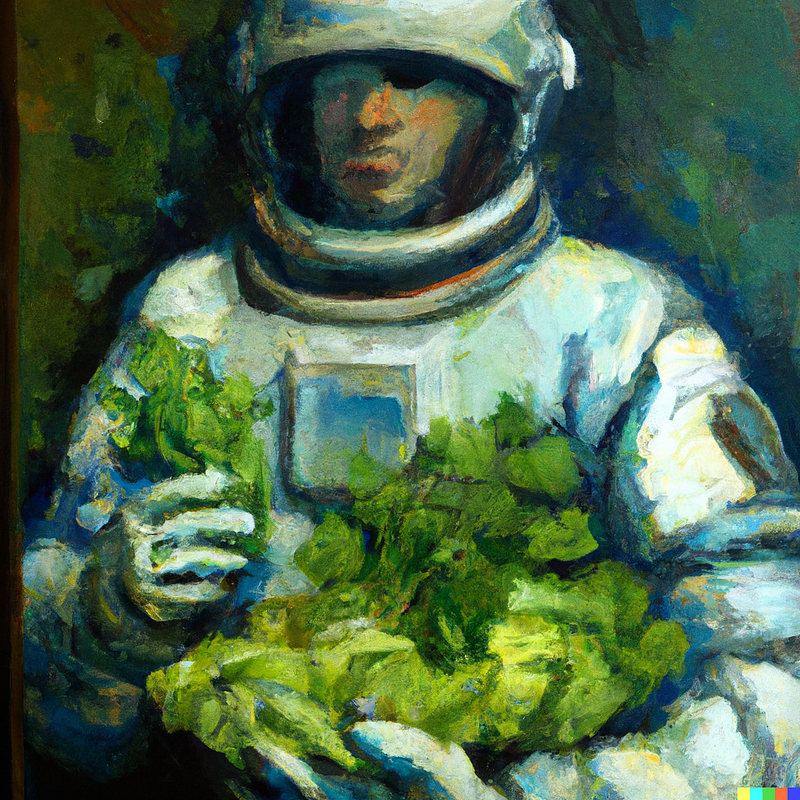
Image by Author+DALL.E

An Italian scientific team composed of the Italian National Agency for New Technologies, Energy and Sustainable Economic Development, Federico II University of Naples, and the Sapienza University of Rome launched its first Green Cube 30 x 10 x 10 cm micro garden into space to explore bio-regenerative systems in plant life and their ability to sustain life in extreme environmental conditions.

This is the first space garden that employs hydroponic cultivation without soil and promises a viable growth cycle in a non-earth microgravity ecosystem. The researchers chose watercress (an aquatic perennial flowering plant) as their test plant because of its high yield.
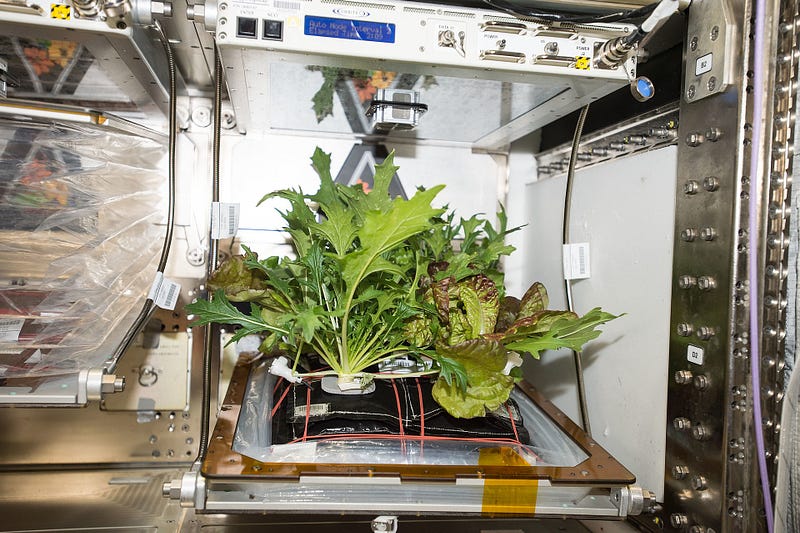
By NASA — https://www.nasa.gov/feature/how-does-your-space-garden-grow, Public Domain, https://commons.wikimedia.org/w/index.php?curid=63744565

The Green Cube has a hi-tech sensor system to control environmental criteria and is equipped with a communication system that transmits data to Earth.

The Green Cube opens new space-farming possibilities and grants astronauts access to live foods and digestive enzymes for nutritional sustenance. Scientists further believe that consuming fresh produce in space will help astronauts endure the physical and psychological stress of being outside the earth’s atmosphere.

Why This Matters Extreme weather patterns, droughts, excessive heat, and historical storms — all brought about by global warming— threaten food production. Scientists predict a thirty percent decline in global yield by 2050. Sadly, it’s not farfetched to imagine that outer pace is the next agricultural frontier.

Beam me up an arugula and kale salad, Scottie.

Sources for your perusal

https://citeseerx.ist.psu.edu/viewdoc/download?doi=10.1.1.458.6789&rep=rep1&type=pdf#page=21

What I’m reading this week:

Farming
Universe
Sustainability
Reciprocal
Nature
Recommended from ReadMedium