
Fantasy League: is it about luck or skill?
Assessing the chameleon-like nature of fantasy fortunes
Fantasy League brings its shares of ups and downs. Sometimes we feel it’s pure skill. Other times we feel it’s all luck. Where does the truth lie? Is Fantasy League about luck? Or skill? Or both? In this post, I attempt to get to the bottom of this vexing question.

Luck or skill?
There are multiple ways of answering this question. Since Fantasy League is a game of decision-making, I’m going to use a decision-making framework that revolves around two variables — decisions and outcomes. Logically we would expect good decisions to lead to good results, and bad decisions to lead to bad results. When this logic gets disrupted, we can get thrown off a bit, and consequently ask ourselves if it’s about luck or skill.
Decisions and outcomes can be plotted in a 2x2 matrix. Each quadrant is discussed next starting with those along the grey-green diagonal.
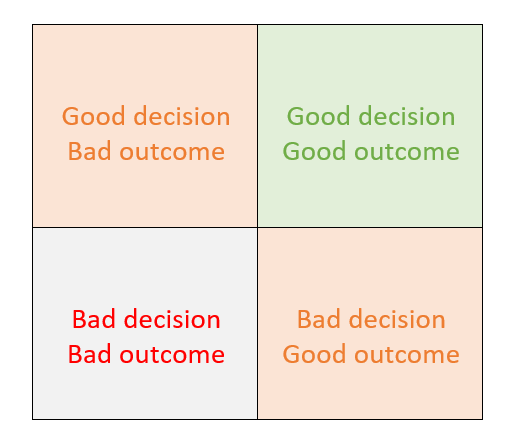
Bad decision — Bad outcome
Bad decisions primarily arise from a lack of analysis or a lack of understanding of how Fantasy League works. Bad decisions arising from poor analysis can sometimes be excused, and chalked down to learning experience. To be sure, Fantasy League is a constant learning experience and we can only grow by learning from our mistakes. However, when these mistakes are easily avoidable elementary errors, then we don’t have any valid excuse.
For example, of the 713 Fantasy assets last season:
- 196 (27%) scored 0 points or less,
- 288 (40%) failed to reach double-digits and
- 328 (46%) only scored a point every other game.
So nearly 50% of the total selection pool is immediately avoidable. Avoidable choices are usually communicated through pre-season pricing. Consistent and proven performers are priced at a premium. Squad or fringe players are priced rock bottom, proportional to their (lack of) playing time and (lack of) points potential. Same goes for players in positions that give low fantasy returns (e.g., defensive midfielders). Pricing communicates expected performance. In addition, transfers and chips available to Fantasy Managers to move out consistent under-performers, unless they are a “bench-enabler” and even of those, it’s never recommended to have more than 1 or 2 (if we count reserve goalkeeper). Banking on miracles from these players with very low probabilities of returns is bad strategy; its got nothing to do with luck.
Operating in this quadrant is almost purely about skill. By following the basics, many bad decisions are avoidable. This in turn means that bad outcomes are avoidable. When we avoid bad outcomes, we feel more in control of our destiny and therefore less dependent (and impacted) by luck.
Good decision — Good outcome
This quadrant is the mirror image of the bottom-left hand one. The same logic applies, but in reverse. A big part of making good decisions is avoiding patently bad decisions. There are some fundamentals which lie at the heart of good Fantasy decision-making. For example, premiums are priced highly for a reason — they score points. It’s important to have a good mix of premium players. Also, if those premium players are highly owned, they effectively become must-owns because if we don’t own them and everyone else does, and they get the points they’re widely expected to get, a rankings slide lies in wait.
Just like it’s easy to avoid basic bad decisions, it’s also easy to make basic good decisions. Getting some simple basics right goes a long way in making good decisions, thereby realizing good outcomes, hence feeling more in control of our destiny. Operating in this quadrant is also more about skill than luck.
Good decision — Bad outcome
By understanding Fantasy League scoring and doing the basics well, we’re on track to finish in the upper 50%, which after accounting for mid-season quitters and inactive Fantasy managers, can rise up to the 40th percentile — not bad for merely following the basics.
Having said that, we want to play to win. Winning requires more than getting basics right; more than a top-half finish. It involves making good decisions and importantly making relatively better decisions than the rest. Better decisions require insightful analysis. While there is no formula for this, heuristics are often available. For example, by selecting players with good form-fixture combinations, we can set ourselves up for better results. Jumping on/off a bandwagon can also be done using judicious analysis.
Good decisions however don’t always go to plan. This is because luck comes into play.
Take Benrahma. After a blistering start of 24 points in the first two games, Benrahma scored a paltry total of 5 in the next two. With a tough fixture ahead, low returns and other attractive options, it made sense to sell him ahead of GW5. Those who did regretted it immediately. Despite West Ham losing 1–2, Benrahma scored a goal —which took a huge deflection off a defender’s leg. He also got 3 bonus points.
Was it a good decision to sell him? Yes. Was it a good outcome? No. If the goal had not been awarded (and treated as an own goal), a whole different outcome would’ve resulted. This is the luck factor coming into play here. There are other instances where a popular fantasy asset can have a goal disallowed for marginal offside, or where another player scores with a fortunate tap-in instead of our fantasy asset etc.
This quadrant can often be more about luck than skill. Having said that, we also here have the opportunity to avoid further misfortune by not falling prey to cognitive biases. The most common one is outcome bias — basing our judgement purely on the result and not the decision. If a good logical decision leads to bad outcome due to bad luck, it’s important to see it for that. It’s also important to avoid the sunk cost fallacy equivalent here. The points of last week are gone. They cannot be retrieved. Instead of trying to “salvage” something from a bad outcome by making a knee-jerk reaction, it’s important to start afresh and focus on future returns.
Bad decision — good outcome
This is the opposite of the previous quadrant where a bad or sub-optimal decision leads (unexpectedly) to a good outcome. For example, it could be a punt on a bench player who ends up starting and scores a brace. A variant of this could be a mini-league situation where a poor choice or bad luck for a rival ends up in our favour.
This quadrant is pure luck. The major caution here is to see it for what it is, and focus on improving our decisions; because lucky breaks do not come with any guarantees. Luck is not a strategy.
Luck and skill?
By avoiding known bad decisions which lead to bad outcomes, and by performing known good decisions which lead to good outcomes, we can win half of the battle. In my experience, luck has no real bearing on at least 50% of our Fantasy League efforts. Once we’re past that point, luck starts to become more consequential. It strikes in two different ways, each with a different likelihood to impact ratio.
- Positive luck (bad decision — good outcome) is relatively rare. Its rarity however also dramatically increases its consequence, particularly late in the season. Last season, the person who led the overall ranking for a long time was toppled on the last day, leapfrogged by others who took a riskier captain bet that paid off.
- Negative luck (good decision — bad outcome) happens relatively more frequently but through experience, patience and avoiding cognitive biases, some of its consequence can be mitigated.
We can visualize the luck-skill trajectory as follows.
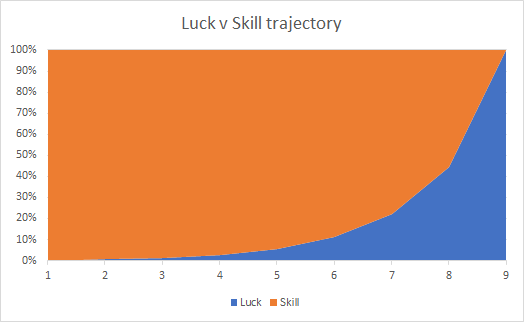
Up to a point, Fantasy is a game of skill. Skill here means a combination of understanding Fantasy scoring and picking the best assets based on available information and statistical analysis. Skill always has a part to play.
Luck however can never be ruled out. Fantasy points are gained based on real-life games. In football, anything can happen. A harsh sending off, a freak deflection, and underdog victory — all this happens. There is always a disconnect between theoretical selections and practical performance. While good Fantasy managers are able to keep that gap to a minimum, no one can control for luck. Luck is an ever-present factor. In Fantasy League, luck strikes unequally. At the very top end, like the Top 1%, when skills levels are similar and ranks are close, luck becomes the differentiator.
On the whole, Fantasy League is a game of luck and skill. At some point in the game, depending on our situation, it may seem more luck or more skill. In reality, both elements combine dynamically, to shape the course of our season. The only thing we can say with certainty is that it’s not 100% pure luck. Making good basic decisions and avoiding bad basic decisions can help us shape a considerable part of our Fantasy League destiny. Equally, it’s definitely not 100% skill either. Just like in everything, luck matters — and becomes particularly consequential when the margins are fine. The most important thing for Fantasy managers is to understand and embrace the concept, and consequence, of both luck and skill.
If you liked this article, you will enjoy my book 📕Smart Problem Solving.