
Fantasy Fiction and Breaking Barriers to STEAM for Black Students
By Mia Subade and Dr. Benjamin M. Drury
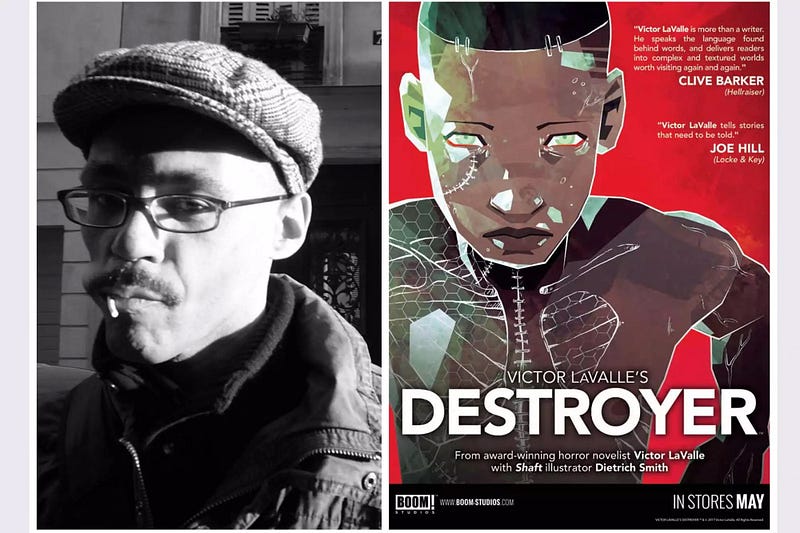
LaValle’s Destroyer criticizes Haraway’s version of the cyborg and this “utopia” it will exist in through the black cyborg. In A Cyborg Manifesto, Donna Haraway asserts that the cyborg “is a creature in a post-gender world; it has no truck with… other seductions to organic wholeness through a final appropriation of all the powers of the parts into a higher unity… The cyborg does not dream of continuity on the model of the organic family” (Haraway 71). Her version of the cyborg is a half-human half-machine whose existence does away from political identities such as gender and sexuality. She states that the cyborg “has no truck” — meaning that it refuses to be involved with — with anything that tempts an organic wholeness, like a biological organism. She calls for a new type of being that transcends earthly dominions and ideals to embrace being one with technology. This, in turn, will produce a world with a “utopian disregard for the lived relations of domination” (72). Donna Haraway’s concept of the cyborg, as well as Wynter’s critique of humanism, can be related to the historic divestment in Black community schools and its impact on limiting the exposure of advanced sciences to Black students.
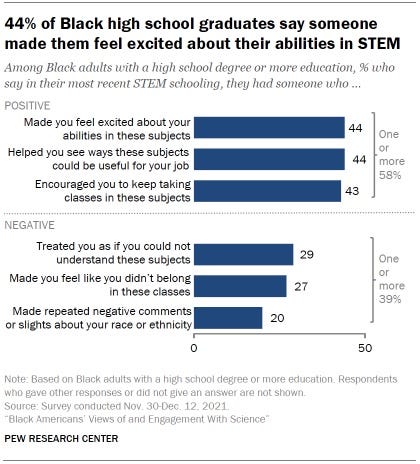
Historically, Black community schools have suffered from systemic underfunding, neglect, and discriminatory practices, resulting in limited resources and educational opportunities for Black students. This divestment in Black community schools perpetuated racial inequalities and hindered the access of Black students to quality education, including advanced science programs. In Haraway’s vision of the cyborg, which challenges traditional notions of identity and embraces a post-gender world, people of color who have been historically marginalized and ostracized may find it challenging to participate. Wynter’s critique adds another layer of complexity by highlighting the unique struggles faced by Black individuals in being recognized as fully human within societal structures.
Wynter emphasizes that Black individuals have historically been subjected to dehumanizing treatment, facing classification and discrimination that goes beyond what other minority groups experience. This exclusion and marginalization create barriers for Black individuals to fully engage with Haraway’s cyborg concept, as their humanity is often denied or diminished. To address this issue, Wynter calls for a “mutation of knowledge” that challenges the narratives that have historically condemned Black individuals to a lower status. This transformation requires a revolution in the way society perceives and values Black humanity, allowing for a new humanist theory that acknowledges and affirms the unique experiences and truths of Black people.
In LaValle’s novel, Destroyer, the character of Akai represents the black cyborg, challenging both Haraway and Wynter’s perspectives. Akai undergoes a transformation where his physical body is replaced by machine parts, symbolizing a departure from the limitations and oppressions associated with his Blackness. This reimagination allows Akai to reclaim agency and autonomy beyond the confines of societal narratives and systemic injustice. LaValle’s portrayal of Akai reconciles Haraway’s emphasis on the integration of humans and machines with Wynter’s desire for a new humanism that empowers Black individuals. By fully embracing his cyborg existence, Akai reclaims his body and engages in activities that bring him personal fulfillment, symbolizing a renegotiation of identity and agency.
Fictional works that feature Black characters engaging in STEAM problem-solving activities provide representation and empower Black youth to see themselves as capable and talented in these fields. By showcasing Black protagonists as problem solvers, these narratives challenge stereotypes and inspire Black youth to pursue STEAM education and careers. Fictional stories, such as Destroyer, can also ignite interest and curiosity in STEAM subjects among Black youth. Engaging narratives and relatable characters can spark a passion for science, technology, engineering, arts, and mathematics, motivating them to explore these fields further and seek educational opportunities in related disciplines.
Discussion surrounding Haraway’s cyborg concept, Wynter’s critique of humanism, and LaValle’s portrayal of the black cyborg provides a framework to examine how historic divestment in Black community schools limits the exposure of advanced sciences to Black students. By challenging societal narratives and advocating for an inclusive and equitable education system, it becomes possible to address the historic barriers faced by Black individuals and provide them with opportunities to explore advanced sciences and fully participate in transformative technologies.
Works Cited
Haraway, Donna. “A Cyborg Manifesto: Science, Technology, and Socialist-Feminism in the Late Twentieth Century.” Posthumanism, edited Neil Badmington, Palgrave, 2000, pp. 69–84.
LaValle, Victor. Destroyer [Los Angeles, CA], BOOM! Studios, 2017.