
Fantastic Iterators and How to Make Them

The Problem
While learning at Make School I’ve seen my peers write functions that create lists of items.
s = 'baacabcaab'
p = 'a'
def find_char(string, character):
indices = list() for index, str_char in enumerate(string):
if str_char == character:
indices.append(index) return indicesprint(find_char(s, p)) # [1, 2, 4, 7, 8]This implementation works, but it poses a few problems:
- What if we only want the first result; will we need to make an entirely new function?
- What if all we do is loop over the result once, do we need to store every element in memory?
Iterators are the ideal solution to these problems. They function like “lazy lists” in that instead of returning a list with every value it produces and returns each element one at a time.
Iterators lazily return values; saving memory.
So let’s dive into learning about them!
Built-In Iterators
The iterators that are most often are enumerate(), and zip(). Both of these lazily return values by next() with them.
range(), however, is not an iterator, but an “lazy iterable.” - Explanation
We can convert range() into an iterator with iter(), so we’ll do that for our examples for the sake of learning.
my_iter = iter(range(10))
print(next(my_iter)) # 0
print(next(my_iter)) # 1
Upon each call of next() we get the next value in our range; makes sense right? If you want to convert an iterator it to a list you just give it the list constructor.
my_iter = iter(range(10))
print(list(my_iter)) # [0, 1, 2, 3, 4, 5, 6, 7, 8, 9]
If we mimic this behavior we’ll start to understand more about how iterators work.
my_iter = iter(range(10))
my_list = list()try:
while True:
my_list.append(next(my_iter))
except StopIteration:
passprint(my_list) # [0, 1, 2, 3, 4, 5, 6, 7, 8, 9]You can see that we needed to wrap it in a try catch statement. That’s because iterators raise StopIteration when they’ve been exhausted.
So if we call next on our exhausted range iterator, we’ll get that error.
next(my_iter) # Raises: StopIterationMaking an Iterator
Let’s try making an iterator that behaves like range with only the stop argument by using three common types of iterators: Classes, Generator Functions (Yield) and Generator Expressions
Class
The old way of creating an iterator was through an explicitly defined class. For an object to be an iterator it must implement __iter__() that returns itself and __next__() which returns the next value.
class my_range:
  _current = -1
def __init__(self, stop):
self._stop = stop def __iter__(self):
return self def __next__(self):
self._current += 1 if self._current >= self._stop:
raise StopIteration return self._currentr = my_range(10)
print(list(r)) # [0, 1, 2, 3, 4, 5, 6, 7, 8, 9]That wasn’t too hard, but unfortunately, we have to keep track of variables between calls of next(). Personally, I don’t like the boilerplate or changing how I think about loops because it isn’t a drop-in solution, so I prefer generators
The main benefit is that we can add additional functions that modify its internal variables such as _stop or create new iterators.
Class iterators have the downside of needing boilerplate, however, they can have additional functions that modify state.
Generators
PEP 255 introduced “simple generators” using the yield keyword.
Today, generators are iterators that are just easier to make than their class counterparts.
Generator Function
Generator functions are what was ultimately being discussed in that PEP and are my favorite type of iterator, so let’s start with that.
def my_range(stop):
  index = 0
while index < stop:
yield index
index += 1r = my_range(10)
print(list(r)) # [0, 1, 2, 3, 4, 5, 6, 7, 8, 9]Do you see how beautiful those 4 lines of code are? It’s slightly significantly shorter than our list implementation to top it off!
Generator functions iterators with less boilerplate than classes with a normal logic flow.
Generator functions automagically “pause” execution and return the specified value with every call of next(). This means that no code is run until the first next() call.
This means the flow is like this:
next()is called,- Code is executed up to the next
yieldstatement. - The value on the right of
yieldis returned. - Execution is paused.
- 1–5 repeat for every
next()call until the last line of code is hit. StopIterationis raised.
Generator functions also allow for you to use the yield from keyword which future next() calls to another iterable until said iterable has been exhausted.
def yielded_range():
yield from my_range(10)print(list(yielded_range())) # [0, 1, 2, 3, 4, 5, 6, 7, 8, 9]That wasn’t a particularly complex example. But you can even do it recursively!
def my_range_recursive(stop, current = 0):
  if current >= stop:
    return
yield current
yield from my_range_recursive(stop, current + 1)r = my_range_recursive(10)
print(list(r)) # [0, 1, 2, 3, 4, 5, 6, 7, 8, 9]Generator Expression
Generator expressions allow us to create iterators as one-liners and are good when we don’t need to give it external functions. Unfortunately, we can’t make another my_range using an expression, but we can work on iterables like our last my_range function.
my_doubled_range_10 = (x * 2 for x in my_range(10))
print(list(my_doubled_range_10)) # 0, 2, 4, 6, 8, 10, 12, 14, 16, 18]
The cool thing about this is that it does the following:
- The
listasksmy_doubled_range_10for its next value. my_doubled_range_10asksmy_rangefor its next value.my_doubled_range_10returnsmy_range’s value multiplied by 2.- The
listappends the value to itself. - 1–5 repeat until
my_doubled_range_10raisesStopIterationwhich happens whenmy_rangedoes. - The
listis returned containing each value returned bymy_doubled_range.
We can even do filtering using generator expressions!
my_even_range_10 = (x for x in my_range(10) if x % 2 == 0)
print(list(my_even_range_10)) # [0, 2, 4, 6, 8]
This is very similar to the previous except my_even_range_10 only returns values that match the given condition, so only even values between in the range [0, 10).
Throughout all of this, we only create a list because we told it to.
The Benefit
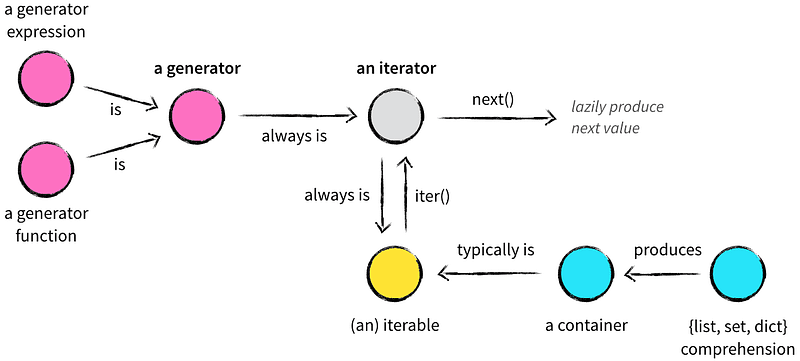
Because generators are iterators, iterators are iterables, and iterators lazily return values. This means that using this knowledge we can create objects that will only give us objects when we ask for them and however many we like.
This means we can pass generators into functions that reduce each other.
print(sum(my_range(10))) # 45Calculating the sum in this way avoids creating a list when all we’re doing is adding them together and then discarding.
We can rewrite the very first example to be much better using a generator function!
s = 'baacabcaab'
p = 'a'
def find_char(string, character):
for index, str_char in enumerate(string):
if str_char == character:
yield indexprint(list(find_char(s, p))) # [1, 2, 4, 7, 8]Now immediately there might be no obvious benefit, but let’s go to my first question: “what if we only want the first result; will we need to make an entirely new function?”
With a generator function we don’t need to rewrite as much logic.
print(next(find_char(s, p))) # 1Now we could retrieve the first value of the list that our original solution gave, but this way we only get the first match and stop iterating over the list. The generator will be then discarded and nothing else is created; massively saving memory.
Conclusion
If you’re ever creating a function the accumulates values in a list like this.
def foo(bar):
  values = []
for x in bar:
# some logic
values.append(x) return valuesConsider making it return an iterator with a class, generator function, or generator expression like so:
def foo(bar):
  for x in bar:
    # some logic
    yield x
Resources and Sources
PEPs
Articles and Threads
- Iterators
- Iterable vs Iterator
- Generator Documentation
- Iterators vs Generators
- Generator Expression vs Function
- Recrusive Generators
Definitions
Originally published at https://blog.dacio.dev/2019/05/03/python-iterators-and-generators/.