
Family Struggles Help Me Face My Meth Addiction
Slammed: a Memoir — Chapter 9 part 4
The Greyhound Bus traveled down I-90 on a cold, clear Christmas Day.
The endless and maddingly flat prairie of North Dakota began to give way to undulating land. Hills and ravines cut by branching creeks and rivers began to form the familiar terrain of Montana.
The tilt of the land allowed me to see an impossible distance. I looked out the bus window on a hundred miles painted in broad strokes of browns, tans, and yellows, increasingly peppered with the green pine trees. We barreled through ravines of blasted out hillsides made to clear a path for the highway. Layers of sediment and rock and millenia lay exposed like a layer cake that had been tipped over. Sandstone buttes began to rise out of the ground, telling me I was growing ever closer to the Rims in Billings.
Last time I was here I was a different person. Blissfully naïve to the darker undercurrents of the world. I was returning damaged, wounded, changed.
As the land became more familiar, as the Big Sky grew, I felt an opening up, a relaxing beginning to happen. The close confines of apartments, subways, skyscrapers and slams had left me cramped, collapsed, and stiff. Now, as I traveled through the ancestral lands of the Blackfoot, Cheyenne, and Crow tribes, I felt a settling, as if the ground hurrying underneath the bus was the first truly solid ground I’d been on in over a year.
As the bus crested the final hill and downtown Billings came into view, I wrote in my notebook, “I’m home.”
After resisting the urge to climb over the people in front of me to get off the bus, I was finally breathing the dry Montana air. It was below freezing, but unlike the Northeast with Atlantic gusts slapping you in the face, the dry cold of Montana gives you a strong handshake and, after freezing the mucus in your nose, leaves you be until hypothermia settles in. The air was not so fresh with the idling buses, nearby oil refineries, and plethora of downtown scents, but to me it smelled wonderful!
Soon after my arrival, with the assistance of a preplanned ride from a couple of high school classmates, I was standing at the front door of my childhood home where my unsuspecting parents still lived. I even bought a huge red bow and attached it to my coat.
My dad answered the door. It took him a few long seconds to register that his youngest son was standing in front of him, a huge silly grin to go along with the huge red bow.
“Oh shit!” my dad exclaimed.
My mother called from within the house. “Who is it Gary?” As she walked up, she too took a couple of long moments to realize what she was seeing, her recognition turning into the biggest smile.
“Merry Christmas!”
At last, Mom and I hugged each other, crushing the big red bow between us. We weren’t repelled from each other like equally charged magnets. We also didn’t break down crying or anything like that.
A mother was simply hugging her son who was home for the holiday.
And it was wonderful.
The next evening, the day after Christmas over a homemade dinner of prime rib, I broached the subject of our immediate family history.
“So, I’d like to ask about Brian and Jeff and me. About all the medical stuff. I know the broad strokes, clearly, but I’ve never really heard the actual stories. Your experiences. If you don’t mind revisiting, that is. I understand if it’s a painful subject.”
“No, I don’t mind,” Mom said. “What do you want to know?”
“Let’s start with Brian.”
Two years after their first son, Jeff, was born, my parents welcomed their second son, Brian.
He was born with a heart deficiency: one of his pulmonary valves was missing. Instead he had a collection of makeshift veins. Consequently, blood wasn’t pumped so much as it freely flowed from heart to lungs. Because of which, Brian couldn’t sleep lying down. Called a “blue baby,” for the first month of his life my mother had to sit holding him upright as he slept through the night.
Brian was a cute, brown haired, freckle faced four year old when he had open-heart surgery. They replaced the faulty veins with a combination of a replacement valve from a pig and an artificial coil that would expand as he grew.
For the next year and a half, he thrived, growing, running, playing, even starting kindergarten, all the things a healthy and happy five year old would do.
Till one day Brian grew ill, like he had pneumonia, and was having trouble breathing. He ended up in the hospital in a bed surrounded by an oxygen tent. My mother, outside the tent, sat beside him holding his hand.
“Mommy, can I sit in your lap? Please?” He didn’t like it, having to stay in bed under a plastic bubble, like one of his toys still in its box. He didn’t feel good and wanted a hug from his mommy.
“No, sweetie, you have to stay in bed. The tent is helping you breathe, remember?” My mother held his hand firmly, the only thing allowed out of the bubble, trying to give him the hug he wanted as best she could under the circumstances.
A nurse came in. “How’s our little trooper doing?”
“Well, he’s a little restless,” Mom answered.
“Well, who wouldn’t be, but it’s to help you feel better, ok bud?” The nurse had a pleasant upbeat tone, comforting but also telling that she had a job to do.
“Mrs. Cormier, would you mind waiting out in the hallway? We just want to do some tests to see how he’s progressing.”
My mother obliged and stepped out into the hall, standing outside the closed door to Brian’s room.
After a few minutes, the door jerked open and the nurse yelled something. Half a dozen workers in blue scrubs along with a couple white coats seemed to come out of nowhere and rushed into Brian’s room.
“What happening…” my mother started to ask when an orderly barked an “excuse me” from behind her. She quickly stepped out of the way as the orderly guided a crash cart into the room.
My mother was frozen with fear as the room that held her child was overrun with beeping machines and excited voices barking and responding in medical jargon.
The nurse hurried out of the chaos. “Mrs. Cormier…”
“What’s happening?!”
“We’re doing everything we can, now, Mrs. Cormier, if you’ll wait in the doctor’s office, he’ll fill you in.” The nurse rushed back into Brian’s room before my mother could protest.
Faced with no other choice, she took a seat in the doctor’s office as instructed, and she prayed. Hard.
After a short eternity, the doctor finally came in.
He gave her the worst news no parent should ever hear.
Brian had died.
His body had rejected the pig valve.
Brian was five years old.
Jeff was seven.
My parents were in their early thirties.
That night, unable to sleep, my mother sat down at the kitchen table and wrote a letter to the surgeon who performed Brian’s heart surgery.
She thanked him for giving her son 18 more months of life.
Four years later, I was born.
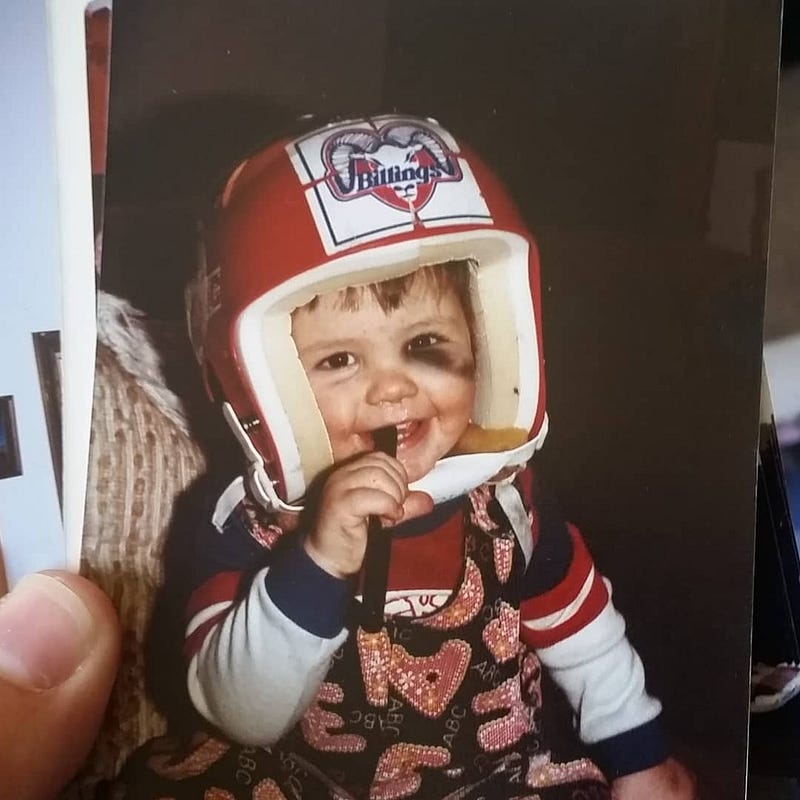
At 18 months old, I started bruising far too easily, to the touch. I would rub my eyes, like toddlers do, and a few minutes later I would have black eyes like I had just fought in a baby prize fight!
First thought to be leukemia, I was eventually diagnosed with Idiopathic Thrombocytopenic Purpura (ITP). Apparently, my immune system, kicked on by a cold, didn’t want to shut back off. When it ran out of cold cells to attack, my white blood cells went after my blood platelets which were, in turn, destroyed by my spleen. No platelets, no clotting, hence the bruising.
I had to wear a helmet for fear that a simple bump to the head could be fatal. To this day my brother still calls me “helmet head.” Not very creative with the nicknames, my brother.
For a year and a half my parents not only had to manage a toddler with a delicate condition, they had a toddler who on any given day was severely bruised from head to toe. My brother has told me — with hostility in his voice as if it happened yesterday — how other parents would see me and, unashamed, clutch their children closer, as if my mother was an abusive monster who would gleefully reach out and smack other people’s children.
One day I tripped and fell and bit my tongue. This meant a trip to the emergency room.
When my mother arrived at the ER with my 12 year old brother in tow, she moved calmly but apace, neither wasting time or freaking out, holding a now blood stained towel to my mouth.
Mom sat me down on the ER front desk as she checked us in. I wasn’t even crying and Jeff asked Mom if he could have a couple quarters for the pop machine. All told, we weren’t giving off real emergency energy. This was all old hat by this point.
Except for the fact that the toddler sitting on the ER check in counter was severely bruised and, on top of that, bloody.
A nurse, full of good intentions, without saying a word, snatched me away from my mother and fled to one of the examining rooms, clearly believing she was saving an abused child.
My mother didn’t yell or scream. She didn’t chase after the nurse. She registered what happened, sighed, and calmly turned to the check in nurse. “Could you see if Dr. Anderson is in and ask him to come down here please?”
“Mrs. Cormier,” Dr. Anderson said when he arrived. “What seems to be the issue?”
With Jeff sipping a Mountain Dew next to her, Mom calmly explained the situation.
“Right, I’ll take it from here,” he said and proceeded to give the snatching nurse the third degree, explaining my condition to her.
“Well, I’m sorry,” she protested. “I’m not convinced this child isn’t being abused…”
“Look,” the doctor ordered. “Look at his arms. Look where you grabbed him.”
Any further protests were caught in the nurse’s throat as she watched deep purple and yellow bruises form right in front of her eyes exactly where she had grabbed me.
The nurse begrudgingly apologized to my mother — still not fully convinced — and later wrote her a letter explaining “if I had known” in a very non-apology apology kind of way.
And this was just one day out of eighteen months.
Then things got worse.
It was Jeff’s turn.
When Jeff was 13, he woke up one morning feeling something was wrong. He couldn’t feel the entire right side of his body. He pinched his right leg and arm with his left hand. Nothing.
He wasn’t immediately alarmed. The previous week he woke up in the middle of the night with a similar feeling, like he slept funny and his limbs were asleep. He had got out of bed and walked around the house till the feeling subsided.
He decided to try walking it off again. Only this time, when he tried to stand up, his right leg buckled. He fell, smacking his head on his desk on the way down.
Mom woke up to the sound of Jeff struggling to crawl up the stairs from his room in the basement. He had only made it halfway up the stairs when Mom found him.
“Jeff, what’s wrong?”
He couldn’t answer. He had lost the ability to speak, only able to make unintelligible sounds of distress.
By the time they made it to the hospital, my brother had lost complete motor function on the right side of his body, unable to move or talk.
My brother feared he had done this to himself somehow, perhaps the result of an injury that he didn’t pay enough attention to from a basketball game the night before. He was terrified that it was his fault.
Asking my mother to step out into the hall, leaving Jeff in the room, the neurologist gave an update.
“Unfortunately, we aren’t able to say exactly what caused it. Right now, our best guess is there was some sort of bleed in his brain in the area that controls the motor functions on his right side.”
“Was this something he caused?”
“No, not at all. That we can say for sure.”
“Ok, good,” my mother said, “But you need to go in there and tell him that, because he thinks he did this to himself.”
Thankfully, after a couple days, Jeff began to regain feeling in his right side. But the damage had been done. He was going to have to relearn everything, walking, talking, all of it.
But just because he couldn’t talk didn’t mean he didn’t know how to communicate.
A different neurologist was working with him, placing geometrical objects in Jeff’s hands — a sphere, a pyramid, etc — asking him to try and pronounce their names. Jeff knew exactly what each thing was as his intellect had survived untouched and he’d been studying geometry in school. But every time he tried to pronounce the name, all he could produce was garbled and unintelligible.
The neurologist, after a few tries, turned to my mother and asked rather bluntly, “Is he coherent?”
Feeling a tap on his shoulder, he turned back to see my brother flipping him the bird.
“Yeah,” my mother replied, “I think he’s coherent.”
While Jeff faced a long road to recovery, my ITP one day just up and vanished. I was scheduled to have my spleen removed when the pre-op blood work showed a perfectly normal platelet count. And none too soon, saving my parents from a $30,000 procedure.
My brother would regain his motor skills, eventually able to kick my ass at bowling with both arms. He did struggle to cope with the cataclysmic disruption of a stroke, killing any and all sports ambitions, not to mention the trials of just being a teenager. Still, he came out the other side a stronger and better person. Not perfect, as he would be the first to tell you, but definitely a better person for it.
My mother was asked once, “Do you ever ask God ‘Why me?’”
“No,” she replied. “But I do sometimes ask ‘Why my kids?’”
Three kids. Three life-altering medical issues. One life-ending. None of them could be seen or prevented as far as we know.
These were acts of God.
These were the trials of Job.
My parents were forced to either play the cards they were dealt…or fold.
In the end, they kept the faith.
They saw it through, suffering with their children, suffering the worst loss a parent can face.
Somehow, they kept a light shining through all of this darkness. And when it had passed, they would go on to provide a loving, stable home. I can actually say I had an awesome childhood, and I believe Jeff did as well.
Did I try to burn down the house a couple of times? Yes, yes I did. But the struggle of having a firebug for a child, or even a son that was gay, aint nothin compared to what had come before.
As I sat with my parents at their kitchen table having devoured a most delicious prime rib dinner, I tried to take it all in. Their history, our history, my history.
HIV. Meth.
These were not acts of God.
These were not the trials of Job.
These were trials of my making.
At first blush, as I would sit to write about all this, I wanted to turn all this history into a story about my betrayal of that history. Into something that was very woe-is-me self pitying, “look at what I’ve done,” much like I felt back at Richard’s as I looked into his mirror.
But that wasn’t what I was truly feeling. Not at all.
What I came away with was much more basic, much more simple.
If my parents can persevere through even the loss of a child, then I too could persevere.
As I hugged my parents goodbye and began my journey back to New York, more and more the only thing on my mind was the first glorious slam I was going to have after two long months of not using.
I never for a moment intended to stop using. I was going to dive right back in just as I had after I returned from the summer shortly before I tested HIV positive.
But another piece had fallen into place. Much as my experience in Of Mice and Men had returned my feet to solid ground, my visit back to Billings had left me with an even more firm footing. The room around me was still dark, but it was no longer pitch black. I was beginning to see my surroundings, however blurry and distorted.
My journey with Tina wasn’t over, but now I was bringing with me something I hadn’t had before: a sense of who I had once been, and who I could be again.
Next Chapter
Chapter Guide
A lot of heart, time, and work goes into each piece. One way you can support me is by signing up for a $5/month Medium Membership. Use this link and I’ll get a percentage of your subscription fee. Huzzah for supporting artists!


