
Family Stories of Making Spices Heal Quarantine Blues
Mom’s hands and spices brought food to life, nourishing ties to ancestral roots that feed my spirit.
I leave home when opening a bottle of spice; Memory Lane is the only available route during a pandemic.
Fragrant memories of making spice blends, like garam masala, take me to my childhood kitchen in Minneapolis, Minnesota. That’s where I watched my mom roast, grind, sift, and bottle spices, including garam masala, translated as “hot spice.”
I watched as ordinary vegetables morphed into sublime deliciousness with a pinch, sprinkle, or dusting of magic in just the right amount.
Mom’s spice blends contained her memories of childhood in India and imparted a sense of joy just beyond my reach. Her laughter-laced stories about my bickering aunts and their antics unleashed my wonder, as much as ground cayenne filled the air to make me sneeze. She’d tell me of the family’s move from Karachi to Gujarat during India’s Partition. It was scary for my seven-year-old mother, who struggled with fears of abandonment thereafter.
Sweet, hot, and pungent flavors of emotion combined to infuse my evolving ideas about leaving, enduring, and becoming. Love from her elders and a grateful sense of longing seasoned Mom’s accounts of her extended-family life.
My grandmother shipped whole spices and special ingredients during my parents’ first few years in the US, as they were not available in stores. Mom would open the neatly packed parcels as they gradually released smells from far away. The aromas seemed to measure the long distances forged with loving determination.
All for a taste from a homeland left in pursuit of a life and home in the making.
I’d sniff, snoop, and look for something special just for me, in typical small-child fashion. The anticipation of surprise filled my preschool heart, and the joy of beholding my shiny bangle or dress fed a longing for love and acknowledgement from afar. The spices, lentils, gifts, and letters nourished us as only comfort, food, and news can.
Shipments from India gave way to UPS parcels from New York City and Chicago. Indian grocery stores arrived in the early 1980s in the Minneapolis-St. Paul area to serve the growing South Asian community. Whether emerging from UPS parcels or grocery bags, spices and other ingredients released Indian-spice perfume into our kitchen conversations, as we filled bottles and bags to flavor our daily meals.
An expanding collection of modern kitchen tools and appliances replaced traditional sieves, graters, and the stainless-steel mortar and pestle. My grandmother gave them to Mom as a part of her dowery. Those original kitchen tools bear the engraved name of my late grandfather, according to tradition. My grandmother equipped Mom for an Indian life in America. She didn’t know Mom would rely more on her ingenuity and creativity to create just the right mix of tradition and new opportunity.
Our family recipes evolved with substitutions and shortcuts in an American kitchen. Techniques of blending spices and preparing food maintained an Indian aesthetic. This approach influences an ongoing process of seeing ourselves as American in our own eyes, through an Indian lens.
Mom’s shared memories of her life before me, and my absurd wish to have been there, allowed me to know and love her family, beyond earthly limitations of distance, time, and even death.
Love, food, and tradition are the main ingredients for my mom’s culinary magic. It’s what she imparted to me through stories, my imagination marinating in an emotional concoction, as she’d tell me how they made spices….
Every March my grandmother replenished spices and other staples for the year. Armies of artisanal suppliers joined generations of women and girls in the family to contribute to the stock of powdered and preserved bounty. It was a productive time of harvest, planting, and spice blending.
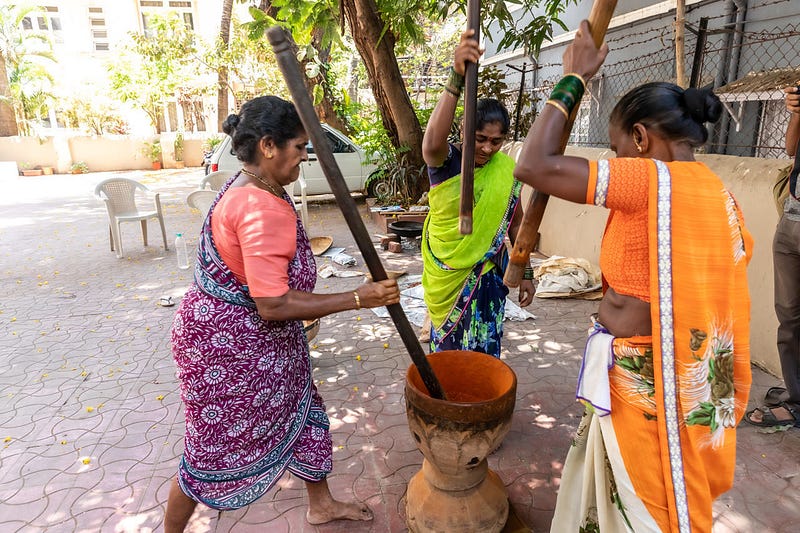
Female family members of traditional itinerant spice blenders, all dressed in colorful saris, would arrive at my mom’s Bombay (now Mumbai) home. The group included a woman, one or two of her teenage daughters, and one or two daughters-in-law. Together, they pounded the year’s supply of essential spices, such as ground cayenne, turmeric, cumin, coriander, and other Indian-kitchen essentials. The women sang Marathi (regional language) folk songs, accompanied by anklets and bangles chiming to their rhythmic pounding of spices in mortars and pestles that stood as tall as they did. I have a dim recollection of this colorful experience as a six-year-old, during a visit to attend my cousin’s wedding.
This image and Mom’s stories come to mind when I gather whole spices from my cupboard to make a simple blend of garam masala. Its magic begins when the stove is off, under the steamy darkness of a closed lid over a just-cooked dish, combined with a green lushness of freshly cut cilantro.
The colorful saris, anklets and bangles, and folk songs have given way to my friendly Indian grocer, my stove, and electric spice blender.
Garam masala’s essence, however, transcends international borders, kitchen technology, and cooking skills. There isn’t even one accepted recipe; regional variations appear in food traditions all over the Indian sub-continent. Its mysterious qualities emit a perfumed earthiness and whispers from all those mothers whose good wishes strengthened and inspired my mom over the years.
Below is a basic recipe for this quintessential Indian spice. You may wish to have a coffee grinder dedicated for spices; any electric coffee grinder will serve the purpose of keeping the aroma of spices out of your morning cuppa Joe.
Basic Garam Masala
- 2 Tbsp coriander seeds
- 1 tsp cumin seeds
- 1/2 tsp whole cloves (1/4 tsp clove powder)
- 1/2 tsp cardamom seeds (or 1/2 tsp cardamom powder)
- 2 bay leaves
- 1 tsp dried chilies (pizza pepper), optional
- 2-in. piece cinnamon (3/4 tsp cinnamon powder)
Gently toast whole spices in a skillet over low heat. Stir occasionally until aromatic, being careful not to burn. Turn off the heat and move to a cool side of the stove. Cool. If using powdered substitutions, add them just before turning off the stove and mix well to avoid burning. Once cool, transfer the mixture to a dedicated spice blender. Pulse the machine several times to produce a finely ground uniform powder. Store in an airtight glass jar and place in a cabinet where you store spices, ideally away from cocoa powder and chocolate, which absorb strong smells.
Try my recipe for curried cauliflower that calls for garam masala at the end. You can also sprinkle it on popcorn. Add soft butter (or oil) and a generous pinch of garam masala to a large bowl of squash cut into chunks; mix well to cover each piece. Bake according to recipe instructions. You might sprinkle garam masala on your grilled meats and vegetables for a spicy twist.
Mom’s memories of her family’s annual spice-making tradition sparked in me a sense of curiosity. I learned about the Ancient Silk Road and the history of spice trade. India’s diverse food traditions are a product of that history in which regional flavors bring past and present together in a meal. Mom opened my eyes to see a world of many food connections in a jar of spice.
I received our family’s traditions, much like a dowry in the form of culture, identity, and a map of sorts, just as she received from her elders. It’s a meandering trail, with regional detours, variations, shortcuts, and full of fragrant, hopeful, and inspiring recipe stories to help me cope with COVID-19 isolation and cabin fever.
Try making a batch of garam masala and take it with you on your kitchen escapes from the current bottle of isolation!


