
Learning Family Secrets at Last
My mom and dad dealt with some heavy stuff
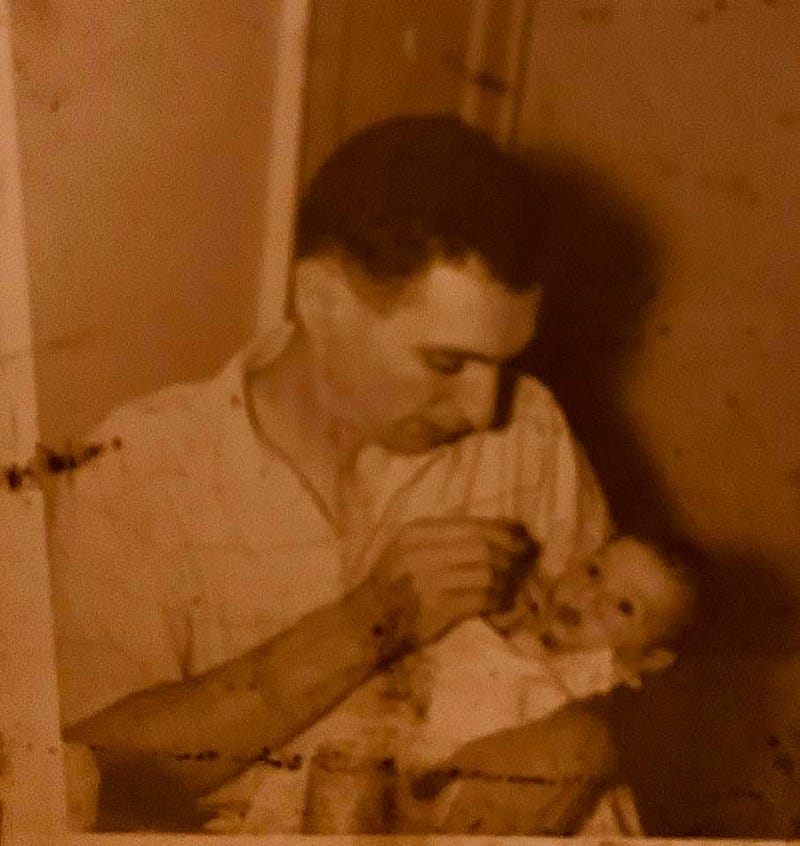
Me and my dad, circa mid-1958 (author’s collection)
After my mom went to live in at a nursing home because her dementia made it impossible to stay at home, my dad and I became better acquainted over the next four years. We turned into sort of a 21st century Sanford & Son act that capsulized the generation gap.
I managed to push him left politically, getting him to vote for Bernie Sanders in the 2016 presidential primary. He supported our candidate for all the wrong reasons, in my opinion: they went to the same Brooklyn high school and and they were both Jewish, not Bernie’s policies. As the senator from Vermont started winning primaries against Hilary Clinton, my dad wrote them down with a “W” or “L” on the page clipped from the newspaper detailing the primary schedule, as if it was a baseball scorecard.
Dad regularly regaled me with tales of him being in the Korean War, such as driving a brakeless jeep, getting dragged out asleep in his cot by his bunkmates who couldn’t stand any longer his snoring.
I always admired my dad’s can-do attitude that he could fix anything. When “Superstorm Sandy” left us without power for eight days in October 2012, he tapped his survival instincts learned from his military training, which never left him even at 82 years old. His makeshift stove on the patio in the backyard even produced hot coffee.
In contrast, I never made it past urban Cub Scouts. The Vietnam War had just ended when I turned 18. My contribution to dealing with the no-power crisis was buying them both thermal underwear from Kohl’s because the temperature was dropping.
Unlike my mom, who was always judgmental, my dad was open-minded. He told me how when he was in Korea he stood up to a bunch of rednecks who assumed one of the soldiers in their platoon was gay. “Leave him alone,” my dad bellowed. I was never more proud of him.
Fairly early into living with my parents again, I started to get to know him better. Even before I moved in with them, he already started going to the local VA hospital for group therapy sessions geared to family members coping with a loved one’s dementia. The social worker was really fantastic, and I needed information in how to talk to my mother.
Fast-forward seven years to October 2019.
Dudley his beloved wire-haired terrier died the previous August — I was out of town on a business trip — I sensed my dad’s days were numbered. First my mom, then his dog; he lost his routines. Most of the time, he’d stare at MSNBC non-stop about the latest Mueller Report revelation or his favorite TV shows, Bluebloods and M*A*S*H (about a Korean War medical unit), both of which always seemed to have marathons going on some channel, when not watching the Mets blow a game. By the fall, he nightly had insomnia.
Haberdashery found
One morning, I found him in a chipper mood, gingerly making his breakfast.
“I know where I bought those socks!” he exclaimed, referring to his collection of the decades-old, 100 percent cotton, thin white variety that lost all their elastic and rolled down his ankles.
His need for socks was a running joke between us for at least four years. A few weeks earlier we walked all over the Smith Haven Mall — to no avail in finding his holy grail.
“I had a dream. I bought them at a haberdashery on Orchard Street on the Lower East Side,” he bellowed.
“Dad, haberdasheries don’t really exist anymore, especially on the gentrified Lower East Side,” I responded.
Despite my father’s insistence that all that is wrong with the world coincided with the advent of the Internet (and reality TV because of you know who), Google did not let me down. On eBay I found five pairs at $20 each of exactly what he sought, and negotiated the seller down to two pairs at $10 each.
I also learned that the defunct Parsippany, N.J.-based hosiery manufacturer, Lismore, indeed had a store one block away from where my dad thought it was located. A Subway chain restaurant now occupied the LES location and the Jersey factory was no more. I jotted down the last phone number listed for the Manhattan store. A vanishing New York website provided a photograph of the one-time storefront.
“Is this the place?” I asked him, showing the photo on my iPad.
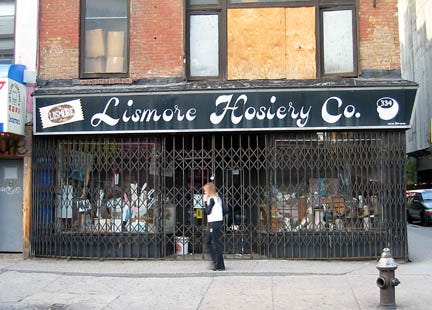
“Yes, I remember that fire hydrant. I could never park my taxi in front of the place.”
Later that week while I was at work in the city, dad called the phone number I found and was told that Ideal Hosiery down the block from the former Lismore can get him whatever he needs.
The next week I trekked through Lower Manhattan across Tribeca, Little Italy and Chinatown to Ideal Hosiery on Grand Street. The cluttered warehouse’s clerk asks, “How many pairs do you need?” to which the owner chimed in, “You must take a half dozen at three dollars each.”
Revelations galore
Occasionally, he’d surprise me by blurting out revelations like “You know, your mother was married before me.”
No, I did not know that tidbit of information. I was too floored to ask him how that made him feel, especially my train had just arrived. He explained that she learned after they were married that her first husband didn’t want children, as her biological clock at 30 was chiming loudly.
In fact, when I cleaned out the house after he passed away, I found the annulment papers confirming my dad’s story that my grandfather indeed accompanied my mother to Mexico to dissolve her first marriage.
But that wasn’t my most startling discovery. Within the first weeks of moving in with them, I found tucked into the heating unit of my bedroom 36-year-old suicide notes from my dad to me, my brother and my mother. His short-lived business operating a deli had just failed. Like most high school students, I was in my own self-absorbed world and didn’t notice any signs that he might be depressed. My bottled-up mother never shared any concern about him.
In the note he left for me, he acknowledged that I was about to graduate high school and my hope to enroll at the University of California at Berkeley. That clearly wasn’t going to happen for a variety of reasons, not the least being my only average grades or lack of financial resources.
I scanned the three sets of notes and emailed them to the VA social worker to see if I should be alarmed. She suggested that since he did not exhibit any signs of depression to not bring it up. I think it was good advice.
I shudder to think he even contemplated taking his life, but thankfully he somehow pulled himself out of that depression. By the time I was a freshman at a local university, he was driving his own taxicab. But that’s a complicated story all of its own, which I’ll save for another installment here.
On 9/11, my dad left off a passenger at the World Trade Center, as the first plane hit the tower that infamous morning. He managed to escape unscathed and made it home around 9 p.m. that evening. He also took a remarkable photo with a disposable camera of both towers on fire. With tears in his eyes, he told me years later that he had a flashback of the Korean War when he saw a child blown up with a hand grenade. I have no doubt he suffered from some level of Post-Traumatic Stress
At the VA, he was the elder statesman at weekly pain-management sessions, whose participants mostly had been in Afghanistan and Iraq. Once at the VA, I met Herbie, one of his buddies from the group, who was only two years older than me and was stationed in Europe at the tail end of the Vietnam War. With my dad present, Herbie, an African-American gentleman, told me how my dad offered to adopt him years earlier when he was going through a rough patch, demonstrating that my dad did not possess a prejudiced bone in his body.
While my dad’s memorial service at the funeral home was well attended by relatives and family friends, a bad thunderstorm meant they weren’t expected to drive 30 miles to the cemetery. Arriving late at the funeral home, Herbie insisted on accompanying my brother and me to the cemetery for the burial. I later arranged for dad’s car to be given to Herbie’s niece. She needed transportation for her infant, who required constant medical treatment. I also gave all the lawn-care equipment in my dad’s garage to Herbie to set up his cousin for a business. I am sure my dad would have approved of the gifts.
In those last few months of his life, I regularly took dad to the VA for emergency room visits over various ailments, including a prostate condition that required surgery. We both certainly were aware that his mortality was beckoning, and on Christmas Eve morning I took him on what turned out to be a three-day stay. The doctors deemed him well enough to go home.
Right before we left the hospital at 6 p.m., I witnessed a side of him I never saw before, snapping at the aide trying to help him dress. During the 20-minute drive home, his tone remained perturbed, explaining that the nurses (who usually flirted with him) were okay, but the support staff didn’t seem to know what they were doing. His demeanor was subdued. I let him know of several cybersecurity articles I had written while he was in the hospital, which usually piqued his interest. Not this time. He also mentioned that the reason why he was on a waiting list for an operation was that several surgeons left the hospital.
As I pulled into the driveway, I instructed to him that I’ll open the door through the garage, and that he should wait for me to help him out of the car to go through the front entrance. Of course, he ignored what I said. After I unlocked the front door and went back to the driveway, I realized he left the car.
A second later I heard an ugly thump. He collapsed in the foyer, in the exact spot where his beloved dog died. Unconscious but breathing heavily, he had a strange smile on his face.
I have no doubt that the mensch planned his demise; he didn’t want to die in the hospital.
Going through his belongings I found two unworn pairs of the socks with the tags on. Maybe one day I’ll have the heart to wear them.
***
If you like what you read, please clap heavily (Medium allowed up to 50), which could turn into money for me at no cost to you. Or if you would like to contribute directly, here’s my Patreon page.