
Family is Largely Responsible for Academic Motivation of Latino College Students
…just ask my former student Adriana
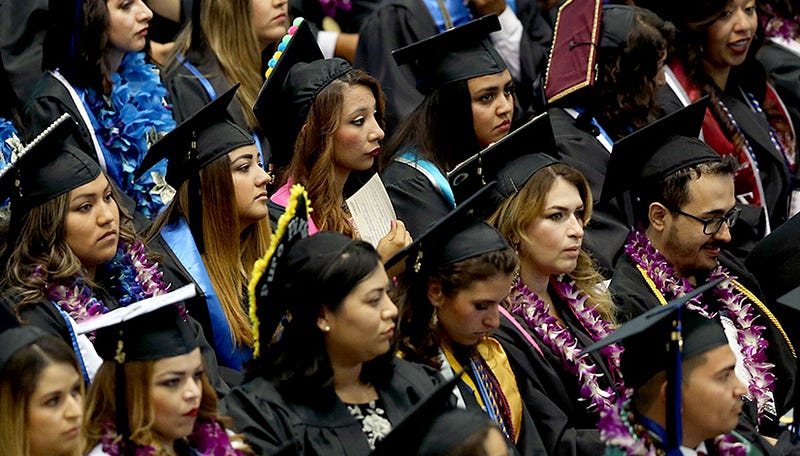
I was reminded by a student of mine how important the family is to the educational experiences of Latinx college students. Adriana is a former student of mine who I have kept in contact with over the last several years since I left my former institution. Adriana identifies as Latina. She and other students I worked with at my former institution frequently shared their experiences with family and education with me. In some ways, I feel as if my students placed a similar level of trust in me as a faculty member and ally to the Latinx community that they do in their family. Abby and I exchange messages every few weeks. We talk about what is going on with them and what they are thinking about doing with their degree. Adriana recently completed their BA and is actively looking for work related to their degree. When we spoke last, we were talking about a new role they were moving into. We also talked about their desire to continue with their education to eventually move professionally beyond this new role. So, I asked them to complete an assignment for me.
My idea was simple. We would work on writing project together to get them more comfortable with professional writing. After all, their next step is graduate school given their recent satisfaction of the requirements of their undergraduate degree. In my classes students regularly wrote a great deal about their personal views and related them to relevant course content. For this assignment, I wanted to provide Adriana with the tools and opportunity to reflect on their own experience with education to understand more deeply what parts of their education have been most powerful. Just start writing and share it with me. Do not think too much about it. Just get the ideas out and send them over. She was scheduled to work that evening and had access to a computer. I asked that she do it that evening…no more than 500 words. What I expected was a story (maybe two) about an experience that took place on campus that was transformational for them professionally. What I did not expect was to obtain a clearer understanding of the importance of family in the life of Latinx college students.
“One of my most meaningful experiences that concerned my education was after I received my bachelor’s degree. I was sitting with my mom at the dining room table, and we were having breakfast. I had graduated about a week prior, and she was telling me how proud she was of me. She told me I was the first person in her family to have a degree and how proud she was of me and how she was sending my graduation pictures to everyone she could think of and telling everyone her oldest child had graduated from a university. As she was telling me this, she started to tear up, and her words…and seeing her tear up…made me start to tear up and she got up to hug me and we were crying for a minute together.”
Children of immigrants living in the United States are no stranger to the idea of going to college. For children of immigrants from Central and South America in particular, ‘el norte’ is introduced to them as a place of limitless opportunity if you work hard and earn a college degree. An American Dream is built in their minds from an early age that requires a college degree to access. Going to college can be presented in some cases as not optional. Expectations of college achievement are established early and reinforced through actions and attitudes within the family. All through K-12, children of immigrants living in the United States are conditioned to believe that a college education is the key to the American Dream; a belief created and maintained by parents, siblings, cousins, grandparents, and other close family members. An additional layer of this conditioning that goes underdiscussed in the research centers on the perception of duty to earn a degree as a repayment for all that was sacrificed by parents and older generations so that they could have the first opportunity to come to America, go to college, obtain the degree, and begin living a substantially better life. Furthermore, this ‘better life’ is expected to be shared among the family who contributed to their success. In other words, a duty to succeed and use their success to uplift their entire family in the United States and abroad is reinforced in all areas of the Latinx socialization experience. Abby goes on to say about the experience of being validated for satisfying her debt to her family for all that they have sacrificed over the generations…
“It was a great moment. It has motivated me to want to continue studying to continue making my parents proud. I felt like I earned my degree for my parents who were unable to go to school because they started working at an early age to help out their families. I feel like my degree meant more to them than it did to me and that’s why in a way, I feel like it’s more their degree than mine. They motivated me, loved me, and supported me always and never hesitated to show it. My parents and their love and support has definitely been a driving force in me continuing my education. My degree is not only for me, but also for them. When I would come home from school, I’d talk to my parents about things I learned in my classes, they’d be learning just as much as I would without having to do the homework. I hope to earn a doctorate degree one day, not only for me, but for them as well.”
As they approach graduation, American high school seniors frequently visit campuses, attend college fairs, complete their FAFSA, and submit a required number of applications established by their school. Seniors who have family members and friends who have gone to college are at a distinct advantage. Students with higher social and cultural capital related to education tend to perform better in academic spaces as compared to students who lack an awareness of what going to college is really all about. Colleges and universities across the United States recognize this trend in the form of increased enrollment numbers of Latinx students. All colleges other than Historically Black Colleges and Universities were considered Predominantly white Institutions (PwIs). PwI student populations are historically white and many of the practices, policies, and programing available for students caters to a white student population. Today, more Latinx are finding their way to a campus and as PwIs.
When the Latinx population of students at a PwI exceeds 25% of the total student body, then the school can apply to become designated a Hispanic Serving Institution (HSI) by the Department of Education. As these institutions transition to serving an increasing Latinx student population, the expectation is that they — the Latinx student — will adapt to the white model of teaching and learning as opposed to the model of teaching and learning adapting to the increase of students who do not share the social and cultural capital most students who passed through their halls have. Metrics of success for HSIs are the same as PwIs — retention, persistence, and graduation. For Latinx college students, the experience of going to college is much more than just beer and circus with a few classes squeezed in between. Most are dispatched to their campus on a mission — earn a degree that will get you into a high paying career while accruing as little debt as possible. After all, how would a college graduate be able to share their new earnings with their family if they must repay it to the government?
What is lacking at many HSIs is a recognition of the contributions of the family to the success of their students and a space for the students to share what it means for them to be able to give their family what they have sacrificed so much for. Families are a primary source of support, guidance, advice, and resources in the life of a Latinx college student. The right school for Adriana and students like her to earn her PhD or other terminal degree is one that recognizes and validates the importance of family in the life of Latinx college students. Stories like the one Adriana shared with me are not unique. Sharing them with people outside of the intimacy of their immediate family can feel uncomfortable if they are sharing their story with someone who might not be able to understand the importance of their family in their life. I asked Adriana to share with me the most important and/or meaningful experience in her educational career. She did not cite anything about the orientation swag she got or college readiness classes or time management workshop or class or professor…she shared the moment she knew the true value of her college degree.