
Photography, Photography Tips, Travel, Poetry
Falling into Eternity During the Perseid Meteor Shower
My first attempt at astrophotography
Continuous as the stars that shine and twinkle on the milky way, they stretched in never-ending line along the margin of a bay… — William Wordsworth (I Wandered Lonely as a Cloud)
To peer into the heavens is to launch oneself into a journey both outward and inward. I’ve never felt simultaneously so small and yet a part of something so vast as when I’ve been able to gaze upon the Milky Way pouring herself across the heavens.
Many years ago, my husband and I lived in Sedona, Arizona for a “sabbatical” year. We sold our house, most of what we owned, and moved to the desert to mountain bike, write, hike and explore the Native American ruins all over the southwest. The neighborhood in which we lived had no streetlights so you could see the stars every single night.
I can’t tell you how many evenings we would bring a blanket out onto the rocky front yard, open a bottle of wine, and stretch ourselves out to watch the satellite, Sputnik, pass us by overhead. We’d count shooting stars and just get lost in the enormity of it all.
Once, we sunk out Land Rover Discovery in Canyon de Chelly, on Navaho tribal lands. Our guide and his family tried to pull us out first with horses, then had to send for a six-wheel drive vehicle to rescue us. While our vehicle sat idling in water up to the level of the seats, we waited on the riverbank, watching the Milky Way rise over the sheer cliff walls.
I’m not sure I’ve ever experienced such awe before or since then. While we’d seen the Milky Way many times, we’d never seen it against a backdrop so inky black, so free of modern lighting, in the same way that the ancient ones, who walked this land so long ago saw it.
That summer night, so long ago, coincided with the Perseid meteor shower, an annual light show in the sky.
We eventually ran out of money and had to return to Orange County, California, where we still live. But that night has always lived on in my dreams.
Years later, I used to attend an annual yoga retreat led Tim Miller at Mount Shasta, California. It seemed to always coincide with the Perseid shower, and, although I had to get up at the crack of dawn to practice, I often found myself outside at night, all by myself, watching those streaks of light flash across the sky.
So, when my sister, who shares my passion for photography, heard about an astrophotography workshop at Mount Ranier, Washington, during the Perseid meteor shower, I just knew we had to go learn how to photograph the night sky.
It’s really not that tricky to do, but there is a technique to it.
The biggest challenge we faced on this trip was the smoke from the fires in the Pacific Northwest and Canada. When we arrived in the park, we could barely even see the mountain. This did not bode well for the photography session to come.
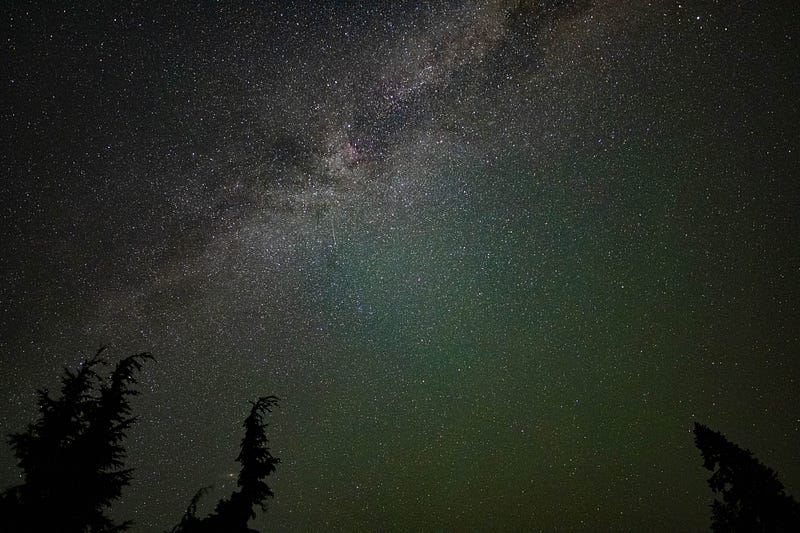
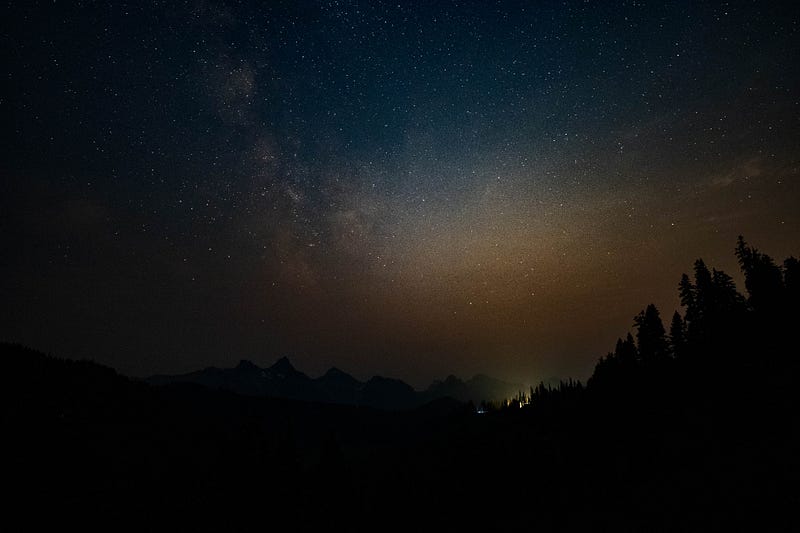
But our instructor, Ross Schram von Haupt, assured us that as the air cooled the smoke would settle and that we would be able to photograph the stars. I wasn’t too sure if I believed him at first, but, low and behold, as the the air began to cool, the smoke began to clear and the stars popped right out. In the following photo, you can see the smoke congealing near the tree line. But, up above, the heavens were beginning to twinkle.
The first step in taking a picture of the stars is to mount your camera on a tripod and attach a remote trigger so that you don’t get any movement of the camera. These photos, since it is so dark, require several seconds of an open shutter to be able to take in enough light to capture anything.
The next step is to find a focal point. Any bright star will do. And, surprisingly, even a light on the horizon, like the National Park hotel, below, will also work.
Alternatively, and this is what I did, you can find a planet, like Jupiter (to the left) in the photo below.
Then you set your ISO (which is sort of like the graininess of old school film) to 6400. In the daylight, an ISO of 6400 would be very grainy, but it is where you need to start with astrophotography photos because it lets in a lot of light. You might change that ISO later, if you are shooting at dawn and the sky is getting brighter.
After setting the ISO, you can either manually or automatically focus on that light or star.
Then — and this is probably the most important part of the whole process — you switch your lens to manual mode so that you can’t accidentally mess up your focus.
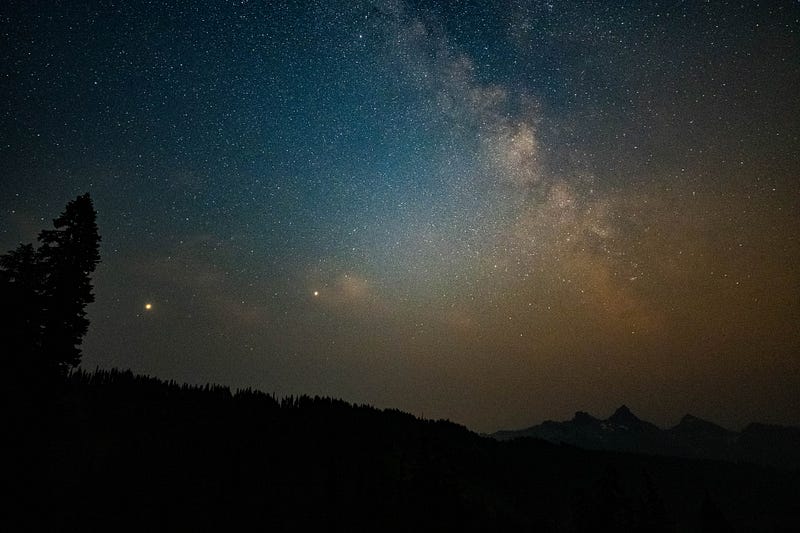
Once you’ve got your focus set, you really just point your camera either at the horizon or straight up to the stars and begin to play with how long of an exposure time works best for your camera and lens. Fifteen to thirty seconds is normally about right. But it will vary, depending on your setup.
In the photo above (the one with the lights of the hotel) I used a twenty second exposure, and it was a little too long. You can tell if it is too long because you’ll get “star trails” — which happen because the earth is moving and the stars are fixed and if your shutter is open too long, the stars won’t look like pin points, but, rather, will “trail” across the sky slightly.
After shooting a few horizon pictures, I turned my camera straight up and just started snapping away, hoping to maybe catch a comet while my shutter was open. All around me, I could hear the five other students occasionally oohing and aahing as a shooting star flashed overhead.
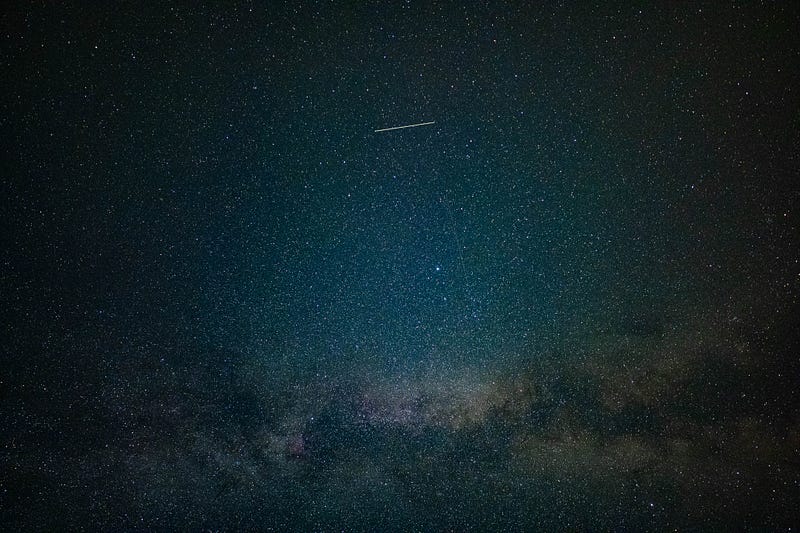
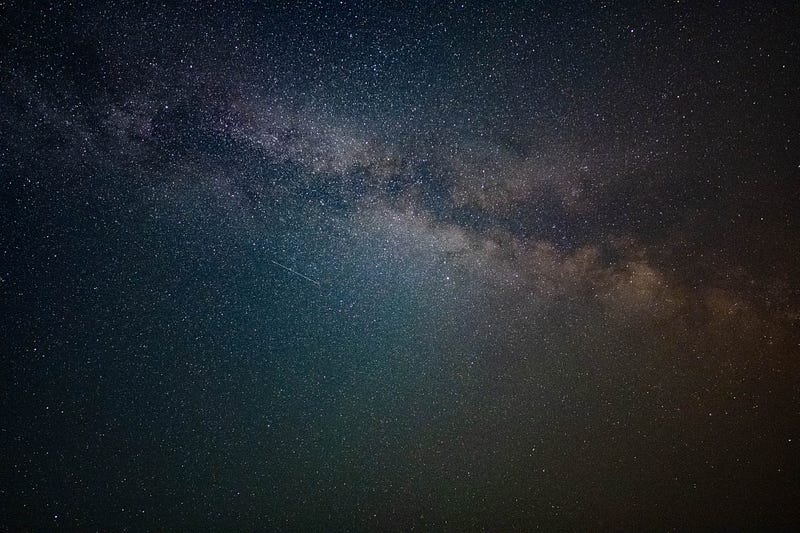
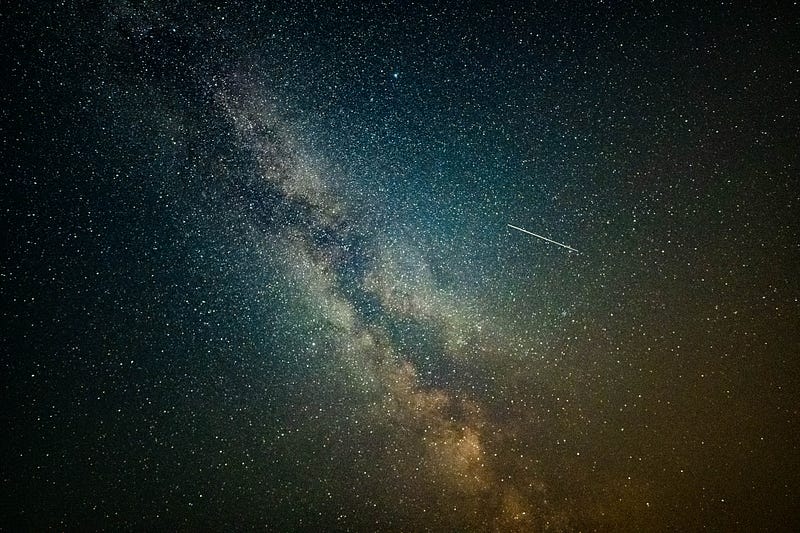
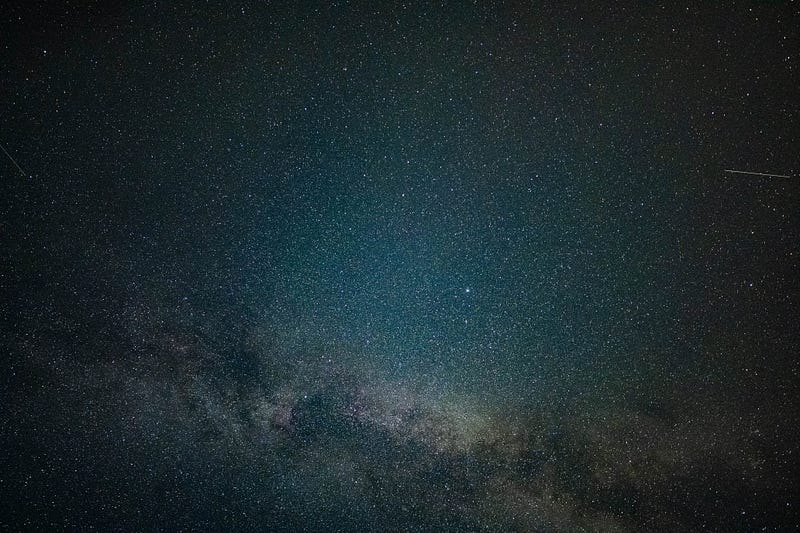
You don’t always catch a shooting star, or you might catch more than one. I didn't move my camera hardly at all between these two shots. Really, the only difference between the two is that the first one has one shooting star and the second has two.
Because of the smoke, I wasn’t sure if I was going to like the photos of the tree, but I really rather like the way the smoke melds into the Milky Way.
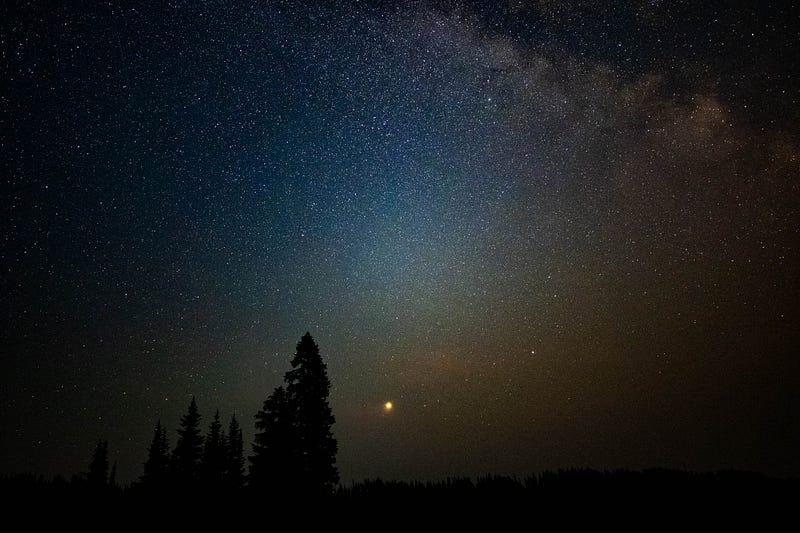
At about midnight, we packed up our gear, put on our headlamps and began the descent down the mountain.
I had purchased a “fixed” 20 mm lens (1.8) for the shoot and I was quite happy with it. For the session that my sister and I did a few nights later (photos to come) of the stars above Mount Ranier, I used a 14–24mm (2.8) lens. Theoretically, the fixed lens should let in more light and allow you to use a shorter shutter speed (resulting in less star trails). But I’m not sure that I can say that I saw much difference.
I think that I have found a new passion in photographing the night sky. I’ve already got a trip scheduled to Bend, Oregon, in a few weeks for my birthday. We’ll be staying in a cabin on eight acres of land with a view of the Three Sisters. I can’t wait to see what sort of photos will emerge.
That night, so long ago, in Canyon de Chelly, has lingered in my mind for all these years. I thought I’d share a poem, which was inspired by that night, with you. It was originally published in Lit Up.
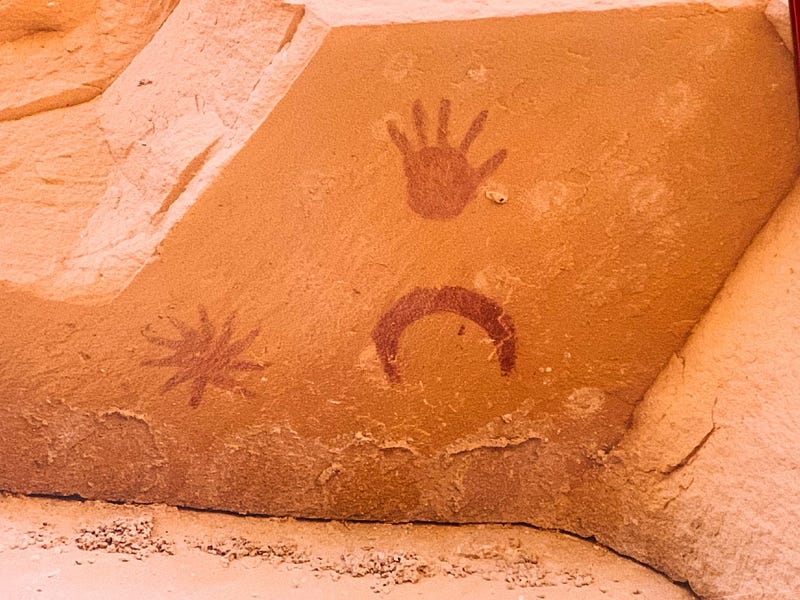
The Ancient Ones
There was a night, in a canyon once, where the walls of rock hugged the sky and the milky way floated by.
I couldn’t breathe, for such an awe may come only once in a lifetime.
The river below, waltzing beside my feet into the vastness of the night seemed to join in chorus with the melody of that river in the sky, flowing in an eternal dance, a pirouette around infinity.
And I felt very small.
For a moment, I fell headlong into the enormity of the universe. A rush of dizziness and timelessness engulfed me.
The breeze, scented with damp sage and red dust, brushed over my skin, and I shivered, but not with cold.
A white-tailed rabbit, her pupils dark with fear and alertness, scurried into the grasses which had tilted over to sip from the river.
I could almost taste the hare’s vitality, her tenuous hold on life in this land of scrawny coyotes, loping out into the night to howl at that vastness overhead.
The Ancients walked here once. Their blood-red and ochre handprints, pressed onto the sandstone cliffs, still tell their story, a tale we will never truly comprehend.
Did the stars look the same to them? Did they weave their stories into the fabric of the night? Did they fly there in dreams?
I can almost feel their breath still, upon my neck, their words whispered around and mingling with the crackle of the leaping flames, and with the sparks drifting up to join their reflections in the sky.
What did they think when the moon ate the sun, and red light washed over the red land? Did their hearts tremble with wonder when that life-giving glowing orb donned her golden robes once again?
And did they ever think that the Perseids meteor shower could touch the earth, stardust to be gathered in their hands….
And the moon, on her nightly round-about the heavens pregnant with light, giving birth to darkness — how did they explain it?
The wind whispered in my ear, and I heard a young girl’s laugh, a tinkling of happiness sprinkling into the night. The chatter of copper bells danced away on soft moccasins.
I spun around, but she was not there.
Did she walk here once, long ago, marveling at the nightly show? Did she hold a lover’s hand as they slipped into the soft night? Did she scream with agony and joy at the birth of her children? Or beat her breast with the searing pain of the loss of parents or mate? When she died, did she join her ancestors in that spinning, dizzying world overhead?
Out of the corner of my eye, I caught a streak of light sweeping across the sky. A star fallen to earth? I wondered, breathless.
The hare, startled by a breath of movement, darted past me, long legs gathering and pulsing in a frantic dash. But, then she paused, still as the canyon walls.
Her pawprints, embedded in the soft wet mud by the river’s edge, mirrored the sky above. I followed them to their point of origin. And there, beside the lapping waters, I thought I saw a small moccasined footprint.
I stooped to look closer, and beside it, something glinted like a tiny star in the shallows.
My fingers traced its surface and closed over the roundness of a small copper bell….
Erika Burkhalter is a yogi, neurophilosopher, cat-mom, photographer, and lover of travel and nature, spreading her love and amazement for Mother Earth’s glories, one photo, poem or story at a time. (MS Neuropsychology, MA Yoga Studies).
Thank you for reading. I hope that you enjoyed my meanderings and photos.
If you enjoyed this piece, you might also like:
Story, poem and photos ©Erika Burkhalter. All rights reserved.