Crime Writers Association Dagger Winner
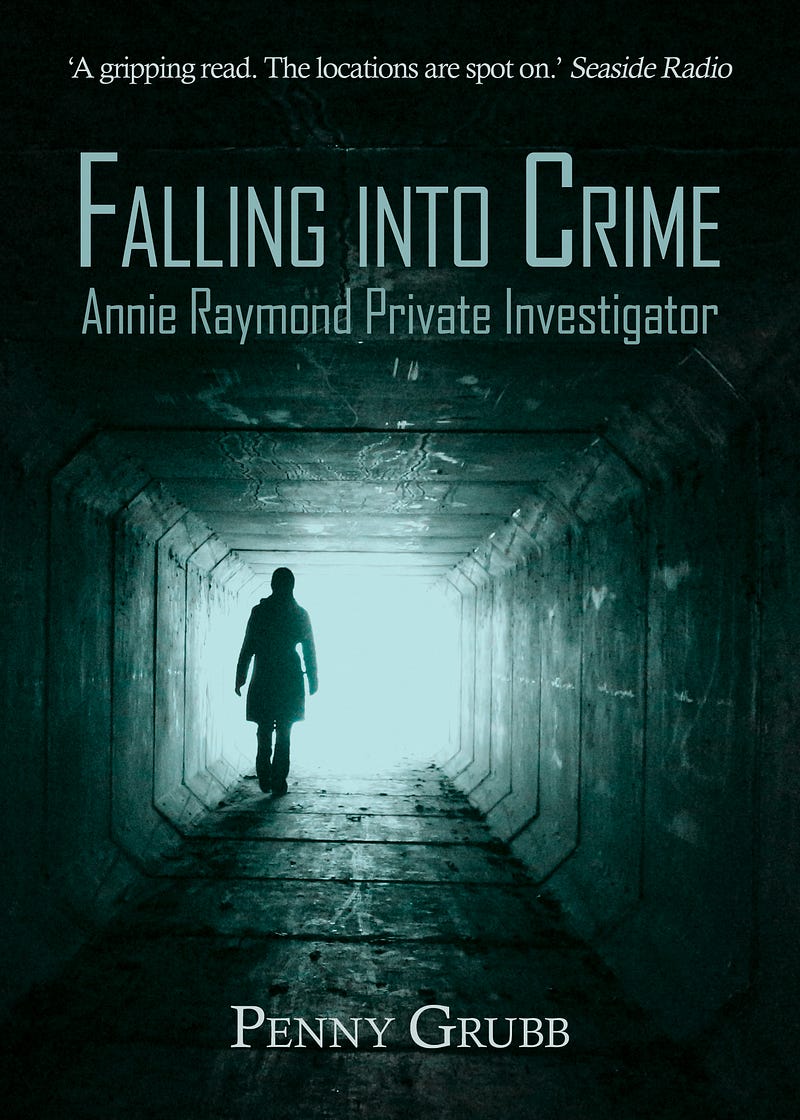
Falling Into Crime— A Crime Trilogy
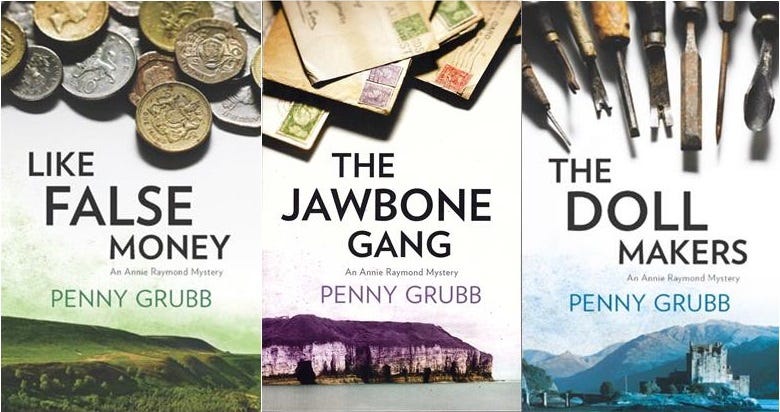
Like False Money — The Jawbone Gang — The Doll Makers
The trilogy, Falling into Crime, includes The Doll Makers, the novel which won an international award and set me firmly on the road to crime. The opening chapter is below. I hope you enjoy it.
Review Quotes
Altogether an excellent read and worthy winner of the Crime Writers Association Dagger.
Holds the reader’s interest from the start and keeps a tight grip on it to the last word.
The story is gripping and fast moving, with touches of comedy as well as edge of the seat suspense.
If you enjoy your crime spiced with a mixture of gritty realism, humour, human failings and intelligence, this is definitely a book for you.
The Doll Makers — Chapter One
The words changed on the long drive north. Annie’s determination did not.
In the Ladies at Leicester Forest East, where she stopped to top up — coffee for her, water for the car — she pulled a comb through her hair and practiced what she would say. Dad. I have bad news. It was the antithesis of the old coming-home fantasy, where her short-cropped hair would be a little longer, her five feet two inches would be clad in a smart business suit, and she’d smile as her father said, ‘I always knew you had it in you, Annie’. She’d failed his every expectation since she was eight years old, and now at twenty-eight she was about to turn his life upside down.
The early morning sun made a mobile oven of the car, and the journey became hotter and stuffier. The blower gave her tepid air and hot engine smells, before beginning a clatter like a death rattle. She clicked it off.
By the time she reached the M6, the traffic eased, allowing more space to rehearse the scenes in her head. From Lockerbie to the outskirts of Glasgow she listened to the ghosts of future conversations.
It’s not me, Dad. It’s Aunt Marian.
Your aunt? What’s she to do with it?
Incredible that her mother and aunt had been sisters. Annie sometimes studied her own reflection for whole minutes at a time, trying to cut away her father’s features and see her mother, but there was nothing she could home in on. Her mother must have been small and slight like her aunt — yet not like her at all, or her father could never have loved her. And her father wasn’t over tall himself; only just made the height requirement when he joined up. But he was stolid and had a stockiness Annie could see in herself.
Though she made good time, Glasgow was well awake and bustling. The traffic demanded her concentration as she drove through and out towards the ferry docks. Cars bounced up the ramp as sea-birds screeched overhead then swooped into squabbling bundles on the water’s surface. She nudged her car on to the deck and climbed out to spend the few minutes of the crossing up on the foot passengers’ walkway, where she leant on the rail. The sea air rushed over her as the ferry pushed its way across the Clyde. The light changed, the clarity of early morning giving way to the haze and heat of the day. For a minute, she surrendered to the sensations of coming home, the smell of the sea, the empty mountains rising up ahead.
Her aunt’s voice on the phone had pulsed with excitement. A massive drugs consignment, Annie. So exciting … lost in the hills … your father’s had a terrible time.
She could dilute out her aunt’s exaggeration, but her father had confirmed a Customs sting gone wrong. Drugs had come this way. Not the huge pantechnicon that her aunt imagined, Drugs Consignment Ltd blazoned on the side of the lorry, but something big. She wondered if it had crossed here, on this ferry. And where had it headed, how had it been lost? A customized vehicle maybe, or customized people. As she squeezed back into her car, she looked at her fellow passengers, but surely there were no drugs mules amongst this lot.
Last lap now. Tell him and get it over with, face the consequences. No other option. He’d give her a rough ride, but he would come through for her. Facing him would be part of the penance.
If she still had the BMW Aunt Marian had bought her, she’d almost be home. But the old Nissan coughed as she jigged it down the ramp, and she daren’t take the direct route over the mountain passes.
As soon as she could, she’d swap this overheated vehicle for tracksuit and trainers, and get into the hills. Nothing cleared the mind better than forcing muscles to their limits. She’d taken to pounding up the Victorian stairways of the older stations once she’d moved to London. They were every bit as good at getting thighs and calves to screaming pitch and lungs to white heat, but lacked the challenge of the hills, hidden ravines waiting to trap the unwary who strayed from the tracks.
As Annie parked outside her father’s house and shut off the engine, a movement caught her attention. A small figure carrying a covered basket scuttled down the path that led from the mountain track. A memory superimposed itself, then fragmented. Annie stopped. Her mother’s face shimmered just out of reach at the edge of her mind.
The girl’s head shot up, maybe sensing Annie’s stare. Their eyes met. It was the girl from the Doll Makers delivering dolls to the shop. The girl ducked her head and scurried on.
Annie turned away. This drugs thing had better be nothing. She didn’t want to find her father weighed down under his own problems, she’d brought enough new ones with her. Bag over her shoulder, she marched up the path.
The door swung open and her smile froze. It was the housekeeper, not her father, framed in the doorway. For a moment they stared their mutual dislike and then footsteps hurried up from the darkness of the hallway. ‘Annie, you’re early,’ her father said. ‘How are you?’
She sensed more than saw the tiny twitch of a knowing smirk. Mrs Latimer might be the stupidest woman alive, but animal instinct told her Annie was in trouble.
I’ve bad news, Dad …
She swallowed the words. ‘Fine.’ She greeted her father with their customary arm’s-length hug and brief touching of cheeks.
Dad … The moment slipped away.
‘I’ve to do a couple of hours this morning,’ he said, with an apologetic nod to the jacket of his uniform as he tucked his warrant card into the pocket. ‘I wasn’t expecting you so early. You have a rest after your journey. We’ll go down to the pub at lunchtime.’
‘Aye, you’ve set off in the middle of the night to be here by now.’ This from Mrs Latimer. ‘There’s nothing wrong, is there?’
‘No, everything’s fine.’ Annie gestured towards the bag where her running shoes hung by their laces. ‘I’ll go out for a run. Get the journey off me.’ We’ll go down to the pub at lunchtime. Just like old times.
She turned and looked Mrs Latimer in the eye, catching a shaft of disappointment. Mrs Latimer thought she’d scented a false trail. Annie didn’t allow herself to feel smug.
The afternoon found Annie lazing outside the pub, a pint of heavy in her hand, legs stretched out. The vast expanse of the loch spread in front of her, the sun glinting off small waves, the incoming tide hustling pebbles along the shore. Children raced about, their laughter and shrieks overlying the rhythmic slap-slap-slap of water against the wooden landing.
She breathed deeply, trying to relax, wanting to eavesdrop on other people’s conversations if she couldn’t be alone. The voices wouldn’t come together. They were a blurred backdrop to the rhythmic slapping of the water, the low growl of the pebbles. The loch stretched out in front of her, dark, cold; untouched by the heat of the day.
A shout from the crowd of children down by the jetty pierced her protective shell. ‘Dad! See what I’ve got!’
Dad … It’s bad news …
She cut her eyes towards the group, half-focused on the young boy, pulling at something he’d snagged below the quay. Freddie Pearson. She had a memory of him outside the shop playing a pseudo-gruesome tug-of-war with another child where a straw doll jerked back and forth between them and eventually ripped apart.
Then she saw her father, his stocky form framed in the doorway of the pub, blinking as he stepped from the gloom of the bar to the bright sunshine. She watched as he wandered over. This was the perfect opportunity. Dad, I’ve bad news …
‘DAD!’ Freddie Pearson’s voice ripped through the summer breeze at a volume that couldn’t be ignored. Annie saw Freddie’s father glance over his shoulder, rolling his eyes in good-natured exasperation to his mates round the table. ‘Good lad, Fred,’ he shouted. ‘Reel it in like I’ve showed you.’
Annie lifted her feet off the ground, flexing muscles that weren’t used to these hills.
‘Looks like the rain’ll hold off.’
Her father pulled out a chair to sit beside her. He smiled.
‘Dad …’ She paused to swallow, her mouth suddenly dry.
As she met his gaze and started to speak, they were both jarred by a bellow from down by the water.
‘DA…AD!’ Freddie was seriously frustrated now, his yell so sharp that everyone turned. He’d reeled in his catch, struggled to lift the rod high enough for his father to see what swung on the end of the line. High enough for everyone to see.
Annie’s mind gave a horrified lurch — a flashback to two boys laughing over a torn doll, its smile incongruous as straw spilt from its severed limb. She saw the pint-pot slip from her grasp in slow-motion, tipping as it fell, brown liquid and foam spraying in the splintering of glass. As it shattered at her feet, her eyes focused again on the children by the landing.
That was no doll on the end of Freddie’s line.
Falling Into Crime
Falling into Crime is published by Fantastic Books Publishing and is available from bookstores. The individual novels were originally published by Robert Hale Ltd. You can read more about this series here.
I own the copyright and have asserted my right to be identified as the author of this book in accordance with the Copyright, Designs and Patents Act 1998.


