
“Fake It Till You Make It” Inspires Confidence
How to make Imposter Syndrome work for you

I wouldn’t be where I am now if I wasn’t an imposter at various points of my life.
After college, I wasn’t ready to commit to graduate school of any sort. I volunteered in Vietnam for three months. When I came home, I got an EMT-Basic license, which took only a few weeks, and, in retrospect, was the easiest of all the tests I’ve ever taken. Six months later, I saw a job posting for a medical assistant for a neurology practice. The listing required a medical assistant degree, which is an associate’s degree that I had no intention of getting. I applied for the job, stating my EMT background and my Bachelor’s as being equivalent. My employer at that time, Dr. Dardas, whom I am forever indebted to, told me he was surprised at my gall to apply for a job that I was not qualified for.
He hired me on the spot.
In doing so, I have no doubt that he gave me my opportunity to go to medical school. I had no doctors in the family, no medical experience except for six months of being an EMT and a couple days of being a candy-striper in college. In my years on the job, I learned how to take histories, check vital signs, apply for insurance authorization, call in prescriptions — practical things that I still use every day as a physician.
We all feel like imposters at some point, in part because our society has made it impossible not to.
Growing up as a teenager (or, as my mom would say, teen-anger) in the early nineties, I distinctly remember an effort to be true to myself, or ‘realness’, as kids call it now. I was a gay, Asian female artist attending an international school of white expat kids — being true to myself seemed an impossible, lofty goal. I was furious when one of my best friends decided that her new motto was, “Fake it till you make it”. At the time, it was a popular vernacular that means to pretend to be something that you’re not. Be popular, be classy, be sexy. A quick Google search reveals that the actual origin of this English phrase describes imitating confidence or competence until it becomes reality. (There is a brief reference to Alfred Adler, who was a homophobic Freud contemporary, and came up with the idea of ‘acting as if’. I will have to dig more into this.) When my entire life was about being real, how can you suddenly come in and tell me that I have to be fake?
As an adult, I appreciate way more what “Fake it till you make it” means. It feels less antithetical to my principles now; in fact, I argue that it is a means of survival in our modern world.

While I worked as a medical assistant, I also coached volleyball at our local elementary school, grades 4–8. As I was deciding what to do with my life, I saw an advertisement in the newspaper for a volleyball coach for a junior college. I applied. They called me for an interview.
I still remember, Chuck, the athletic director, a stocky, middle-aged man, asked me what qualified me to be a college volleyball coach. I wasn’t even sure why he interviewed me. I didn’t have a degree in sports physiology; I didn’t play volleyball at a Division I school.
“I’ve been coaching for three years and I was captain of my college volleyball team and helped lead the drills, which lead my team to a conference victory.”
He eyed me, a 5’6” Asian woman, likely in disbelief that I played college ball and was captain of the team, no less. What I lacked in stature, I made up for in tenacity, mind you. Tenacity, and vertical jump.
I got the job.
Much has been said about imposter syndrome. I need not repeat it here. The fact of the matter is, we all feel like imposters at some point, in part because our society has made it impossible not to. Fresh out of the college gate, we have no credentials to do anything, and yet are expected to have some experience. How is that possible?
So many times in my life I’ve had to overstate my case. I had to have confidence in myself when no one else did, just to make myself belong. And eventually, I did. Imposter syndrome isn’t a victim’s curse, it is an opportunist’s blessing. You feel like you don’t belong because you don’t — that is, until you do.
The point is not to do something you’re completely unqualified for and would endanger others by doing. The point is to have the confidence in yourself to get your foot in the door.
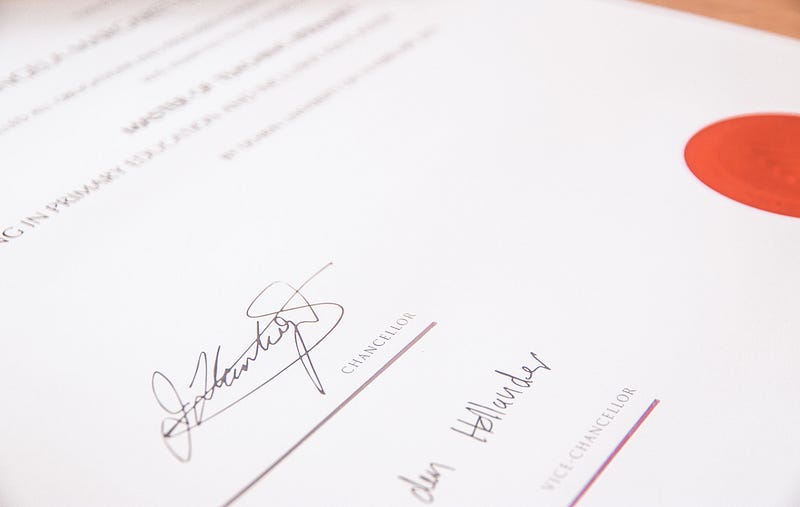
I put myself on the Ethics Committee of a large organization. I did not have a Master’s in Medical Ethics but I have a passion for it and I read about it every chance I get. I love the Ethics questions on our multiple choice tests, but most of all, I valued the chance to be involved in the everyday ethical questions our patients face. So when they asked me what qualified me to be on the Ethics Committee, that’s what I wrote down. I know it’s not a Master’s, but surely it was enough to get my foot in the door? And it was.
Degrees are a huge deal in our society now. You have to have an MPH, an MBA, an MHA, etc etc to do anything these days. Any reasonable employer, though, will put ‘MBA or equivalent experience’, knowing that you can actually learn those same skills after many years on the job. I will admit there are things, little things, maybe structural, systemic things that a degree will teach you — for example, I really don’t recommend going out and becoming a doctor without a medical degree — but there are things that a degree won’t teach you, too.
When I applied to be a Children’s Literature Fellow, I was waitlisted. My Bachelor’s is in Art; my graduate degree is in Medicine. I did not have a portfolio of writing, nor did I have an MFA, which my competitors did wield. Instead, in an honest bluff, I wrote that I had been a writer my whole life, listing my meager accomplishments as proof. I was accepted.
I’ve been board room meetings, presented at international conferences, lead a team of resident physicians, even helped transition our hospital to an electronic medical record. I became a Master Gardener and taught cartooning to school kids. Every single time, I sat in a room full of people that I felt were smarter, stronger, better-looking than myself, and I felt like I didn’t belong. Over time, what I’ve learned, though, is that the imposter feeling just means that you are in a place where you have something to gain. You are learning something. You’re getting valuable experience.
Imposter syndrome isn’t a victim’s curse, it is an opportunist’s blessing.
As an Asian woman in the very patriarchal world of surgery, I have often had to feign confidence when I didn’t have any. Remember, the crux of imposter syndrome is the fear of being revealed as a fraud. The point, though, is that you’re not. You just think you are. So if you have to say, “Yes, I’ll accept that difficult patient” or “Yes, I can handle a month of back-to-back days on call,” pretending to have faith in yourself is inspiring others to have faith in you. The point is to have true confidence in what God gave you. Not fake confidence when you don’t have the gifts to back it up. One more time: what you’re faking isn’t your self. You’re fronting the confidence to be your authentic, wonderful self. What was it Shakespeare said? “All the world’s a stage,/ And all the men and women merely players.”
You may argue, the world should not have to be this way. We should not have to bite off more than we can chew. I argue that it is the only way we can grow.
I approach my life this way now — while I always understand fear of failure, I never understand lack of trying. All you can do is put yourself out there and be confident in what you have to offer — and you will never be an imposter again.
Subscribe to my monthly newsletter, Flying Penguins Plus, a digest of my best work every month delivered directly to your Inbox!