
Faith Healers, Medicine Men and Women, and Traiteurs
Is traditional medicine the only way to heal? Cultural traditions say maybe not.

The concept of faith healing no doubt stirs controversy whenever it’s mentioned. But, I have firsthand experience that it has worked for me.
Now, I’m not talking about one of those crazy charismatic religious services where a tumultuous preacher flails his hand towards a follower, who then falls to the ground.
Traiteurs — local faith healers in the culture I grew up in.
My grandfather was what is known as a traiteur here in South Louisiana. Traiteurs have been around forever in Cajun Country.
When I was a young woman, I was cursed with painful menstrual cycles. And a few times a year, they were accompanied by the headache from Hades. I’m talking about the kind of headache where you wish you were dead. I couldn’t move my head or be in bright light, and I felt like I would die.
When these headaches hit, I could go through a bottle of Tylenol or another bottle of pain reliever very quickly. Still, they wouldn’t offer much relief for my headaches.
Even though I knew my grandfather’s healing treatments were a Godsend and usually worked, I’d hesitate to ask for a session. For one, the rational part of my brain didn’t want to admit that there was merit to it.
But, I’d eventually head on over to my grandparent’s house and ask for my grandfather’s help in making my headache go away.
Now, my grandfather was a very quiet man. For one thing, most of the time when he spoke, he spoke Cajun French. He knew very little English. He was a meek and kind soul.
When he went into a healing session, he’d place his hands around my head, close his eyes, and suddenly go into a deep meditative prayer. It would almost be trance-like but his eyes were closed. His lips would move, but nothing audible could be heard and I had no idea what he was saying as he prayed. It was a very peaceful experience.
By the time he’d be done, a headache that I might have had for a week would suddenly be gone.
In my elation, I’d often praise him, thanking him profusely. But, he’d be quick to say ‘no’ and shake his head horizontally. He’d then quietly point up and say ‘God. It’s God. Not me.’
I’ve since learned that traiteurs aren’t allowed to charge for their services, nor are they allowed to take credit for their work. They acknowledge God as the true healer and they are simply vessels.
Is it possible that there’s more to it?
I have an inordinate amount of faith in God. So, it’s not unreasonable to me that He would heal someone. Jesus did it all the time in the Bible. And if you’re a believer, God is huge, right? There’s nothing He can’t do.
Even if you aren’t a believer, people who don’t believe in a higher power often seek alternative treatments every day that offer them relief. Treatments like acupuncture, mind-body therapy, hypnosis, and biofeedback. Many of these have no scientific basis, but they work for so many anyway.
I’m not an all or nothing kind of person when it comes to rationalizing things. Sometimes I think there’s more than one plausible explanation for something.
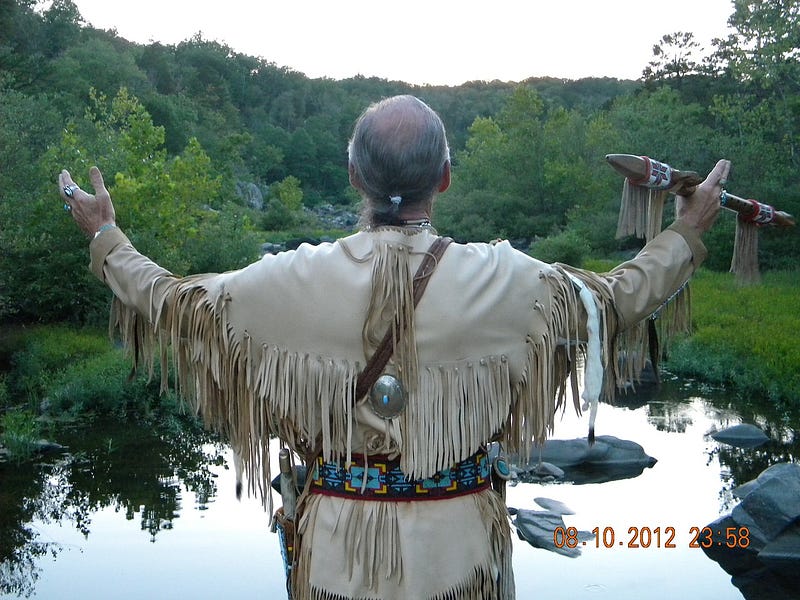
Medicine men and women — Instrumental to many tribes
Let’s look at another kind of alternative healer — medicine men and women. I watched a touchingly beautiful and gripping movie the other night — White Lies. In the movie, there’s a medicine woman named Paraiti. She’s a tribal midwife and healer in New Zealand.
I won’t get into the actual plot of the show except to say that it’s one of the best movies I’ve seen this year.
As Paraiti treats people, she uses herbs as a natural remedy for many of the ailments she treats. But, I couldn’t help but be drawn to something else that seemed to be an integral part of her treatments.
Compassion combined with a gentle laying on of hands, and what seemed to me to be a transference of healing energy. The healing seemed to stem as much from the human touch as it was a drawing out of negative energy and replacing it with life-giving energy. That was just my take on it, but it was a beautiful thing to witness.
And when you think about it, it’s the sort of thing that’s severely missing in today’s medical climate. Medical treatment today seems sometimes cold and sterile, without feeling or compassion.
I absolutely believe in the power of positive energy, compassion, and most importantly, the human touch. Could these things be an instrumental part of some types of faith healing and the healing that so many experience when exposed to this type of medicine?
Science says it shouldn’t work. But it does.
As Psychology Today points out, faith healing has no rational scientific basis. In some scientific studies, faith healing has been shown to be as effective as a placebo outcome that resulted in the resolution of an illness.
In either case, there’s no logical reason for it to work. Yet, it does for so many. Is it a placebo effect or is there something bigger at play?
In the Navajo Indian culture, one out of eight men is a medicine man. Medicine men are the leaders, doctors, and teachers of the Navajo people. The Navajos don’t have doctors with medical degrees. They have medicine men.
A medicine man might heal a tribe member by having them purge, treat them with herbs, lay hands on them, and massage certain spots of their bodies. They also pray and chant over them, usually in the form of an ancient tribal song.
There’s also quite a bit of superstition involved as the medicine man aims to rid a body of any demons that might have set up house in a tribe member. Then the medicine man performs an Indian dance and makes offerings to God or as so many of them believe, to the gods.
Many tribe members on the receiving end of this treatment get well. Or so they say. We can only go by the teachings of their history.
The Navajos and other Indian cultures aren’t the only ones who practice this type of healing. Many cultures, such as those found in Africa, rely on faith healing for their people.
When it comes right down to it, faith itself seems to be an instrumental component of these types of healing. Belief is a powerful thing and it can work for or against a person. If a person believes, good may come of it. If they doubt, then they are unlikely to reap the full benefits of faith healing.
At a minimum, faith healing seems to boost the immune system. This may offer a physiological explanation for a person’s sudden wellness.
But, I’m sure many who’ve been the recipient of a faith healing, myself included, will tell you that they believe there’s something bigger at play.
I believe there’s a time and a place for everything. I credit modern, traditional medicine, in part, for keeping me alive with my chronic disease. I also give credit to my Creator and I believe He does bestow some with the gift of healing.
What do you think? I’d like to know. Drop me a comment below.
Disclaimer: Much of the evidence presented here is anecdotal and based on personal accounts. Faith healing may work for some and not for others. If you have a serious medical ailment, consult a medical doctor for an opinion and possible treatment about your condition.