
Fair Warning
Recent Mini-Nuremberg Rallies
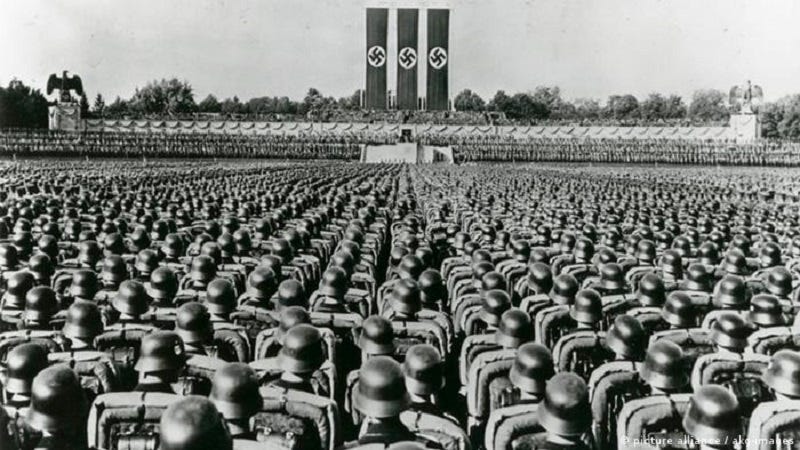
A heartfelt word to friend and foe Beware of crowds and where they go
Why is it, I wonder, that crowds are so much more easily swayed than individuals? Why are mobs so easily steered and prodded?
I believe it has all to do with reason versus emotion. You’re not going to whip a solitary person up into a frenzy — if you try, he or she will regard you not only with suspicion but with compassion. To convince a single person you must resort to, and appeal to his or her, reason — perhaps, also, to some degree his or her intuition.
If you make sense, well, he or she might just be swayed your way. If not, then not so much.
Emotion, on the other hand, well — and to make my point, let me quote a short article that appeared in Deutsche Welle in November 2012:
At a Nazi Party rally in 1935, Hitler described his ideal of the Hitler Youth as “swift as a greyhound, as tough as leather, and as hard as Krupp’s steel.” The phrase was subsequently quoted often and used as a slogan.
On September 14, 1935, a small, unattractive man with a toothbrush mustache, in a stiff white shirt, brown tie and uniform, addressed some 50,000 members of the Hitler Youth Movement in the gigantic stadium of the Nazi party rally grounds in Nuremberg. His fists clenched, the Führer spoke to a captive audience, which stood to attention in orderly rows and frequently interrupted his words with impassioned shouts of “Sieg Heil!”
The longer he spoke, the more he whipped the crowd into a frenzy of enthusiasm with talk of the rampant degeneracy of the Weimar Republic and the need for a new German who was “more disciplined, fit and trim.” He told the sea of upturned faces that “a young German must be as swift as a greyhound, as tough as leather, and as hard as Krupp’s steel.”
It’s hard to tell from film footage of this speech whether all the young people present were genuinely moved by Hitler’s words, whether they actually understood his message or were simply carried away by the electrifying atmosphere. The only surviving footage is stylized in the same way as Leni Riefenstahl’s notorious propaganda film “Triumph of the Will,” made one year previously at the Nazi Party Congress in Nuremberg.
Close-ups of young, shining-eyed Aryans and shots of vast arenas filled with rows of blonde, uniformed young people overseen by the Führer himself combine to create the impression that an almost religious event is taking place. This was exactly the effect Hitler’s fiery speeches and the spectacular mass rallies so beloved of the Nazis were supposed to achieve.
The Power of Imagery
Othmar Plöckinger from the Institute of Contemporary History in Munich has researched Hitler’s speeches in-depth. “Hitler was undoubtedly a successful orator, especially in the early years,” says Plöckinger. “Around 1933, his speeches became more weighed down with show.”
In the run-up to his rise to power, the right-wing press responded primarily to the Nazis’ knack for imagery and the pomp and ceremony of Hitler’s public speeches, rather than the actual content.
Leftwing writer Franz Jung gave a glimpse of the extraordinary organizational effort that went into the Nazis’ mass events in his eye-witness account of a May 1 parade in Berlin shortly after the Nazis seized power in 1933: “For the first time in history, a gathering of one-and-a-half-million people is to take place on the Tempelhofer Feld, the press has reported. The Propaganda Ministry published a review of operations which states that 18,000 people organized into six columns will gather within one hour […] The top of the first column will reach Tempelhofer Feld at 2:00 p.m., and the rally will begin at 8:00 p.m.”
The media was brought into line to ensure that the desired effect of Hitler’s speeches was underscored by press coverage. A day after he gave a speech, almost all the major dailies would reprint it word for word; it would be reported on the radio; film footage of the event would be shown weeks later on newsreels screened in cinemas.
It was the Nazis’ skilled media manipulation that allowed Hitler’s appeal to German youth to be “as swift as a greyhound, as tough as leather, and as hard as Krupp’s steel” to become a popular quote that went down in German history. Over the years, the fact that it was first spoken by Hitler was eventually forgotten.
Militaristic Message
Swift as greyhounds, tough as leather? Hitler’s speech seems bizarre now, not least on account of his failure to mention any traditional values that young people might aspire to, such as education, wisdom and justice. As it happened, Hitler had come up with the sentence long before the Hitler Youth rally in 1935 — he has used it 10 years earlier in his book “Mein Kampf.”
Even then, Hitler was more interested in what Othmar Plöckinger calls “military” discipline rather than educational ambition.
“There is no explicit mention of education and young people in “Mein Kampf,” although Hitler’s fondness for military thought and action is already in evidence,” he says. “In this respect, militarism obviously served as one of the main cornerstones of the Nazi society.”
By 1935, Hitler’s power was consolidated, the NSDAP had 3.9 million members and the opposition had largely been eliminated. The Nazis were in a position to plan German expansion and rearmament. Hitler introduced conscription, breaking the terms of the Versailles Treaty, which had placed restrictions on Germany’s armed forces.
Hitler’s speech to young Germans in 1935 was a taste of things to come. In 1936, a law was passed that made the Hitler Youth the only youth organization in Germany, made up of the Hitlerjugend proper, for male youths ages 14–18; the younger boys’ section Deutsches Jungvolk for ages 10–14; and the girls’ section Bund Deutscher Mädel (BDM, the League of German Girls).
In 1939, membership became compulsory. Nearly 8 million youngsters took part in drills on the schoolyard, shooting exercises and mustering, all with the goal of becoming as swift as a greyhound, as tough as leather, and as hard as Krupp’s steel. The Hitler Youth was disbanded by Allied authorities in 1945.
Yes, Hitler was a gifted rabble-rouser (to put it mildly) and, by his own intents and purposes, one must admit that he was successful. Of course, the end game didn’t quite go as planned — just to make sure his suicide would turn out well (as in certain death), he not only took a cyanide capsule, but he also shot himself with a pistol. So much for swift as a greyhound, as tough as leather, and as hard as Krupp’s steel. Just a pile of 56 years old, flabby German coward.
Now, a recent President seems to have ripped a few pages out of this German coward’s playbook which we saw evidence of during his strange political “Lock Her Up” rallies. Not too much reason involved here, but a lot of mob-mentality emotion. Very un-American, that — we who pride ourselves on our rugged individualism.
And I’m sure that many (though by no means all) of the twenty or so thousand attendees at these Mini-Nurembergs were just that, rugged individuals, proud selves as it were.
But, it seems to be quite well known that one does get carried away, as they say. We see it in sports: hockey games and soccer games come to mind. I’ve been there myself, carried along by the jubilant group emotion at a hard-fought-for score, or the bordering-on-hatred rising like miasma at the clearly unfair and potentially injurious tackle.
But why? Why do we get carried away?
I ran across this Quora thought, which I found insightful: “I think there are only two ways a person can be carried away by a crowd. Sadly, both of those ways are entirely possible and have indeed happened.
“In the 18th Century, people who had made themselves completely unwelcome in a community were, literally, carried away by a crowd: out of town, on a rail, usually tarred and feathered.
“And, less literally, here in the 21st Century, any type of vigilante behaviors, and they do exist, would be a physical being carried away by an unruly crowd.
“There is also the emotional being carried away by a crowd. We need look no farther than the emotional sway Herr Hitler had on good and decent German people.
“For some enigmatic and unfathomable reason, when a moral, and upright person, who wouldn’t hurt a fly is caught up in mob mentality, they frequently act like they would never do on their own; along with the rest of the crowd.
“I think their logic runs along the lines of: I am only 1% to blame for my actions. My culpability is shared with the other 99 participants. Naturally, the other 99 people, individually, feel the same way.”
Well put, I think. And I believe the “sharing of the blame” is a strong factor in allowing yourself to let it all down and become 100% mob as it were.
But how, though?
Turning to Wikipedia, the often spot-on clarifying voice: “Herd mentality, mob mentality or pack mentality describes how people can be influenced by their peers to adopt certain behaviors on a largely emotional, rather than rational, basis. When individuals are affected by mob mentality, they may make different decisions than they would have individually.”
Yes, I’d say. Putting it mildly.
I think a long, hard look at the upturned, bordering on ecstatic faces admiring (and drinking in) their Messiah during one of these “Lock Her Up” rallies tells the story quite eloquently.
The January 6 mob attack underlines it.
© Wolfstuff
P.S. If you like what you’ve read here and would like to contribute to the creative motion, as it were, you can do so via PayPal: here.


