
Fair Share: 90% of Americans Want Wealth Shared in a Way that Looks Like Socialism

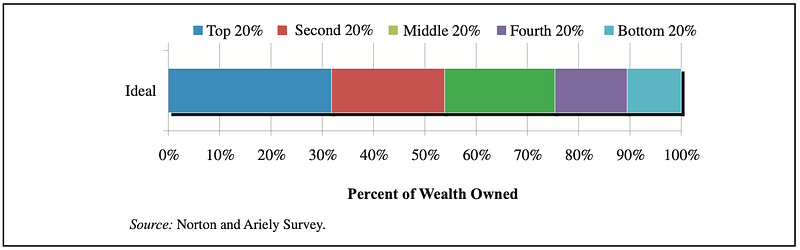
Today’s proof that most people are good: 90% of Americans want a much fairer distribution of wealth. A decade ago, a major study by Michael Norton and Dan Ariely revealed that nine out of ten Americans, regardless of race, sex, politics, or class, want an economic hierarchy that gives 36% of the nation’s wealth to the top fifth of the population, and smaller shares to each lower fifth, leaving the bottom fifth with 11% of the wealth.
The actual distribution of wealth is strikingly different. In reality, the top 1% of US households has a third of the wealth. The next 9% has another third. The last third is divided unequally among the next 50%, leaving the bottom two-fifths with so little that they are invisible on a chart of the actual distribution of wealth.
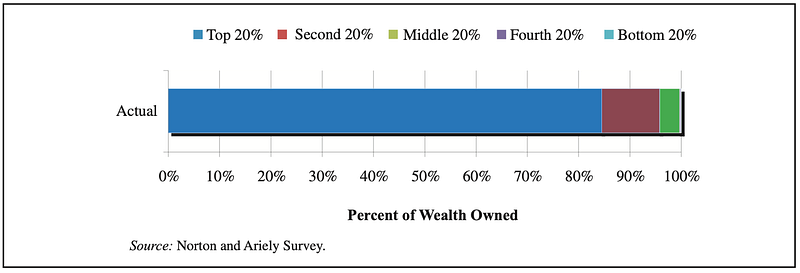
What strikes me when comparing the actual distribution of wealth and what 90% of Americans want:
- They want the bottom fifth to have 11% of the wealth—as much as the second fifth actually has, and over 100 times as much as the 0.1% that the bottom fifth has today.
- They want the fourth fifth to have 15% of the wealth—75 times as much as the 0.2% that the fourth fifth has today.
- They want the middle fifth to have 18%—four and a half times as much as the 4% that the middle fifth has today.
- They want the second fifth to have 21%—over twice as much as the 11% that the fourth fifth has today.
- They want every group to have more except for one—they want the top fifth to have 36% instead of 84%. If you think giving the largest share to the rich is “punishing the rich”, all I can say is it’s a punishment that most people would love to get.
I expect at least three objections to this information from capitalism’s fans:
- But a wealth hierarchy isn’t socialism!
- But America already has the fairest distribution of wealth!
- But you can’t trust a survey!
The quick answers: Wrong, wrong, wrong.
- Objection #1: That’s not socialism!
Capitalists confuse socialism with Christianity. Jesus said, “Sell your possessions and give to the poor, and you shall have treasure in heaven.” Karl Marx promoted a different idea: “From each according to ability, to each according to need.” The socialist goal is to make a world where we all have what we need to make a good life.
Socialists know it would be impossible to create a world of perfect economic equality, and if it was possible, it would fail to account for a simple fact: People in different circumstances have different needs.
In 1875, Frederick Engels wrote:
As between one country, one province and even one place and another, living conditions will always evince a certain inequality which may be reduced to a minimum but never wholly eliminated. The living conditions of Alpine dwellers will always be different from those of the plainsmen. The concept of a socialist society as a realm of equality is a one-sided French concept deriving from the old “liberty, equality, fraternity,” a concept which was justified in that, in its own time and place, it signified a phase of development, but which, like all the one-sided ideas of earlier socialist schools, ought now to be superseded…
- Objection #2: Capitalism is fair!
The United States is the richest country in the world, but it has one of the world’s most unequal distributions of wealth. We can see that using a standard measure of inequality, the Gini ratio. In a theoretical country where one person has all the wealth and no one else has any, the Gini ratio would be 100. In a country where everyone has the same amount of wealth, the Gini ratio would be zero.
- Objection #3: You can’t trust studies!
David Cay Johnston addressed the quality of Norton and Ariely’s work:
The survey sample, with more than 10 times the 504 people often used in polls, is robust and credible. (For the report, see Doc 2010–21608.)
The genius in the survey was to avoid questions using loaded terms like ‘‘estate tax’’ and ‘‘death tax.’’
Instead those surveyed were shown pie charts and asked what they thought was the ideal distribution of wealth and what they estimated to be the wealth distribution in America.
Norton and Ariely said this about how they did the survey:
A nationally representative online sample of respondents (N 1⁄4 5,522, 51% female, mean age 1⁄4 44.1), randomly drawn from a panel of more than 1 million Americans, completed the survey in December, 2005. Respondents’ household income (median 1⁄4 $45,000) was similar to that reported in the 2006 United States census (median 1⁄4 $48,000), and their voting pattern in the 2004 election (50.6% Bush, 46.0% Kerry) was also similar to the actual outcome (50.8% Bush, 48.3% Kerry). In addition, the sample contained respondents from 47 states.
We ensured that all respondents had the same working definition of wealth by requiring them to read the following before beginning the survey: ‘‘Wealth, also known as net worth, is defined as the total value of everything someone owns minus any debt that he or she owes. A person’s net worth includes his or her bank account savings plus the value of other things such as property, stocks, bonds, art, collections, etc., minus the value of things like loans and mortgages.’’
If you want to do more research:
- The top 20% of US households has more than 84% of the wealth. The bottom 40% has only 0.3%.
- The top 1% of US households has a third (32.3%) of the wealth.
- The bottom 50% of American families has 2% of the wealth.
And here’s a good video based on the survey:


