
Fair Pay Chronicles: Minimum Wage and Overtime
Know your rights to fair compensation in the employment relationship.
The concept of minimum wage and overtime regulations in the U.S. is grounded in protecting workers from exploitation and ensuring fair compensation for their work. These regulations come from a long history of labor movements and legislative action aimed at improving working conditions and compensation.
The push for a minimum wage began in the early 1900s as part of the broader labor movement, such as the Bread and Roses Strike of 1912, in response to poor working conditions and very low wages, especially in factories and for women and children.
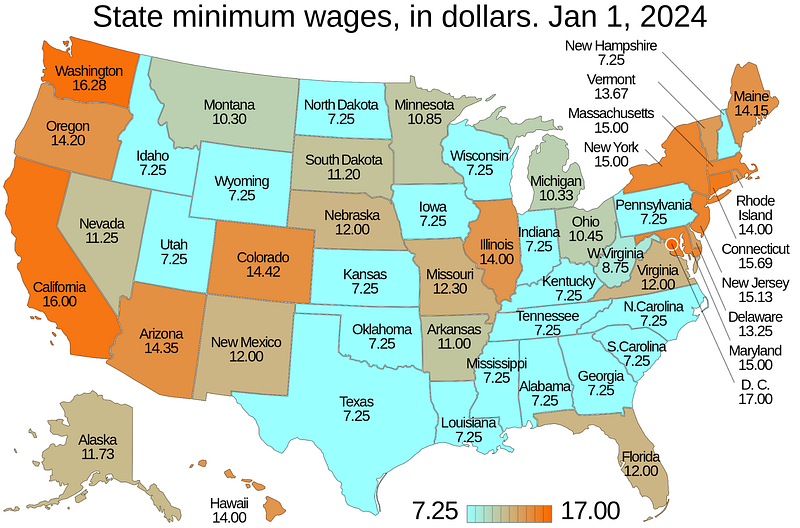
Fair Labor Standards Act (FLSA) of 1938 was a landmark U.S. law that established the first federal minimum wage, initially set at 25 cents per hour in October 1938. It also introduced the standard workweek, child labor regulations, and overtime pay. Since 1938, the federal minimum wage has been updated 29 times to reflect changes in the cost of living and economic conditions. Please note, states can set their own minimum wages if they are higher than the federal rate.
Overtime pay was also established under the FLSA. It required employers to pay workers time and a half for hours worked beyond the standard 40-hour workweek. By making overtime expensive, the law aimed to encourage employers to hire more workers for additional work instead of overworking their current employees, thus reducing unemployment. Was it the right decision? Opinions are divided.
Minimum Wage
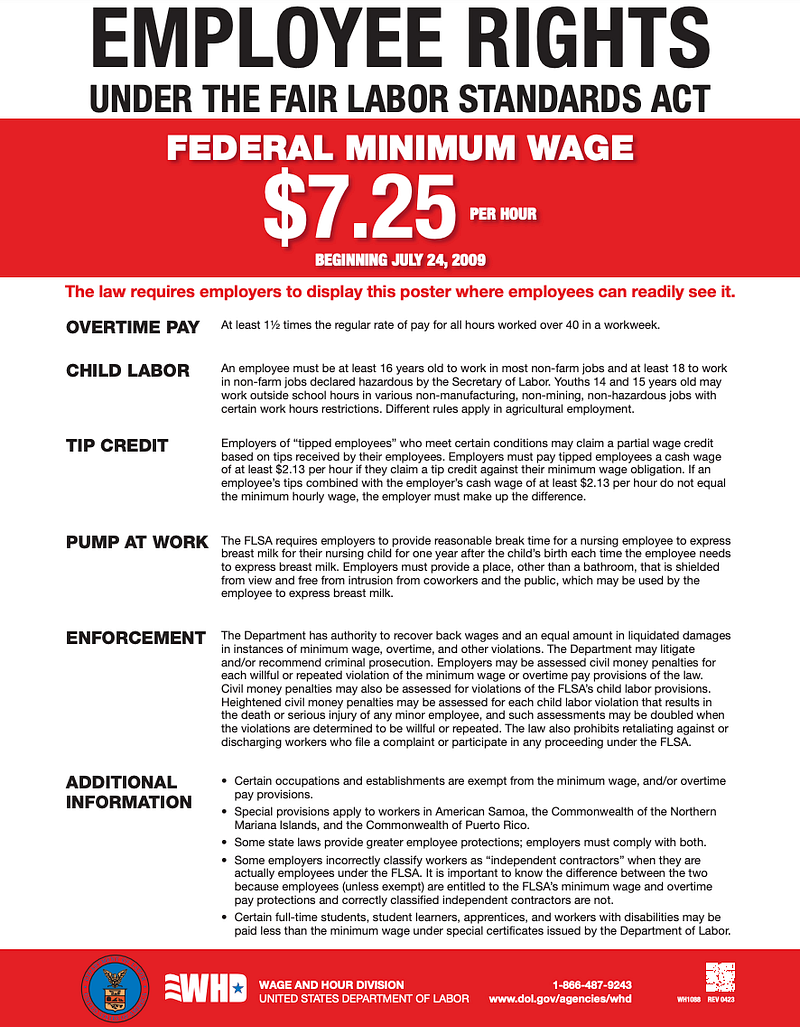
The federal minimum wage serves as a safeguard to ensure that workers receive basic compensation for their work. Currently set at $7.25 per hour, this rate is the minimum amount that employers across the country are required to pay their employees for standard hours of work, with the intent of providing a basic standard of living.
Exceptions and Their Implications
The tipped employee rule recognizes the special nature of jobs where a significant portion of an employee’s income may come from tips. In these jobs, such as those in the hospitality industry, the law currently allows a lower base hourly wage of $2.13 (plus, as mentioned earlier, some states have their own rates, usually higher than the federal level). However, this comes with some caveat: the sum of the base wage and tips must equal or exceed the federal minimum wage of $7.25 per hour. Despite the lower base wage, employees in tipped positions have the opportunity to meet or exceed the federal minimum wage through their tips. If they do not, the employer is required by law to make up the difference, thereby protecting the employee’s right to fair compensation.
Younger Workers
For workers under the age of 20, the regulation establishes a lower minimum wage of $4.25 per hour for the first 90 calendar days of employment. This exemption is intended to incentivize the hiring of young workers, who often lack experience and are entering the workforce for the first time. The regulation attempts to encourage employers to take a chance on training and developing younger workers. After this initial period, these workers must be paid at least the full federal minimum wage to ensure their transition to the standard wage framework.

Overtime Pay Requirements
When it comes to overtime, the basic idea is that if you work more than 40 hours in a week, your employer must pay you time and a half your regular hourly rate for each hour you work over 40. It is about the average hourly rate you earn. This average is found by dividing your total pay (minus the exceptions, like out of pocket for your job, extra money for working overtime or on weekends and holidays, bonuses given out at the employer’s discretion, gifts, or pay for times when you’re not working because of vacation, holidays, or illness) by the total hours you worked.
If you’re paid a salary instead of an hourly wage, you figure your hourly rate by dividing your weekly salary by the number of hours it represents. So if you make $1,500 a week for 40 hours of work, your hourly rate is considered to be $37.5.
For people who work in non-government jobs, any overtime pay must be given as actual money rather than extra time off work. However, government (public sector) employees may be given the option of taking additional time off, known as compensatory time, instead of receiving extra pay for overtime.


What Counts as Work Hours and What Doesn’t
When we talk about “compensable time” in the context of work, we’re trying to figure out what activities or periods of time should count as part of your work hours. This is important because it can affect how much you get paid, including your regular and overtime pay.
In general, you should be paid for all the time you work, from the moment you start your job tasks until you finish them. If there are additional tasks that you absolutely must do in order to perform your primary job, those tasks also count as part of your work time.
However, under a provision of the Fair Labor Standards Act called the Portal-to-Portal Act of 1947, the time you spend traveling to and from where you perform your primary duties doesn’t count as work time. Also, simple tasks you do before or after your primary tasks that aren’t critical to your job don’t count as working time.
For example, there was a court case (Steiner v. Mitchell (1956))about workers in a meat processing plant who had to sharpen their knives to do their jobs properly. The court ruled that since sharpening the knives was necessary to their main job of cutting meat, the time spent sharpening the knives should be paid.
In another case of IBP, Inc. v. Alvarez (2005) involving workers at another meatpacking plant, the court considered whether the time spent waiting to put on protective gear should be paid. The workers had to wear the gear to perform their primary job of cutting meat, so putting on the gear was considered necessary and should be paid. However, the time they spent waiting to put on the gear was a bit different. Sometimes waiting was necessary, sometimes it wasn’t. Because waiting wasn’t a direct part of their main job, the court ruled that the workers shouldn’t be paid for waiting. That’s because waiting didn’t directly help with the primary job of cutting meat and it was considered a step removed from the actual work.
Also with the widespread use of smartphones and other mobile devices, it’s becoming increasingly difficult to separate work time from personal time. Employees often find themselves checking work email or completing work-related tasks outside of office hours, such as evenings, weekends, or even on vacation. This extra work time, often done on smartphones, can add up, and some employees want to be paid for it.
Current employment laws, including the FLSA and the Portal-to-Portal Act, don’t specifically address the issue of being constantly connected to work via technology. However, as more employees push for compensation for this time, companies may face more legal challenges.
To avoid legal problems, businesses should set clear rules about using technology for work outside of regular hours. They should also regularly review what employees are doing for work and how they’re being paid to make sure everything is accurate. This can help prevent costly legal issues.
Exempt Employees Under FLSA
The Fair Labor Standards Act (FLSA) has rules about who gets paid minimum wage and overtime, but not everyone is covered. Some workers, called “exempt employees,” don’t have to be paid overtime or even minimum wage under these standards.
Most often, though, when people talk about exempt employees under the FLSA, they mean certain types of workers who are considered executive, administrative, or professional. These employees aren’t entitled to overtime pay or minimum wage under the law.
There are two main things that determine whether an employee is exempt in this way:
- Salary level. The employee must earn at least $684 per week, which is just over $35,000 per year.
- Job duties. The work they do must fall into one of the executive, administrative, or professional categories. This can get a little complicated, but here’s a simple breakdown: (i) executive employees manage parts of an organization, supervise at least two full-time employees (or their equivalent), and have a significant say in hiring and firing. Think of a department head who’s in charge of a team, handles discipline, and is involved in budgeting; (ii) administrative employees perform clerical or non-manual tasks that are critical to the operation of the business. They have to make important decisions on their own. This is more behind-the-scenes work, as opposed to front-line roles such as cashiers or factory workers; (iii) professionals are divided into two groups: learned and creative. Learned professionals have advanced knowledge in fields that require specialized study (such as engineers or lawyers). Creative professionals are those in artistic fields where imagination and talent are key (like composers or painters).
There’s also a special rule for highly compensated employees. If someone earns at least $107,432 a year, does clerical or non-manual work, and regularly performs work that would be considered executive or administrative, they are considered highly compensated.
For more detailed information on each exemption and its criteria, the U.S. Department of Labor provides comprehensive fact sheets, such as Fact Sheet #17A for executive, administrative, professional, computer, and outside sales exemptions, Fact Sheet #17D for more detailed information on professional exemptions, and a handy reference guide covering broader aspects of the FLSA.
Disclaimer
The information provided in this article is for informational and educational purposes only and is not intended to serve as legal advice or as a substitute for legal counsel. While efforts have been made to ensure the accuracy and completeness of the content herein, it is important to note that legal principles and regulations can vary significantly based on jurisdiction and specific circumstances. Therefore, this article should not be used as a definitive legal resource or as a basis for making legal decisions. Readers are strongly advised to consult with a qualified attorney for advice on legal issues or matters, as each individual case may require detailed and personalized legal analysis.
Reliance solely on the information provided in this article without seeking professional advice from an attorney may lead to unintended legal consequences or misinterpretation. The author or publisher of this article do not accept responsibility for any potential errors or omissions, nor will they be responsible for any losses, injuries, or damages arising from its display or use. The information provided here does not create an attorney-client relationship between the reader and the author or publisher.