
Failure To Rescue
The Day Frederick’s Heart Stopped Responding
I once had a patient in the Cardiovascular Intensive Care Unit (CVICU) that I never actually met, but I’ll never forget.
Fredrick was a 79-year-old who had open heart surgery, called a CABG (coronary artery bypass graft) or cabbage in the medical world. His new home was the CVICU. To keep his heart beating, he had returned from surgery with a special pump (called an intra-aortic balloon pump) and an external pacemaker.
The special pump helped his weak heart push blood around his body. The pacemaker kept his heart beating.
When I met Fredrick he was still sedated and had been back from surgery in the CVICU for less than one hour. I was gathering report and was minutes into my night shift, when the special pump started alarming and the pacemaker started blinking.
Without the special pump and the pacemaker, Frederick’s heart wasn’t beating and wasn’t pushing blood around his body. I had to act fast.
As I checked the pacemaker, I also shouted out for someone to call the surgeon, someone to draw up medications, and someone to start documenting. I remember this as one of the first times these actions felt fairly routine to me.
A few years earlier, when I was nearing the end of nursing school, I decided I wanted to work in the Pediatric Cardiovascular Intensive Care Unit (Peds CVICU). I had become enthralled with the skill and competence of the pediatric CVICU nurses. Their ability to handle complexity and uncertainty at a moment’s notice was a skill I wanted to master. At that time, new nurses had to work for at least one year in the adult CVICU before taking care of pediatric CVICU patients.
Learning About Rescue Plans
That’s how I ended up taking care of Fredrick at 7:30 at night learning the ins and outs of quick judgement calls, mastering in-depth nursing skills, and recognizing the finicky dynamics of the cardiovascular system.
What I hadn’t thought about at that time were the consequences. What happens when skill and competence aren’t routine? What happens when these life-saving actions falter?
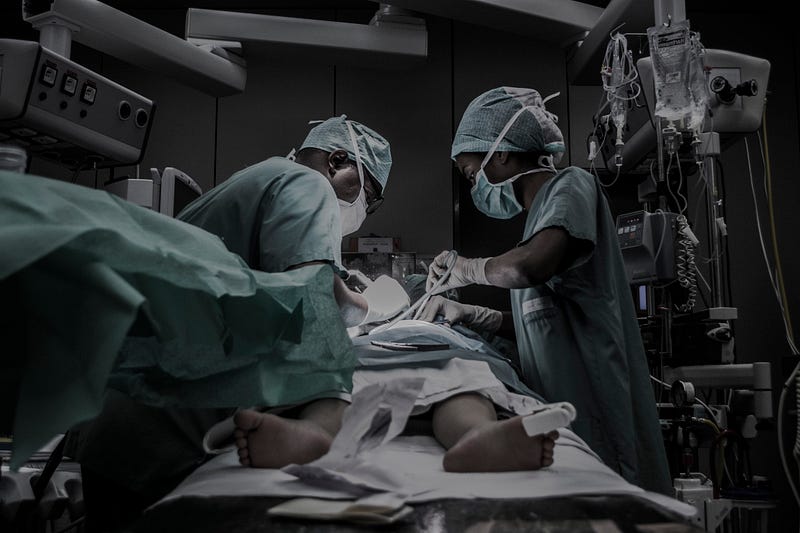
Within fifteen minutes the cardiothoracic surgeon was at the bedside calling for the open heart cart — that meant he was going to open the chest in the unit and not take the patient back to the operating room. The open heart team had already gone home for the day and it was not unusual during night shift for the ICU nurse to assist the surgeon at the bedside.
Suddenly, Fredrick’s ICU home became a surgical suite — without all the bells and whistles.
I leaned over Fredrick’s body feeling my own heart beating against my ribs and seeing my hands shaking as I held the suction tube near his heart while the surgeon worked to save him.
“Don’t get it too close,” the surgeon snapped, taking my hand and adjusting the position, ending with “hold it right there”.
Time of death: 1:43 AM
The surgeon spent over four hours alternating between reaching inside of Frederick’s chest and squeezing his heart to circulate the blood and carefully placing wire after wire along the distance of the SA (sinoatrial) node, the portion of the heart where the electrical impulses are generated.
When a heart cannot generate an electrical impulse, it can no longer beat. A pacemaker can generate an impulse for the heart that can’t do this on its own, but first the heart has to have tissue that can accept the impulse from the pacemaker.
This is what the surgeon was doing, searching for the one place on Frederick’s heart that would accept the impulse and allow his heart to beat again. But Frederick’s heart was too sick to respond to the impulse.
It was meticulous work. He would attach a tiny pacing lead to the heart, attach the other end of it to the pacemaker, then turn it on…hoping it would capture, hoping he’d found a viable piece of tissue, hoping the heart would start beating.
When it didn’t, the surgeon massaged the heart for a while to circulate blood, then, he’d start over. Placing another lead less than 1mm below the last one. Turning on the pacemaker. Hoping. Massaging. Placing another lead.
After trying over twelve pacing leads, he massaged the heart for a very long time before removing his hand for the last time from inside Fredrick’s chest.
The room was packed with medical equipment and subdued healthcare workers. The only sound was the ventilator pushing air in and out of Frederick’s lungs.
The surgeon looked up at the clock and said, “Time of death, 1:43 am.”
Frederick’s heart lie exposed and still, each pacing wire still in place, strewn across his open chest in an orderly fashion. The breathing tube was hanging from his mouth causing his chest to rise and fall, his hair was tasseled, matted against his head.
I placed my hand on his forehead as my colleagues scattered back to their own work.
The Risk of Failure
Nursing is not unlike other professions in that we all face complexity and uncertainty in our chosen career paths. We all confront the risk of failure. Initially we struggle to become adept at the critical capacities that keep us from failing at our jobs, then we tend to cruise into the sunset of rote performance.
The difference with nursing is that the loss is often at the expense of human suffering and lives lost. As such, measuring outcomes in terms of patient lives saved, patient satisfaction scores, and patient re-admissions is common lingo in healthcare.
But that doesn’t keep us from losing lives on our shifts because people do die regardless of our most valiant and flawless attempts to save them.
Perhaps a failure shouldn’t be measured in number of lives lost.
Perhaps, failure should be measured according to the plan followed.
Following the Plan
In healthcare we have plans in place, trained responses to specific situations. The purpose of these plans is to avoid the failures of death, relapse, and readmission.
But failure can also happen when the wrong plan is followed or, at a minimum, when someone fails to abort the wrong plan as soon as they recognize they’re going in the wrong direction.
As the crowd of nurses and therapists dissipated from Fredrick’s room, the surgeon remained poised over my patient’s open chest. Since I was Fredrick’s nurse, I hadn’t gone far . . . not to talk to the family, not even to go to the bathroom.
The surgeon lowered himself from the step stool and turned toward me, “What you’d do to him? He was fine when he left the operating room.”
The intensity of this particular CVICU surgeon was not new to me. A year earlier I would have crumbled into tears at the accusation.
But I knew without a doubt that my initial actions with Fredrick were unmarred. I had followed the right plan given the situation. I was certain.
I leaned toward him and said, “I didn’t do anything. His pacemaker lost capture.”
The surgeon retreated, sighing deeply, letting his body slouch against the wall. He removed his glasses, rubbing his eyes. In a soft voice he said, “That was the sickest heart I’ve worked on in a long time.”
“Now you tell me?” I snapped. “You could have shared that when he left the OR.”
The Rescue Plan
Often what we intuitively think are failures in healthcare — the deaths— aren’t truly failures. I couldn’t pinpoint this until some years later when I read about failure to rescue (FTR) rates after open heart surgery.
Failure to rescue refers to the inability to prevent death after a complication develops.
I don’t know how long physicians have been using failure to rescue as a quality indicator in surgery, but it seems to me to be a failed unit of measurement in itself.
The way it stands now, failure to rescue is not about the best facilities and hospitals, the best physicians or nurses, the best skills or competence. It’s about avoiding death as an outcome.
What failure to rescue should be about is the plan . . . the rescue plan.
Risks and Failures
In healthcare we talk about risk management, preparing for the worst, and limiting damage within the context of recognizing the proper rescue plan.
These plans include knowing which plan to initiate and when to initiate it but also knowing when to abort the current plan and choose another plan.
If Fredrick’s surgeon had shared with the ICU nurses and providers his belief that Fredrick’s heart was one of the sickest he had encountered, would it have altered the plan when the Frederick’s heart stopped responding to the pacemaker?
Frederick’s heart was really sick, would I have done anything differently had I known this ahead of time? Most likely not; I knew to follow the rescue plan.
Hospitals and clinics are where people get well, but also it’s were people die. Because of this there will always be risks and failures in healthcare. There will always be deaths that count toward failures to rescue, so how can we ever measure success?
The Defining Moment
The good news is, when complications arise, there are plans in place to avoid losing a life, to avoid harming a life. Rescue is always a possibility. But it’s not always what happens.
This may be hard for persons outside of the healthcare arena to understand, but failure isn’t a life lost, it’s recognizing and choosing the right plan when complications arise.
It’s knowing when to abort the wrong plan and take a different approach. This knowing rests in the skill and competence of the healthcare provider to choose the right plan.
It’s there so I can give wonderful people like Frederick the best possible chance for rescue, regardless of the outcome.
The day Frederick’s heart stopped responding to the pacemaker was not a failure for him or for me. The defining moment that day was the rescue plan and the only failure would have been failing to initiate the plan.