
Self-Development
Failure is Part of Life
Swallowing it with a smile
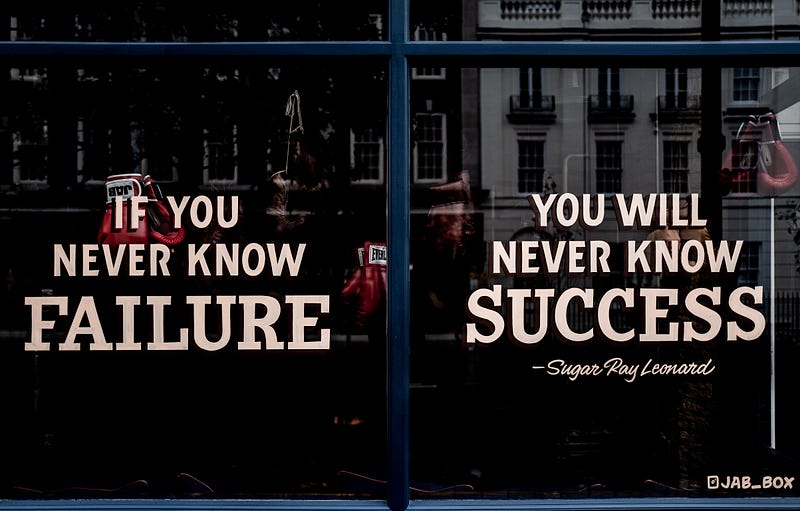
Everyone knows that failure is part of life. We’ve been told that since the day we first started school. I can’t argue with that. And before I go any further, please note that this is not a service piece in which I give five ways to cope with failure.
I’m not able to write that article because I’m a failure at dealing with failure. People that lean toward perfectionism usually are. Of course the flip side of failure is success, and what is more successful than perfectionism? Nothing really. If you’ve answered every question right on a test, written a perfectly cohesive, coherent essay or given a flawlessly-executed speech, you’ve tasted perfectionism and success.
Success is the bell that rings melodiously at the end of a long hard road to a destination. On the other hand, failure, if we are to continue the above metaphor, is the dissonant clang of cymbals announcing errors, mistakes, and important omissions.
Whether we want to admit it or not, we’ve all been clanged far too much in our lives. I know I have. Even learning to ride a two-wheeler was an ordeal for me. I failed, persisted, failed, persisted until what to my wondrous surprise, I actually balanced myself on the vehicle and rode as if I had been doing it for years.
That’s the good part of failure. Once you have defeated it by editing that article the fifth time or interpreting that literary work so it makes sense to you, you have put yourself smack in the middle of success. You’ve converted failure into success, and you can forget all about that disturbing interim when your article lacked succinctness or you could not determine the theme of a classic novel.
But what happens when you are unable to convert failure into success? That’s exactly what happened to me when I taught third grade. I failed in fits and starts. It wasn’t like I walked into the classroom and couldn’t figure out what to do with two dozen or so nine-year-olds. In many ways I did the correct things. I gathered the necessary supplies, observed other people to see how they taught, and applied ideas I had learned in college classes.
But somehow and like a recipe for coffee cake that comes out too sweet or too moist or just falls apart when you serve it, I could not put all the pieces together to achieve a palatable dish. The problem was that I was failing at different points along the continuum of teaching. For one thing, I could not discipline adequately, and I was too ashamed to ask for help. I also didn’t really care about the less bright or rambunctious students, and once or twice I’m ashamed to say I embarrassed them on purpose. Even so I still got decent evaluations. But I knew — and I expect the children also knew — that I was far from the ideal teacher.
I tried to convert my failure into a success, but the funny thing about the process of conversion is that if you don’t have the commitment or motivation, you cannot complete the process. It took me five years to realize I lacked the commitment to improve my teaching skills. Moreover shame washed over me constantly because I regarded my failure as a teacher as part of a greater failure. I had not chosen the right career — a career for which I had some passion.
I lacked passion for presenting what I considered dull material, and I lacked passion for delighting in the learning of young people. I had traded it in for practicality and a decent job offer. I wanted to graduate college with instant credentials for employment, and teaching was the instrument to allow me to do that. I never asked the hard questions such as what did I really want to do for the next 50 or so years? I was too obsessed with perfectionism in terms of GPAs and praise from teachers and too blind and naive to realize that perfectionism would never give me the confidence and success I truly yearned for.
So I turned in my erasers and resigned as a teacher. I only admitted my failure to myself and my close family, and even they could not understand why I gave up a tenured job to fail at finding another one. Because that’s just what I did. Instead of asking the right questions, I again continued to ask the wrong question: What would be an expedient career decision for an unemployed teacher?
The right question — what was my passion? — -would not surface until I failed a few more times. On the surface these failures would appear as successes, but I was not happy so something was wrong. Some of it was chronic depression, but a lot of it was disgust at having failed yet again. I was a good-enough librarian, but I never thought so.
Yes, perfectionistic standards were barriers to my experiencing success, but even so, I never developed the attitude and bearing so critical to excelling at a job in which you help others to find information. So, yes, I failed again to ask the right question and, as a result, I asked the universe to find me another — more different, presumably better — job as a librarian.
The universe balked and saw me for the liar I was. I finally got the message after a stint as an acquisitions librarian who chose materials for a collection in the Southwest. I didn’t want to be a librarian. I wanted to write. Most of the day I read reviews of books, and I wanted to be that person who wrote the books or at least wrote the reviews.
So I became a freelance writer and opened myself up to more failure. By then I was getting good at bouncing back from it. I still have not gleaned any secrets to impart to others who chose the wrong careers. I just kept moving ahead and hoping to convert my failure into success.
At least, I told myself, I had cleared one of my hardest hurdles: I was in a writing career, a career that aroused the passion I had so long pushed away because it wasn’t practical. Unfortunately, writing is a magnet for failure unless you persevere. So perseverance and persistence became my conversion techniques, and eventually I had some success.
Have I learned to cope with failure better? Yes, I have. Do I do it with a smile, as my subtitle above indicates? Sometimes I do, sometimes I don’t.
If I’ve learned anything about failure from my years of experience, I’ve learned that perception is key to the conversion formula. If you always see the glass as half empty, you’ll always be a failure in your eyes. Confidence and courage are two keys to perception. If you believe the glass will continue to fill up as long as you have the strength to push on, then you are a success.
So I tend to smile more at failure when I feel confident. So what if I didn’t sell that book proposal or that humor piece or that nonfiction idea. I tried my best. The passion is still there as is the commitment — they generate the fuel to keep my engine moving ahead. Always.


