
Fail Again. Fail better.
Samuel Beckett is tired of your inspirational posters
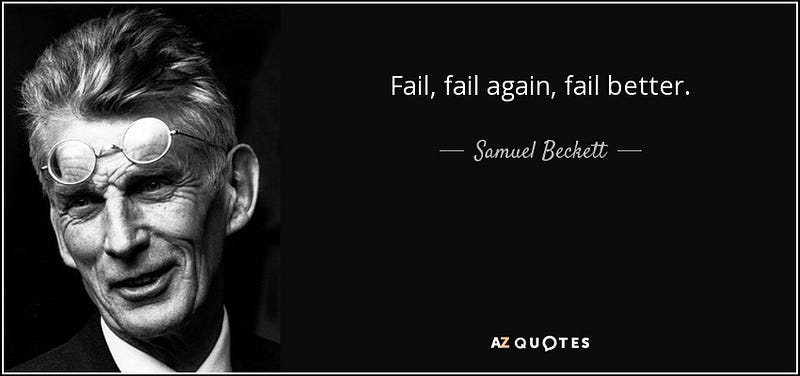
On this would-be 116th birthday of the Irish writer Samuel Beckett, let’s accept that the now-iconic quote from Worstward Ho! “Ever tried. Ever failed. No matter. Try again. Fail again. Fail better.” has nothing to do with self-help. It isn’t about launching a business. It isn’t about running a marathon. It isn’t about becoming the best version of yourself after obsessively reading Atomic Habits.
I’m sure you’ve seen it before. Perhaps it was on a motivational poster in your high school cafeteria. Perhaps you read it on a blog post from a tech start-up. A disrupter. Odds are, wherever you saw it, someone had it wrong. That isn’t to say it’s misquoted. Indeed, Beckett did write these words (five times, in fact, over the course of the novella). But to just read these lines and draw a conclusion would be a bit like saying The Grapes of Wrath is about a road trip. We really aren’t getting the whole story.
The common takeaway from “Fail again. Fail better.” is that what we need to do in the face of adversity is persevere. That if we keep going, things will eventually get better. That every failure will fail a little less until we achieve success. When the going gets tough, the tough get going. You can do it, buddy! Each iteration more saccharine than the last.
To quote Beckett again, this time from a different context, this willful misreading
“has my soul drowned in vomit.”
I am far from the first to point out that many, many, many people misuse this quote. Go to any university’s English (or French!) department and someone with a tweed jacket will lament how Beckett has been taken up by self-help gurus who have only read a handful of his words. Beckett did not believe that the self could be helped. He wasn’t even so sure of the idea of a self in the first place. But let’s save that discussion is for another time and place.
And it isn’t just the literati and ivory tower types who cringe at the memeification of Beckett’s quote. Some popular publications, like this article from OpenCulture, have tried to dispel the rumor.
Even here on this site, Gavin Lamb, PhD wrote a compelling piece where he too looks at the quote in context. Though tempting, I still can’t quite get behind his message that Beckett “offers writers a roadmap for failing forward.”
For me, there is no forward. So, let’s back up.
A little background will be helpful here. Samuel Beckett was born April 13, 1906. On that particular year, April 13 fell on both Good Friday and, evidently, Friday the 13th. What an auspicious start! He was born to a comfortable Protestant family in a suburb of Dublin, and excelled in school, despite his rather mercurial disposition. He was a brooder. He was at home in books and devoured them in a handful of languages (English, French, Italian, German, and even Latin with a sprinkling of Greek). After his studies, he moved to Paris and would remain there until his death at the age of 83.
In Paris he took up writing seriously, mentored by his fellow Irishman James Joyce. Though Beckett tried his best to find a readership for his works in English, it was not until he switched to writing in French that his career truly gained momentum.
Typically, if you have heard of Beckett then it is thanks to his play Waiting for Godot, which was originally written in French as En Attendant Godot. In this absurdist drama, two men chat while they wait on a bare stage for a fellow named Godot. He never comes. The men contemplate suicide but, in the end, are too idle. There is no happy ending. Nothing gets better.
Beckett’s writing process was one of reduction. Each draft is shorter than the last. If you compare his early writings to his late you would be surprised to learn that it is the same author. His earlier, flowery and descriptive prose has little to do with the brutal bareness of later works. He endeavored over the course of his life towards a stricter and stricter minimalism.
But in this progression, the endpoint is silence. And you cannot put your mark on silence without damaging it irreparably. Here, there can only be failure.
Let’s look at “Fail again. Fail better.” in the context of Worstward Ho!
On. Say on. Be said on. Somehow on. Till nohow on. Said nohow on. Say for be said. Missaid. From now say for missaid. Say a body. Where none. No mind. Where none. That at least. A place. Where none. For the body. To be in. Move in. Out of. Back into. No. No out. No back. Only in. Stay in. On in. Still. All of old. Nothing else ever. Ever tried. Ever failed. No matter. Try again. Fail again. Fail better. First the body. No. First the place. No. First both. Now either. Now the other. Sick of the either try the other. Sick of it back sick of the either. So on. Somehow on. Till sick of both. Throw up and go. Where neither. Till sick of there. Throw up and back. The body again. Where none. The place again. Where none. Try again. Fail again. Better again. Or better worse. Fail worse again. Still worse again. Till sick for good. Throw up for good. Go for good. Where neither for good. Good and all.
The novella from which this excerpt comes was published in 1983, toward the end of Beckett’s life. He was old, he was often sick, and he was tired of, and from, writing. It is a meta-narrative. That is to say, it is a book about writing a book. It is a book about writing the worst of all possible books. There isn’t necessarily a story but rather a description of a failed, and failing, story.
As you read along you catch a glimpse into the mind of the writer: the doubt, anxiety, even boredom. Say this… no. This. No… say it like this. Still bad. He is paralyzed on the page. The story can’t move forward because the author fails to wrestle his language into submission — it has dominion over him. He wants his language to fail at meaning. And yet it still always manages to say something.
For me, this is the message of “Fail again. Fail better.” It is an homage to failure. It is an homage to submission. It asks us to accept failure for what it is. Failure does not need to be recuperated into triumph. It does not need a redemption story. A failure can just be. And it is inevitable.
The reason the quote is so often understood positively is due to the presence of this word “better.” We are accustomed to “better” meaning “improved.” But Beckett has flipped this on its head. In “Fail again. Fail better.” it is instead used to mean something closer to “amplify.” It is not about failing less but failing more.
To fail better, to fail even more greatly, is not to succeed, but rather is its complete opposite.
Surely, this is not what the tech bros in Silicon Valley are striving for (even if many of them are headed there anyway). But this is Beckett’s lesson to us: we can strive for failure just as we strive for success. This does not make them one and the same. Allow failure to be what it was named to be.
So go forth, and fail.
Julien Bellos writes on literature, running, better ways to live, and anything else that strikes his fancy. He has a PhD in literature and knows a thing or two about Samuel Beckett.


