
A new framing mechanism to act as a cipher and thus bring these four dialogs into focus.
FACTS AND TRUTHS: A Dialogue
Sam Harris and Jordan Peterson are academics, media stars, and Intellectual Dark Web heavyweights. These two scholars are worthy of our attention.
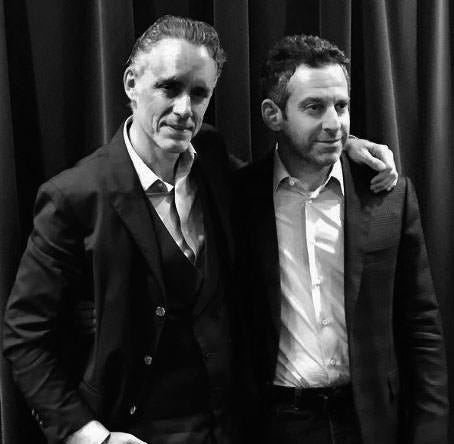
The purpose of this post is to allow listeners to re-examine the painful disconnect between two scholars, Sam Harris and Jordan Peterson. Both academics, now also media stars and Intellectual Dark Web heavyweights. These two scholars are worthy of our attention. My hope is to guide listeners to a new perspective from which to consider this series of debates on fact versus truth.
THE FORUM
For those unfamiliar with the above-mentioned debates, Harris and Peterson met on stage four times over a month during the summer of 2018 (Vancouver on June 23 and 24, Dublin on July 14 and in London on July 16). Harris, known for his hyper-realism, and Peterson, known for attachment to the defining role of myth and stories, struggled to find common ground.
According to Harris, “[Peterson and I] had two podcast interviews, and they were painful to one or another degree. We disagreed about some fundamental things and found it difficult to converge…” in The Independent. While a number of MEDIUM members have commented on these talks, I seek to provide a narrative frame to act as a cipher and thus bring these four dialogs into focus.

THE CONTESTANTS
Sam Harris is a neuroscientist, best-selling author, philosopher and host of the podcasts Making Sense and Waking Up. He has a reputation as one of the leading lights in both New Atheism and secular spirituality. Dr. Jordan B. Peterson is a professor of psychology at the University of Toronto, a clinical psychologist and the author of the multi-million copy bestseller 12 Rules for Life: An Antidote to Chaos. Over these well-attended events, they held a dialog consisting of an amazing display of intellectual honesty, the crisis of meaning, and how public intellectualism should be conducted if we are to find our way out of the maze generated by our Humanist Knowledge.

As humans, we are organized in social systems. It is human nature to put all data into context in order to tell a story, re-create the world by this means, and thereby be able to predict outcomes (causality). By participating and listening to ethical debates, we can allow the truth to emerge as a large number of flawed and limited minds battle it out. I am not aiming at the audience (those with power and influence in forming theory) but at the listeners (those for who the theory is about and should connect) with this post.
Back to the story….
Have you ever assembled a piece of IKEA furniture? What a crazy amount of screws, nails, pegs and unknown — can anyone really understand the directions?
To simplify the process and instructions, IKEA has a unique solution — driven by machine intellect — design and a need for a ‘flat-pack.’ All made possible to an assembly process using one simple tool, the HEX-KEY.

Understanding the world is analogous to the process of assembling a piece of furniture — you need tools and fasteners. The concept of WORLD, like furniture, is made of wood — the wood of the concept WORLD is humanity’s first artifact, LANGUAGE. We use this TOOL of language to construct the world in our minds and thereby be able to predict outcomes (causality).
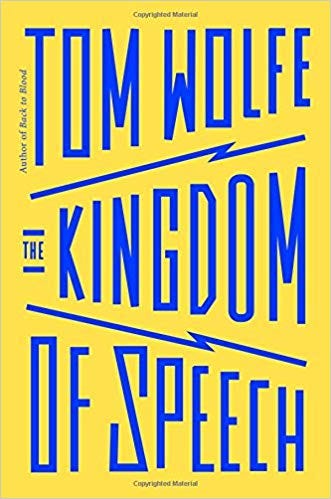
*Read The Kingdom of Speech, a critique of Charles Darwin (NOT Darwinism) and Noam Chomsky written by Tom Wolfe. Wolfe argues that speech, not evolution, sets humans apart from animals and is responsible for all of humanity’s complex achievements.
HUMANITY’S HEX-KEY — AGREEMENT ON A TOOL
Both Harris and Peterson spend most of their discussion on the common ground known as rational critical thinking. Reason is humanity’s supreme tool of survival. Without it, humanity must depend on those who use it. With it, humanity becomes a trader, neither claiming the unearned nor granting it.
So utile is Reason that we lose into the past our prior tools of Hammer and Screwdriver (see below). So expansive our self-work, we have covered and buried all that we had made with these first tools. OUR HAND BECOMES FIXED in our use of the HEX-TOOL. All else is forsaken, forgotten as if never having existed. As now we have words to arrange our thoughts, the use of any hand-tool becomes remembered as only the HEX-TOOL.
Nature makes a complete fool out of us. It uses intuition. A form of false knowing that is the source of our problems. The brain is a sense-making machine and relies on intuition when it has no alternative narrative. To battle intuition, we use storytelling. However, often we gain false knowing through a story (immersion in the narrative) as well.
Reason has given us so much when paired with science. I agree with Michael Shermer “the arc of the moral universe ‘is a long one’ but ‘it bends towards justice’ — Shermer argues that the rise of trade and rise of literacy through the Industrial Revolution’s need for highly educated knowledge workers, has created a “moral Flynn effect” and led to cultures with lower rates of violent crime.
The analytic HEX-TOOL is the ability to name and split the whole world into parts of your own choosing, split the parts and split the fragments of the parts, finer and finer and finer until you have reduced it to what you can use. You have to cut deep to get at the root of a thing.
Thus, in the passage of time, when civilization needs to rearrange a plank originally fastened with screw or nail, we pull out our master tool, the HEX-TOOL, and attempt to remove the fastener (screw/nail created in a pre-literate, possibly pre-Homosapien time). To our growing frustration, our master tool does not work!
WHY THE DISCONNECT?
For Harris (a man of the enlightenment and its domination of the material world), he considers IKEA to be all the furniture you need. Flat box stored, instructions without words and a single hexagonal tool needed for assembly. You can assemble any furniture you need (you can explain and live in the world). This world-view requires the use of only facts derived by the scientific method — empirical facts.
The only thing that permits human beings to collaborate with one another in a truly open-ended way is their willingness to have their beliefs modified by new facts. Only openness to evidence and argument will secure a common world for us. Sam Harris
For Peterson, assembling furniture can be done IKEA style, however, there are older more fundamental tools to use like:
HAMMER: THE NARRATIVE as THEORY

It is human nature to put all data into context in order to tell a story, re-create the world by this means, and thereby be able to predict outcomes (causality). Most individuals operate under an implicit societal narrative that they are unable to change on their own. Humans rarely abstract general principles from examples, therefore, we use STORY (a narrative construct rich in retrieval cues, i.e., making use of associations) to help identify and formulate the common strategies and methods that underlie critical thinking. Harris and Peterson could not agree on whether only FACTS can be TRUE, therefore, could not join a common narrative.
There are truths of drama and literature, and there are material truths of science. But there are times when those two align and they’re true literally and metaphysically, literally and metaphorically at the same time. Jordan Peterson
SCREWDRIVER: EVOLUTIONARY PSYCHOLOGY (across 3 billion years)

Evolutionary psychology is a theoretical approach to psychology that attempts to explain useful mental and psychological traits — such as memory, perception, or language — as adaptations, i.e., as the functional products of natural selection.
“There is an unspeakably primordial calculator.” To prove his point, Peterson uses the example of lobsters, which humans share a common evolutionary ancestor with. Peterson argues “like humans, lobsters exist in hierarchies and have a nervous system attuned to status which runs on serotonin.” Jordan Peterson

USE OF THESE OLD TOOLS: CONSILIENCE
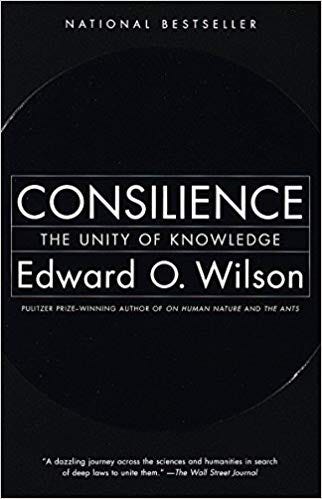
The principle of consilience of findings was popularized by E. O. Wilson in his 1998 book Consilience: The Unity of Knowledge.
For example, the theory of evolution is supported by a convergence of evidence from genetics, molecular biology, paleontology, geology, biogeography, comparative anatomy, comparative physiology, etc.
Peterson uses the combination of these tools (Narrative & Evolutionary Psychology) to explain many of the challenges society faces in the current Humanist Age.
You may say, ‘Well, dragons don’t exist.’ It’s, like, yes they do — the category ‘predator’ and the category ‘dragon’ are the same category. It absolutely exists. It’s a superordinate category. It exists absolutely more than anything else. Jordan Peterson
A wonderful example of this emergence built upon a pre-existing system is the role of the biological disgust mechanism in social interactions as discussed with Jonathan Haidt and Steven Pinkner — Jordan Peterson: The Psychology of Disgust with Steven Pinker and Jonathan Haidt. In addition to its role in helping to expel harmful foods from the body, disgust also forms an important component of the behavioral immune system, the suite of psychological mechanisms that aid in the detection and avoidance of potential contaminants before they can make contact with a community.
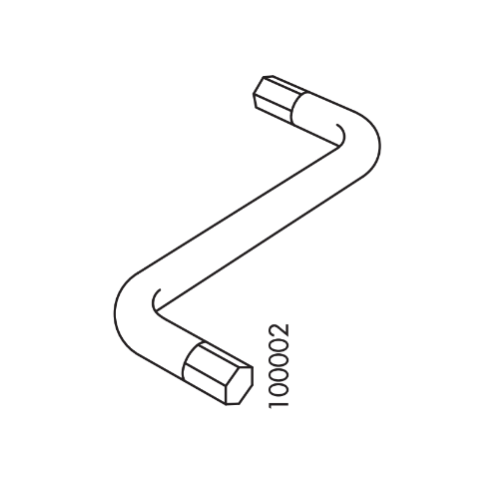
THE HEXAGONAL UNI-TOOL!!
Of all our human tools, reason is the last acquired and most valued (it developed — after observation, instruction, and memorization). There is a danger of relying upon only one tool…
In narrative, Reason is Sapientia. SEE BELOW from 1600s.
Sapientia (Wisdom), as reason personified, sits opposite Fortuna (Fate/Infinite).
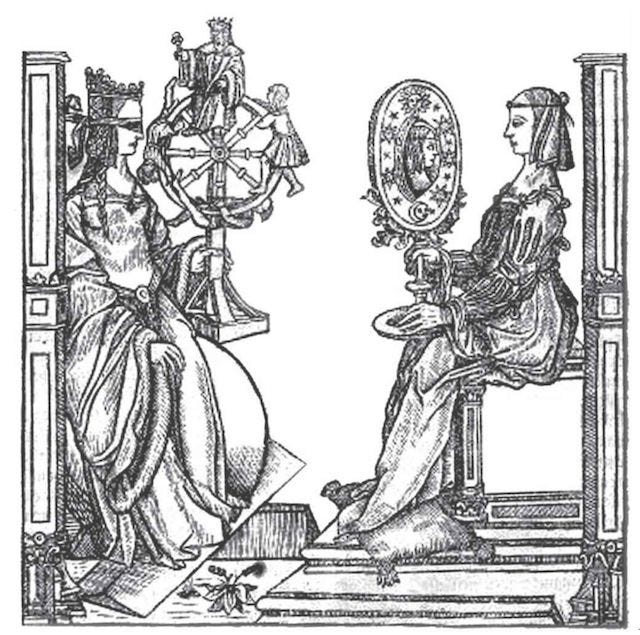
The goddess of quantifiable reason, Sapientia the calculating and vain deity of science, gazes into a hand-mirror, lost in admiration of herself. Also clad in opulent raiment, she stares into an oval mirror of reason with a circular pedestal, lost in admiration of her self-brilliance. An allegory of the danger of omniscience, do her choices have inherent correctness? With knowledge, nothing is hidden on an oval…
SAPIENTIA’s most exceptional power and greatest threat is her own capacity for self-recognition and self-admiration — endless capacity for pride — presuming omniscience. That is why she is looking into the mirror.
SAPIENTIA has good reason for self-admiration. With science’s development of empirical facts using the scientific theory spurred by the Enlightenment, SAPIENTIA has shrunk FORTUNA’s domain.
HOW MUCH?
Before you consider the domain of empirical FACTS to have been fully explored, consider this simple reality: UNCULTURABILITY.
We are grossly ignorant of bacterial life on earth. Environmental microbiologists estimate that less than 2% of bacteria can be cultured in the laboratory….For example, the colonic microflora is suspected to be predominantly unculturable. It is therefore likely on numerical grounds alone that unculturable and therefore uncharacterized organisms are responsible for several oral and other human infections. A known instance is syphilis, caused by the spirochaete Treponema pallidum, which remains unculturable today. Journal of the Royal Society of Medicine

Since science does not provide a mechanism to grow 98% of bacteria in a Petri dish, we ignore it.
Civilization advances by extending the number of important operations that we can perform without thinking about them. All things that we “know” no longer demand our attention. To know something is to do it automatically, without thinking, to categorize it at a glance, or to ignore it entirely. The nervous system is “designed” to eliminate predictability from consideration and to focus limited analytical resources where focus would produce useful results.
Much of our confidence in the continued advancement of civilization comes from the belief of a physical universe known and understood based on our use of the Scientific method. It is a theory. In modern science, the term “theory” refers to scientific theories, a well-confirmed type of explanation of nature, made in a way consistent with scientific method, and fulfilling the criteria required by modern science. In other words, a narrative we all accept. Forgotten is that it explains very little of our physical existence (in the realm of bacteria, about 2 percent).
Both Peterson and Harris are bogged down in a battle between FACT/TRUTH when the heart of the discussion should be USEFUL KNOWLEDGE. To take a deep dive into USEFUL KNOWLEDGE, consider listening to David Deutsch’s A New Way to Explain Explanation (The TED Interview) or Finding Our Way Through the Cosmos (Making Sense podcast with Sam Harris).
If you wish to understand the old tools favored by Peterson, I suggest you read Map of Meaning:
We each inhabit a story, describing where we are, where we are going, and the actions we must undertake to get from the former to the latter. These inhabited stories are predicated on an underlying value system (as we must want to be where we are going more than we value where we are). In addition, they are frames of reference, allowing us to perceive (things that move us along; things that get in our way), make most of the world irrelevant (things that have no bearing on our current frame), and determine emotional significance (positive: things that move us along; negative: things that get in our way). Jordan Peterson
To appreciate Harris’s view of such old tools, consider this quote from the endnotes of his book The End of Faith and intends it to be a counter-example to Joseph Campbell’s work on mythology.
He walked into a bookstore, randomly grabbed a book called A Taste of Hawaii: New Cooking from the Crossroads of the Pacific.
Here’s what Harris wrote in the end-note. And therein I discovered it as yet uncelebrated mystical treatise. While it appears to be a recipe for seared fish and shrimp cakes with tomato relish, we need only study list of ingredients to know we are in the presence of unrivaled spiritual intelligence. Then I list the ingredients: One snapper fillet cubed, three teaspoons of chopped scallions, salt, and freshly ground pepper… there’s a long list of ingredients. Then I go through with a mystical interpretation of this recipe. The snapper fillet is the individual himself. You and I, awash in the sea of existence, and here we find it cubed which is to say that our situation must be remedied in all three dimensions of body, mind, and in spirit. They have three teaspoons of chopped scallions, this further partakes of the cubic symmetry suggesting that that which we need add to each level of our being by way of antidote comes likewise in equal proportions. The import of the passage is clear: the body, mind, spirit need to be tended with the same care. Salt and freshly ground black pepper; here we have the perennial invocation of opposites. The white and black aspects of our nature. Both good and evil must be understood if we would fulfill the recipe of spiritual life. Nothing, after all, can be excluded from the human experience. This seems to be a tantric text. What is more, salt and pepper come to us in the form of grains which is to say that the good and bad qualities are born at the tiniest actions and thus we’re not in good or evil in general but only by virtue of innumerable moments which color the stream of our being by force of repetition. Then this dash of cayenne pepper: clearly a being of such robust color and flavor signifies the spiritual influence of an enlightened adept. I go on and on and this is all bullshit because it’s meant to be bullshit.
If you like this article and want to read more such articles without any restrictions, why not consider becoming a Medium member (if you are not one already) by using my referral link below?
I get a portion from your monthly fee at no extra cost to you and it will go a long way in supporting me as a writer.