
Facing the Powerful despite Feeling Powerless
Dads’ Survival Guide: Possibilities
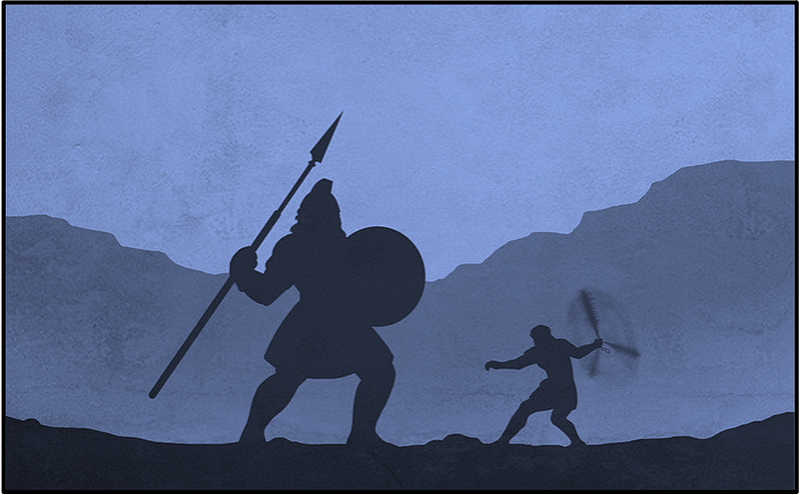
Goliath never stood a chance.
That’s the conclusion of author Malcolm Gladwell in his assessment of the epic confrontation between the Philistine giant and an Israelite shepherd boy named David.
A boy of 15. Maybe. Who tended sheep. Representing his Jewish brethren. With no protection. Or armaments. Besides a handful of stones. Squaring off against a grizzled warrior. Standing 6 foot 9. Decked head to toe in bronze armor. Wielding massive weapons. Including a shield-piercing spear “as thick as a weaver’s beam.”
Dads can relate to David. Walking into daily battles. With odds stacked against us. Confronting powerful forces. While feeling powerless.
Our kids, as well. Face to face with daunting circumstances. Against the giants of life. When one must choose to go forward. Or shrink back.
Teaching our children how best to look at these situations can make all the difference. Helping them see the opportunities. Rather than just the obstacles.
The Giant
The underdog theme of David vs. Goliath is familiar to Dads. Cited in countless movies. Coaches speeches. Movies about coaches’ speeches. Yet, the real story is often misunderstood.
The Philistines were invaders from Crete. On the march to Jerusalem, their army took a southern ridge of the Elah Valley. King Saul and his ragtag band of Israelites assembled on the northern edge. An attack by either side across the ravine and up the incline would be suicidal. So, as customary, the Philistines sent out their best warrior. To square off one on one. For the winner went the battle.
“Come to me.” For forty days, Goliath challenged his opponents from the floor of the valley. Mocked and derided them, mostly. As the Israelites huddled in fear. Terrified. With no man willing to fight such a dangerous foe.
“Saul and the Israelites think they know who Goliath is,” notes Gladwell. “They size him up and jump to conclusions about what they think he is capable of. But they do not see him.”
This is the mistake so many of us make. We encounter giants. Make assumptions. Jump to conclusions. Frighten ourselves. Then choose a course of action. Or inaction.
Also, we fail to notice important clues. In this case, Goliath’s weaknesses. Immobilized by hundreds of pounds of armor. And mostly blind. A common affliction among giants of his size.
“The powerful and strong,” wrote Gladwell. “Are not always what they seem.”
The Underdog
Nor the underdogs.
David was in fact, just a kid. A small, yet confident kid. Unlike his countrymen, he was not awed by the giant. Arriving from Bethlehem to deliver food for his brothers, David volunteered. Stepping forward to contest Goliath on behalf of his nation.
Saul objected. “You are a lad, and he is a man of war from his youth.” The youngster remained steadfast. “When the lion or the bear would come and carry off a sheep,” said David. “I would strike him down and rescue it from his clutches.”
Saul relented. Then tried dressing David in proper armor. He refused. Why? How could David stand a chance against such a heavily armed adversary?
Technology.
A Different Fight
When David appeared, Goliath was insulted. “Am I a dog? That you should come at me with sticks?” He was expecting another warrior. Similarly outfitted. For close, hand-to-hand combat. Where size, brute strength and battle experience would prevail.
David had no intention of engaging in traditional head-on conflict. As Goliath preferred. David was a slinger.
He killed the lion and the bear with a slingshot. A crude weapon. Yet, deadly. Skilled marksmen “could sling a rock and hit a target within a hairs breadth without missing,” according to Old Testament scripture. And David honed his aim hour after hour while minding the sheep.
With just a sling and five stones, David ran down the ridge to meet Goliath. “You come at me with sword and spear,” he shouted, “but I come against you in the name of the Lord Almighty, the God of the armies of Israel. This day the Lord will deliver you into my hands.”
The underdog. Confident in his skill. And cunning. Assured that the Lord was with him.
Unfair Fight?
On the surface, this seemed like an unfair fight. And it was. Contrary to the traditional viewpoint, David held the upper hand. “Goliath had as much chance against David,” noted historian Robert Dohrenwend, “as any Bronze Age warrior against someone armed with an automatic pistol.”
Reminds me of the infamous ‘Raiders of the Lost Ark’ scene. Crowds in the Cairo marketplace circled up as an Arab Swordsman with his massive scabbard challenged Indie. Calmly, Jones whipped out his pistol and shot him. Fight over.
Same with David. He sprinted into the Elah Valley. Whirling his sling. Then hurled a projectile with precise accuracy. Striking Goliath in the temple. Felling the giant. Boom. Done.
Defeating the Giants
“This duel reveals the folly of our assumptions about power,” writes Gladwell. Adding that too often, we attribute the advantage to physical might.
Sure, Goliath was big. And ferocious. Yet, weighed down by heavy armaments. And basically blind. David was small. Nimble. Skilled. And savvy.
“Power can come in other forms,” Gladwell concludes. “In breaking the rules, in substituting speed and surprise for strength.”
Dads face plenty of giants in our lives. Financial. Relational. Parental. Past mistakes. Frailties. Addictions. External monsters. And internal demons. Holding us back from life-long dreams. Of the future. Or just making time. To be present. For our families. Today.
Too often we envision these Goliaths as bigger than they are. While imagining ourselves smaller than we can be. Our assumptions about power are skewed. Victory more conceivable than we think. Whether we rely on favor of the Lord. Or just individual talent. Grit. And ingenuity.
This is the lesson for our kids.
Life is full of powerful, intimidating adversaries. Encounters, made more dangerous in our own minds. Leaving us feeling small. Powerless. But guard against hasty assumptions. Stereotypes. Or generalities.
Don’t dwell on our shortcomings. Or limitations. Instead, look at the openings. Opportunity. And the sense of hope we can each garner from everyday possibilities.
Go, Dads. Go.


