
Facilitating Healthy Storming
Some teams form and norm skipping storm, and consequently perform mediocrely. Other teams storm badly and norm chillingly with low team trust.
The key is in facilitative leadership and in this Mental Model Dōjō community session we discussed the professional topic of how to help Agile teams, or any team, go through a healthy Tuckman process of forming, storming, norming, performing.
Here’s a replay of the session.
※ View session participant Michael Ong’s notes ※
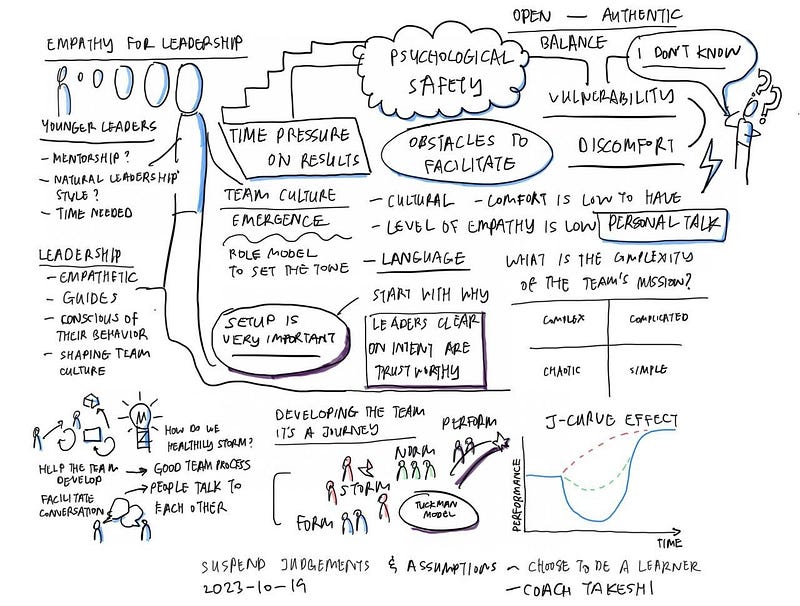
※ Join our next Mental Model Dōjō community session (free) from here: https://agile-od.com/community-events ※
Transcript
The late organizational psychologist Bruce Tuckman coined the group and team forming stage concept of forming, storming, norming, performing, and correctly adjourning, back in 1965. While there are criticisms to this model as overly simplistic and linear in its description, I find this concept useful and congruent to my own experience of supporting team development.
Particularly, I find critical importance in the storming stage. Some teams form and norm skipping storm, and consequently perform mediocrely. Other teams storm badly and norm chillingly with low team trust.
The key is in facilitative leadership, and in this session I’d like to share a few tips on how to get that going with newly formed teams, and how to reboot that process with teams that have gone stale.
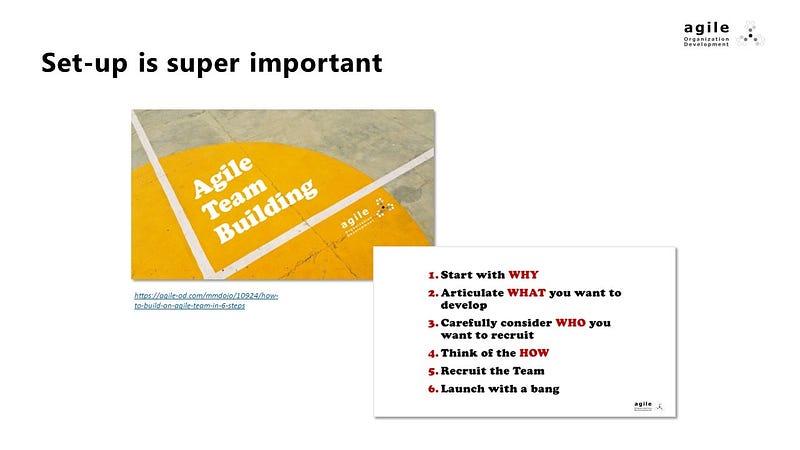
First, set-up is super important in forming a team. Ideally speaking, like a startup if there could be one or two founders with a desire to do something great and they drive a process of recruiting a team with a powerful why, what and how, that would be great.
However, in the corporate innovation context, often cases project teams are formed at the directive of a sponsoring leader, and both team leads and members are appointed rather than recruited. In this case, the team forms in a “we were called in so here we are” way rather than in a more powerful “we’re here because we want to do this something” way.
Nonetheless, it is still possible to go through a powerful forming process even with “called-in” teams if the effort is made. The key is in generating and forming a shared ambition; a joint sense of mission.
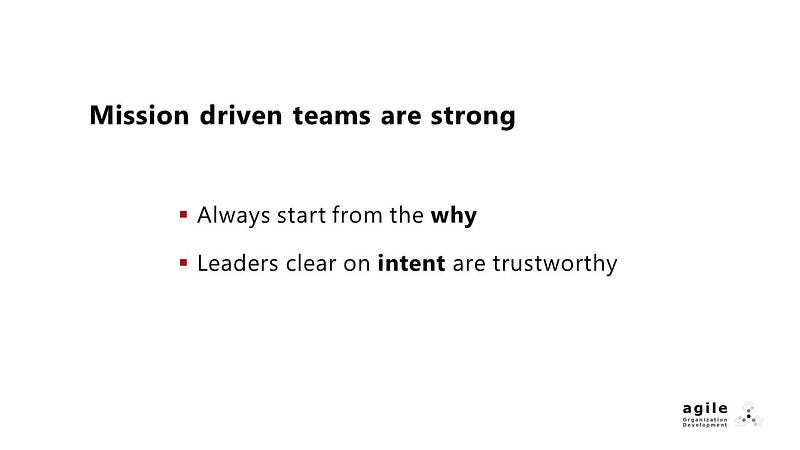
And it’s important because mission driven teams are strong. They go a long way if that sense of mission is authentic, realistic and persistent.
So always start from the why.
And if you are the leader of such newly formed teams, make a big effort on being consistent on communicating your intent, over and over. Because leaders who are clear and consistent on their intent, i.e. clear on why we are doing what we are doing and how we are doing, they are perceived as trustworthy by team members. And trust is a key factor of a team’s survivability, I’m sure no one will doubt.
That was the “why” of the teamwork, and now let’s put the focus on the “what”.
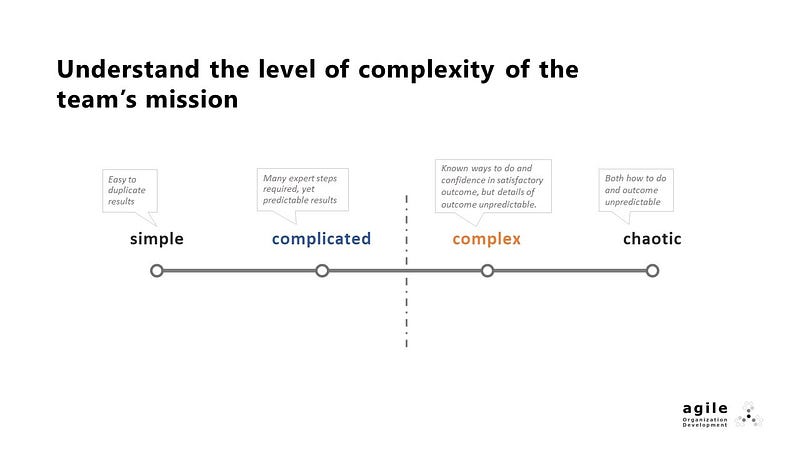
Simple, complicated, complex, chaotic, this is David Snowden’s Cynefin framework. If the team’s work is going to be somewhat within the complicated zone, then it’s okay to focus on setting up team processes for efficiency and execution quality, because while it still most likely will be intricate work with many expert steps to take, the work is of predictable outcome nature.
Meanwhile, if there is uncertainty in the what and how of the work, then the work is exploratory in nature and it’s in the complex zone. In this case, unless the leader has a crystal ball, they won’t be able to tell with certainty what to build, and therefore rely on the team through a process of trial and error and iteration, figure out what to build.
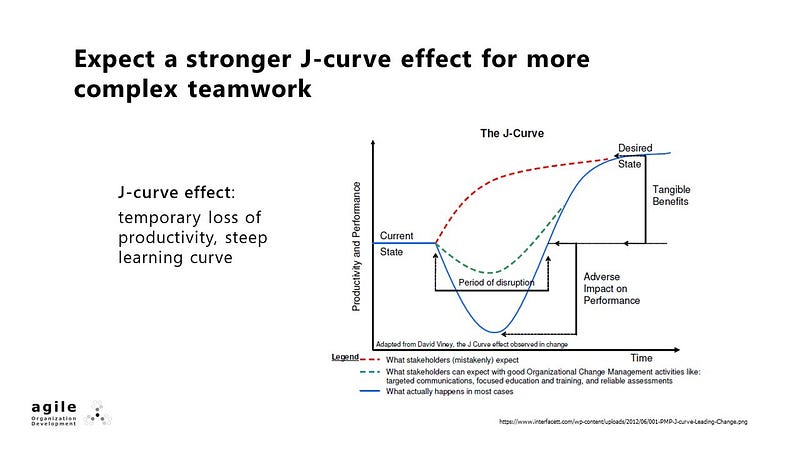
Since the team is working on something complex, there is a learning curve on figuring out what to build. Further, if this is a first time formed team, they are also figuring out how to build things together for the first time.
So there’s a learning curve on both the what and the how, and during this period, the team won’t be productive. This phase of low or negative productivity is called the J-curve effect, and the more complex the team’s challenge is, the steeper the J-curve will be.
Leader’s will need to be aware of this initial pain ahead of performance and manage stakeholders’ expectations accordingly. Stakeholders are always impatient for results, so this is a subtle yet very important job for the leaders to manage.
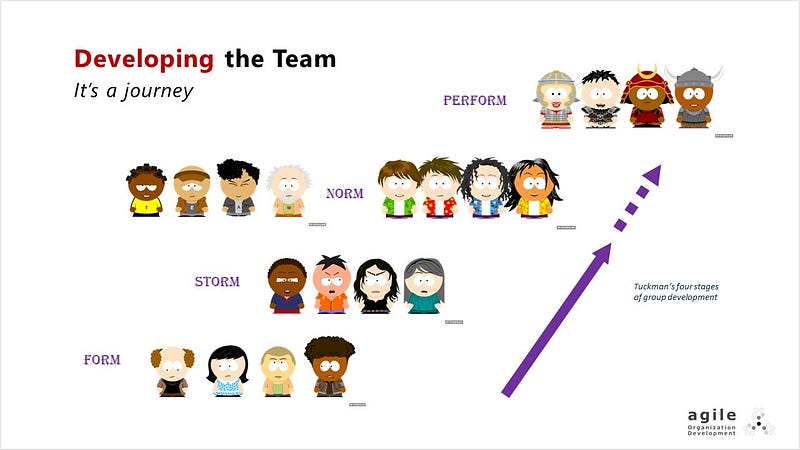
So again, form, storm, norm, perform.
Set-up well to form, and storm healthily and persevere the J-curve, otherwise the team will norm mediocrely and won’t realize it’s real potential for performance.
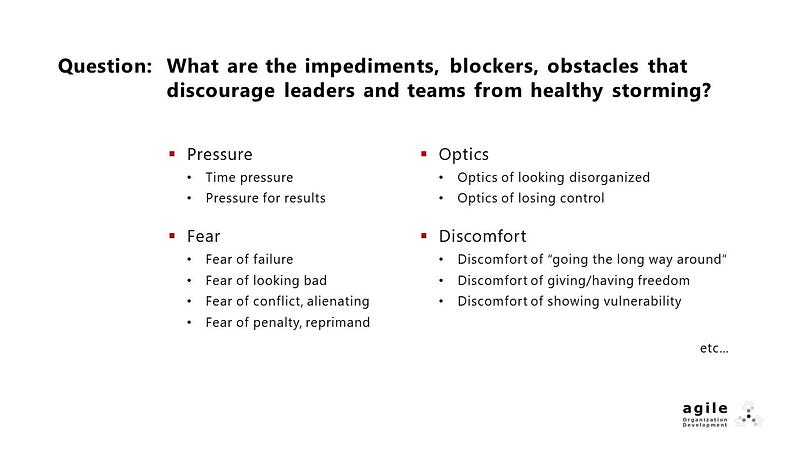
Therefore healthy storming is key. But storming is painful, and the temptation to avoid storming all together is so strong. In our dōjō session, I paused to ask this question of “What are the impediments, blockers, obstacles that discourage leaders and teams from healthy storming?” Here’s the summary of what came out from our discussions.
First there’s the pressure; pressure for time and pressure for results. Again, impatience is kicking in here.
And then there is fear; fear of failure, fear of looking bad. And fear of conflict and alienating others — how can we be adults when discussions heat up? I wouldn’t want to be perceived as a confronting and difficult person to work with!
And fear of penalty or reprimand — which again ties into bad optics. From the outside the team may look disorganized and the leader is losing control. If a stakeholder walks up to the leader and the team, “What the hell are you guys doing? Get yourselves organized!”, what can you do?
It takes a gutsy leader and a devoted team to “go the long way around” and fight back this optics with a “Trust us, we know what we’re doing, it’s a necessary pain in the process” statement. Going this way is seriously uncomfortable.
Meanwhile, there are other discomforts too. Instructive leadership is in a sick way, actually comforting. It’s simple for the leader to tell people what to do and likewise easy for team members to just do what’s been told — the lazy mode in us wants it because it’s comfortable. Empowerment in truth can be tiring; releasing the grip of control is a struggle with many leaders, and on the recipient’s end, some may find having freedom burdensome.
And finally, the discomfort of showing our vulnerabilities. Admitting to the team that I don’t know what to build and how to build, that would make me look like a weak leader! A leader has to look confident and in control! Departing from this old self image of a good, strong leader is often a big hurdle in becoming an agile leader. It’s seriously uncomfortable.
As you saw, storming is seriously uncomfortable. And in an office setting where everyone is expected behave nicely, storming often doesn’t happen or happens in a very subtle, benign way.
So, leaders will need to make an intentional effort to encourage storming. Leaders will also need to manage the risk of unhealthy storming, i.e. the type of storming that breaks trust.
Instigating healthy storming, it’s intricate business. It’s an art, an elevated leadership skill.
Here’s my version of how I tackle this complex challenge. After getting lost so many times, I’ve come to the realization that I have to keep it stupid simple. It’s a paradox, radical simplification for complexity handling, but it works for me so here’s the share.
My motto for team management is “Functioning and performing teams have two simple traits: there’s a good team process in place, and people talk to each other.”
When I say good team process, I mean team codes, norms, rituals etc., not just team rules and processes that were given to them but things that emerged naturally and organically after team members started figuring out how they can work together. So it’s “their” team process that they own and abide to.
And when I say people talk to each other, I’m talking about real conversations, not position talks but conversations, dialogue where team members are speaking with each other with a genuine desire for mutual understanding. I’m listening to you attentively because I really want to understand you, that kind of real conversations.
Two simple character traits but both are things we don’t often see, right? Yes, that’s why high performance teams are hard to come by.
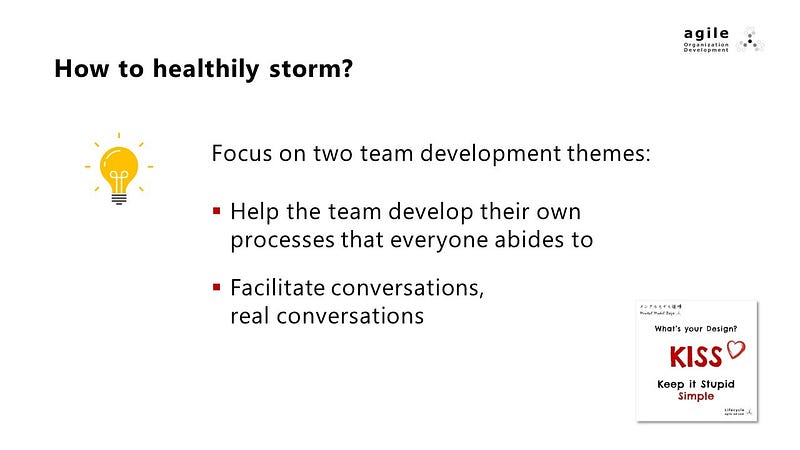
So with these two key team character traits as targets, as leader my focus for facilitating healthy storming will be just twofold:
- Help the team develop their own processes that everyone abides to, and
- Facilitate conversations, real conversations
Nice and simple right? Just sticking with these two guideposts, I have decent success in helping teams storm nicely.
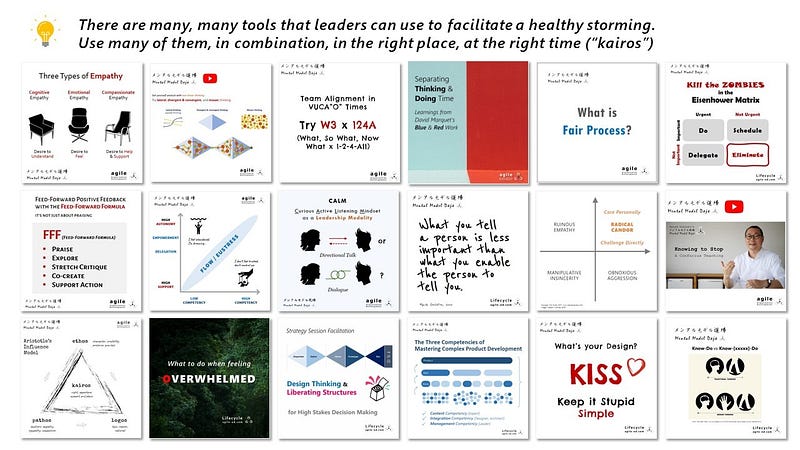
In actuality, I use many, many tools in combination to facilitate the development of the two target process and behavioral character traits of a performing team.
But it’s not confusing because it’s a cascade. Just really attentively listen to the team, and when you think it’s helpful, pull out any mental model that you find most useful for the team at that time and place (which is “kairos” in Aristotle lingo).
Again, this itself is a process of trail and error. Be courageous, and help your teams storm healthily.
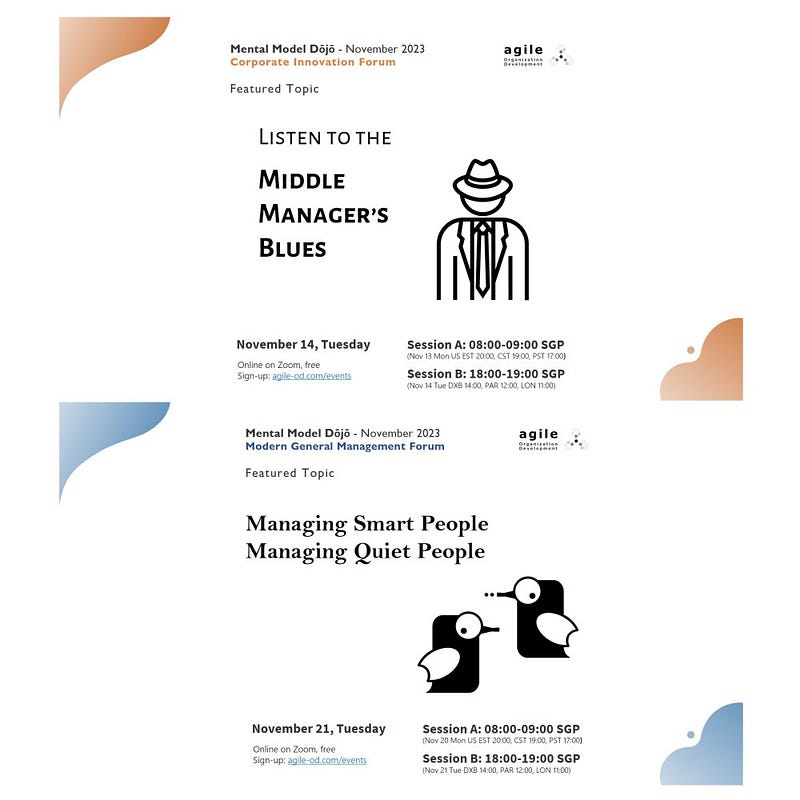
Enjoyed the session replay? If so, join our next Mental Model Dōjō sessions: https://agile-od.com/community-events
https://agile-od.com/community-events
※ About the Mental Model Dōjō ※
We’ve got to have many mental models in our head, and array our experiences on a “latticework” of mental models, says Charlie Munger. OD (Organization Development) in today’s context is nothing but complex. There’s no magic bullet singular solution to the many challenges that leaders and teams face in day-to-day work. We need a multiplex of tools, approaches, frameworks, i.e. mental models.We created the Mental Model Dōjō learning community at Agile OD to foster lifelong learning for our current and alumni clients, and to invite anyone with the learning mindset to explore and experiment the many cognitive tools, thinking frameworks, communication approaches, collaboration modalities and, simply put, philosophies created by the great minds of old and new.
※ About Agile OD ※
We are a tribe of expert coaches, trainers and facilitators that help leaders, teams and organizations adapt to the rapidly evolving world with the power of learning. (agile-od.com)


