
Facebook — The Biggest Brother in Town?
Exploring the antitrust case against Facebook — Has Mark Zuckerberg created an unprecedented monopoly?
By Nathan Menezes
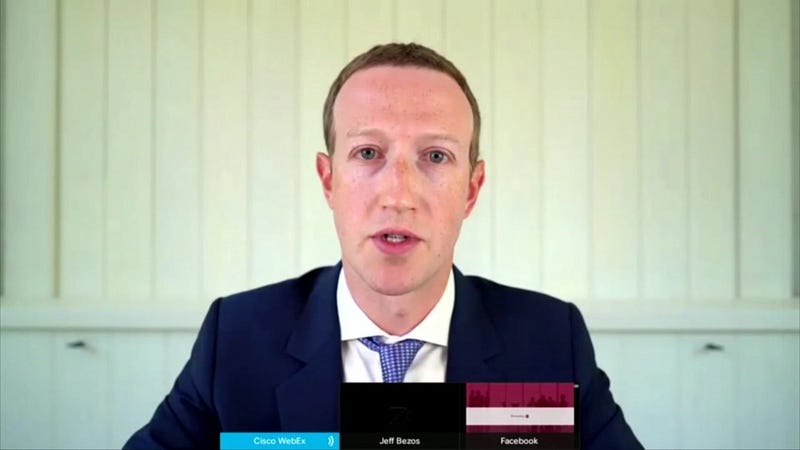
Facebook has grown to become an indispensable part of our everyday life. The story of its exponential growth is one which needs no reiteration, from turning down $1 Billion to being presently evaluated at $635 Billion, Mark Zuckerberg has amassed billions of users all over the globe. However, it is no secret that the social media giant has been facing growing public scrutiny, most recently facing a Congressional hearing alongside Apple, Google and Amazon, on the 29th of July, which explored an antitrust case on the tech giants. The platform was also subject to an ‘Ad Boycott’ by corporate giants such as Coca-Cola, Microsoft, Starbucks, Sony, and Target, as a result of Facebook allegedly allowing hate groups to flourish across its social network. In 2019, Facebook Co-Founder, Chris Hughes, joined a plethora of voices which appealed to regulatory agencies to implement antitrust authority to or even “break up” the ever-growing corporation. Hughes holds the opinion that the move is necessary to prevent the more sinister effects that emerge from social media platforms, including but not limited to the spread of fake news and public disinformation. The questions which arise are whether Facebook is, in fact, a monopoly, and if so, what are the insidious consequences of such a market structure.
In 2018, Zuckerberg faced a congressional hearing on account of the infamous revelation that data from 87 million Facebook users were inappropriately utilized by data firm Cambridge Analytica. Apart from highlighting the increasing concern over the use of citizen’s data in elections all around the world, the hearing explored the claim that Facebook had formed a monopoly over the industry. On being asked “Who’s your biggest competitor?” the Facebook CEO struggled to form a concrete answer to a seemingly simple question; Zuckerberg went on to answer that the “average American uses eight different apps” on a daily basis in order to connect to their friends. Although the Founder didn’t mention the names of these apps, on further inspection, it is seemingly evident that 4 of these 8 applications are owned by Facebook. Move forward to 2020 and Zuckerberg’s opening statement at the congressional hearing claimed “The most popular messaging service in the U.S. is iMessage. The fastest-growing app is TikTok. The most popular app for video is YouTube. The fastest-growing ads platform is Amazon. The largest ads platform is Google,”
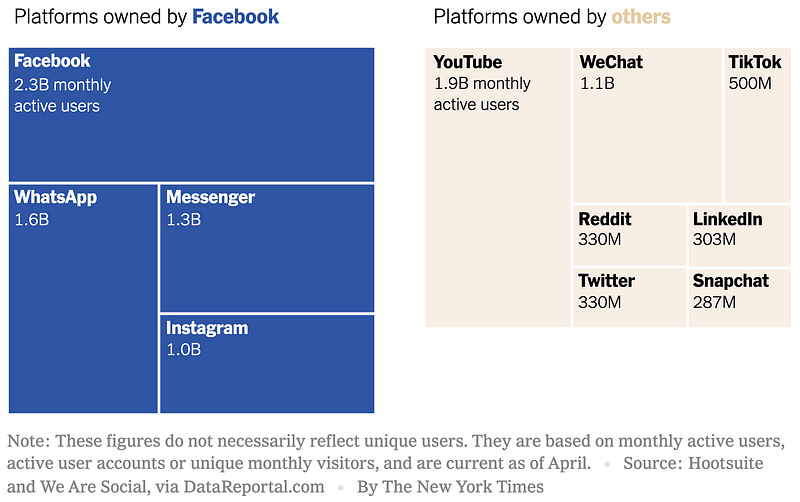
To explore whether Facebook qualifies as a monopoly, we can utilize the broad principles from the traditional competition and antitrust policy analysis, in which policymakers consider the economic circumstances of the industry in a stepwise manner. The primary step would be to determine whether the industry the company functions in is competitive. The Justice Department’s Antitrust Division and the Federal Trade Commission usually determine this by considering the market share the company holds in the industry. No official limit to the market share held by a single company exists, but the FTC usually refrains from scrutinizing a company for monopoly power if it occupies less than 50 percent of a market, on the other hand, the lowest-ever market share determined to result in monopoly power by the European Commission was 39.7 percent. In the case that the industry is competitive, it is left alone. However, if it isn’t (as seems to be the case for Facebook), then one must proceed to the next step.
When this is applied to Facebook, it is difficult to isolate an accurate description of the industry the company operates in due to rapid changes in company’s holdings and technological features which result in a change in the overall sector. Messenger, WhatsApp, Instagram, and Facebook as applications cover social media, photo sharing, and messaging, among other industries. Experts contend that in the United States at the minimum, Facebook has a dominating presence in each of its consumer areas of activity. This suggests that the primary markets in which it operates services are indeed no longer competitive.
In order to move a competition policy inquiry forward in the United States, the company being scrutinized must also be shown to use their dominant market position to exploit the consumer, the judicial system over time has interpreted this to mean a hike in prices charged to consumers. It is argued that companies such as Facebook and Google are not guilty of exploitation, because consumers are not charged money for access to even the highest revenue-generating services such as social media and search. At Mark Zuckerberg’s 2018 congressional hearing, on being asked how the service plans to makes money without charging customers a fee, he famously responded: “Senator, we run Ad’s.”
Facebook generates its massive revenue from targeted advertising, which means users do not pay to use the service. Nevertheless, it is not free and Chris Hughes claims it is certainly not harmless. The business model meticulously crafted by Zuckerberg thrives on maximizing the attention its platforms capture from its users. The applications aim to encourage users to increase the amount of data and information they share about themselves, along with tracking every minute detail of your interaction with its platforms, such as the amount of time spent on a certain post or page. The fee we pay to use the platform is our data and our attention, and neither come cheap. In light of the market concentration displayed by companies such as Google and Facebook, one could claim that firms which collect such large amounts of data and exploit so much of our attention in such invasive and questionable manners are responsible for systematically exploiting its customers. Dipayan Ghosh, the author of Terms of Disservice explains the systematic exploitation of Facebook’s users as:
“These firms are two-sided platforms that have monopolized the consumer side; accordingly, they extract the end consumers’ currency on one side of the platform at extortionate monopoly rates, and exchange it for monetary revenue at tremendously high margins on the other side of the platform.”
This is the subtle but perilous form of exploitation which must be duly noted by regulatory agencies and bodies. It is important to also discuss Google’s performance in the targeted ad industry, as it is often used as an argument to disprove Facebook’s alleged monopoly. Facebook is nothing short of a major player in internet advertising, but it’s still outdone by Google. Facebook’s ad revenue grew 49% to $39.9 billion in 2017, whilst Google’s ad revenues increased by 20% to $95.4 billion. One can claim that Google and Facebook hold a duopoly in internet advertisements, but it seems inaccurate to claim Facebook has a monopoly. However, naming ‘Internet Ads’ as the industry which Facebook operates in is a gross misrepresentation of the platform. Thus, it is a weak claim.
The third step to determine whether a company is a monopoly is to determine whether budding entrepreneurs and other firms can compete in the industry. Instagram’s founder Kevin Systrom told an investor he feared Facebook CEO Mark Zuckerberg would go into “destroy mode” if he didn’t sell him the business, according to Rep. Pramila Jayapal, D-Wash., citing documents uncovered by the House committee’s investigation. This is where Hughes insights into the mindset and culture at Facebook prove to be of unparalleled importance, he claims that Facebook’s domination is not an accident of history but is an outcome achieved through systematic practices in order to maintain and further Facebook’s omnipresence. The Co-Founder claims that Facebook’s strategy was to beat every competitor in plain view, and regulators and the government tacitly — and at times explicitly — approved. WhatsApp & Instagram were both emerging as threats to Facebook, WhatsApp was successful in penetrating the instant messaging market whilst Instagram was proving to be a worthwhile competitor in the photo-sharing sector. Zuckerberg responded to these threats by acquiring both the platforms. WhatsApp had virtually no profit-generating mechanisms but is now highly responsible for driving the company’s progress. The founders of both WhatsApp and Instagram are now no longer part of the organization, owing to professional differences.
In scenarios where acquisitions have not been possible or do not prove as beneficial, Facebook has made use of its superior position in the industry to either strong-arm other platforms into failure or have proceeded to mimic their technology. Chris Hughes explains in a New York Times Article how Facebook tackled Vine, a video sharing and content creating platform which initially gained extremely high traction and is responsible for the fame of numerous YouTube stars.
“The News Feed algorithm reportedly prioritized videos created through Facebook over videos from competitors, like YouTube and Vimeo. In 2012, Twitter introduced a video network called Vine that featured six-second videos. That same day, Facebook blocked Vine from hosting a tool that let its users search for their Facebook friends while on the new network. The decision hobbled Vine, which shut down four years later.”
According to WIRED Magazine, there exists an informal slogan at Facebook: ‘Don’t be too proud to copy.’ This arose after Snapchat began to emerge as a popular platform for photo-sharing, the application’s success was largely due to its ‘Stories’ feature, which Facebook went on to mimic and duplicate on both Facebook and Instagram. Instagram now even has a feature which allows users to send images which disappear after viewing them. The result of this business practice is the inability for competitors to raise money to compete with Facebook, investors are aware of Facebook’s capability to replicate and better technology, eventually wiping out the competition. This is a phenomenon which occurs when digital industries are largely dominated by one power, it results in a lower number of startups due to power being concentrated in the hands of few. This can also be observed with Amazon and Jeff Bezos’ growing empire. It is therefore often said that the consumer internet sector is a kind of natural monopoly. A natural monopoly is a type of monopoly that exists due to the high start-up costs or powerful economies of scale of conducting a business in a specific industry. Further, companies like Facebook and Amazon display network effects, which means the value of the services offered by the companies increase when more users are active on the application. However, natural monopolies typically exist in industries where the service offers public benefit or is an essential service such as water supply and gas, Facebook is far from fitting into either of the two.
Perhaps the most terrifying element of the power Mark Zuckerberg has amassed is Facebook’s control over speech. Hughes went on to write, “In 2014, the rules favoured curiosity-inducing “clickbait” headlines. In 2016, they enabled the spread of fringe political views and fake news, which made it easier for Russian actors to manipulate the American electorate.” Facebook responded to this growing concern by hiring independent contractors to moderate the content and decide which videos count as hate speech or free speech, which images are erotic and which are simply artistic, and which live streams are too violent to be broadcast. These attempts have been largely unsatisfactory and there has been a growing outrage with Facebook’s inability to check and control hate speech being shared on the platform, this has led to amounting pressure on numerous large corporations to boycott the utilization of Facebook ads. On the other hand, some believe that even attempting to moderate the content on the internet is an infringement upon ones right to freedom of speech. In an interview with Vox, Zuckerberg mentioned an occasion which is a reflection of Facebook’s power over speech and communication, he stated that he personally decided to delete the private messages of Facebook users who were encouraging genocide there. “I remember, one Saturday morning, I got a phone call,” he said, “and we detected that people were trying to spread sensational messages through — it was Facebook Messenger in this case — to each side of the conflict, basically telling the Muslims, ‘Hey, there’s about to be an uprising of the Buddhists, so make sure that you are armed and go to this place.’ And then the same thing on the other side.”Mark made a call: “We stop those messages from going through.” Though most would agree that this was a morally correct call, it is frightening to see that Facebook had the power to make this decision with no accountability towards any governmental or regulatory agency. This could suggest that in theory, Mark Zuckerberg has the power to prevent the masses from seeing various messages if the leadership doesn’t approve of the content. Mark is aware that this grants him an excess of power. As a measure to control this power, he is tilting Facebook’s focus toward emphasizing more private, encrypted messaging that Facebook’s employees can’t see, let alone control. Further, he proposed an independent commission to handle difficult content moderation decisions by social media platforms. It would afford an independent check, Mark argued, on Facebook’s decisions, and users could appeal to it if they disagreed. But its decisions would not have the force of law, since companies would voluntarily participate.
This trend towards excessive concentration in the hands of a few juxtaposes the very essence of the “free-market” dictum (which vouches for greater competition) that countries like the United States espouse and advocate. This is a trend which we see at large across nations and industries. It’s barely been a decade since the 2008 financial crisis, which lay bare the inadequacies of companies that grow ‘too big to fail’. Furthermore, there exists ample research indicating that executives of such large corporations mould the political and social construct to such an extent that we end up with plutocracies masquerading as ‘democracies’.
Closing out the more than five-hour-long hearing, antitrust subcommittee Chairman David Cicilline, D-R.I., said the testimony showed him all four tech firms (Apple, Facebook, Google & Amazon) “have monopoly power.”
“This hearing has made one fact clear to me: these companies as exist today have monopoly power,” he said. “Some need to be broken up, all need to be properly regulated and held accountable.”
The panel will now turn its attention toward releasing a report of its findings from the investigation, which will inform legislative proposals to update the antitrust laws. All four companies are still facing antitrust investigations from a mix of federal, state and international regulators.
With more and more reputable voices joining the campaign to break down Facebook, along with Mark’s own acknowledgement of his excessive powers, it seems like a change is long overdue. It seemed as if this mammoth control over technological platforms has united both the democrats and republicans, with both agreeing that such firms have too much power. Expert economists, lawyers and policy-makers have debated upon the most ideal course of action to be implemented with regards to monopolies in the consumer internet sector, some believe that it must be treated as a utility whereas some firmly believe that such mega-corporations must be broken up. What is clear is that measures must be taken to prevent the increasing concentration of power and data in the hands of fewer and fewer individuals, for such phenomena not only choke entrepreneurial efforts, thus stifling innovation but also places our individual rights and privacy at a risk. In an age where data is the new gold, it is not only imperative to direct our attention to intrusive digital mechanisms but it is also of utmost priority to establish stringent data protection laws, as well as strong antitrust bodies.
References
Ghosh, D. (2020, April 03). Don’t Break Up Facebook — Treat It Like a Utility. Retrieved July 20, 2020, from https://hbr.org/2019/05/dont-break-up-facebook-treat-it-like-a-utility
Hughes, C. (2019, May 09). It’s Time to Break Up Facebook. Retrieved July 20, 2020, from https://www.nytimes.com/2019/05/09/opinion/sunday/chris-hughes-facebook-zuckerberg.html
Stojanov, G. (n.d.). SEARCH, CONNECT, OBEY. Retrieved July 20, 2020, from https://www.tandfonline.com/doi/full/10.1080/17409292.2019.1722405
Sun, L. (2018, April 18). Is Facebook a Monopoly? Retrieved July 20, 2020, from https://www.fool.com/investing/2018/04/17/is-facebook-a-monopoly.aspx


