8">Why? Because it sounded like <i>“What’s up?”</i>, an apt name for a status-telling app.</p><p id="ef9e">Koum excitedly started working on this idea and on his birthday a week later on Feb. 24, 2009, he incorporated WhatsApp Inc. in California.</p><p id="5efb">While Koum decided to work on the backend of this application, he deligated the task of working on the iPhone application to Igor Solomennikov, a developer in Russia that he had found on <a href="http://rentacoder.com/">RentACoder.com</a>.</p><h1 id="6b19">The Taste Of Success</h1><p id="6099">Joined by Brian, WhatsApp soon started getting popular.</p><p id="ae45">When Apple launched a push notifications service in June 2009, Koum updated WhatsApp so that each time you changed your status it would ping everyone in a user’s network.</p><p id="120f">At this point, the founders noted something really interesting.</p><p id="47e8">It was that WhatsApp’s users were updating their status in response to the statuses of the people in their network.</p><p id="86aa">They soon realised that in the world of expensive SMSs, they had inadvertently created a free-to-use messaging service.</p><p id="d65f"><i>And how much did it cost to run this business?</i></p><p id="2e75">With Koum and Acton working for free for the first few years, their biggest early cost was <b>sending verification texts to users</b>.</p><p id="d675">This ranged from 2 cents per SMS in the US, to 65 cents in the Middle East.</p><p id="15b8">To cover some of this cost, the founders switched the app from ‘free’ to ‘paid’ by putting a 1/year price tag on it.</p><p id="3bb0">Both the founders also raised money from private investors and by early 2011, WhatsApp was proudly in the top 20 of all apps in the U.S. App Store!</p><p id="7b15">Two years later in February 2013, when WhatsApp’s user base grew to about 200 million active users and its staff to 50, the founders raised more money with <a href="https://www.sequoiacap.com/companies/whatsapp/">Sequoia Capitals</a> investing another 50 million.</p><p id="de8b">At this point, WhatsApp was being valued at 1.5 billion!</p><h1 id="13f0">Sticking To Core Principles</h1><p id="ffd1">Growing exponentially, Brian’s principles on WhatsApp’s philosophy never changed.</p><p id="34da">He hung this paper with a handwritten note in his office to remind himself of them every day.</p><figure id="50d2"><img src="https://cdn-images-1.readmedium.com/v2/resize:fit:800/0*Gdsy9ZN3TbjMlJ5w"><figcaption>Brian’s Note On WhatsApp’s Philosophy (<a href="https://i.insider.com/530607026bb3f77f3916d249?width=1200">Source</a>)</figcaption></figure><p id="188a">Koum also notably stuck with the app’s philosophy on user privacy and stated that:</p><p id="3420">“We want to know as little about our users as possible. We don’t know your name, your gender… We designed our system to be as anonymous as possible.”</p><p id="57d6">In February 2014, Facebook acquired WhatsApp for a whopping 19 billion.</p><p id="ce0e">This was one of the largest tech deals ever and it left everyone amazed, wondering about such a huge valuation of WhatsApp.</p><p id="2c71">By this time, WhatsApp had over 600 million users.</p><p id="3d69">It was truly a phenomenal growth in a matter of just a few years!</p><figure id="88bc"><img src="https://cdn-images-1.readmedium.com/v2/resize:fit:800/0*jMZLTM0RvgmHq-JG"><figcaption>Jan Koum signing the $19 billion Facebook deal paperwork (<a href="https://imageio.forbes.com/blogs
Options
-images/parmyolson/files/2014/04/koum-signing-e1392861286150.jpg?format=jpg&width=1440">Source</a>)</figcaption></figure><h1 id="8afb">A Take Away To Never Forget</h1><p id="1a11">The story of WhatsApp is a classic reminder for everyone that failures are not permanent.</p><p id="c549">It is completely okay to fail.</p><p id="7915">It is natural to be rejected.</p><p id="2a7e">You cannot avoid setbacks in life.</p><p id="3f4f">Just remember that with every fall, all you can do is <b><i>get back and work twice as hard.</i></b></p><p id="51c1">WhatsApp’s success story is an essential reminder to <b>do things that you love</b>, and things will eventually work out for you.</p><p id="86f7">Even if they don’t turn out as you previously thought, you’ll still have the time of your life doing what you love!</p><figure id="204a"><img src="https://cdn-images-1.readmedium.com/v2/resize:fit:800/0*bxdpLjXjv6iI6YBm.jpg"><figcaption>Brian Acton & Jan Koum, the founders of WhatsApp (<a href="https://uploads-ssl.webflow.com/5fce0f6bc9af69423eefaa13/64c4d41bdbb7982002be13d4_Jan-Koum-Brian-Acton-Whatsapp-1940x900_34429.jpg">Source</a>)</figcaption></figure><p id="8780"><i>If you found the article valuable and wish to offer a gesture of encouragement:</i></p><ol><li><i>Clap 50 times for this article</i></li><li><i>Leave a comment telling me what you think</i></li><li><i>Highlight the parts in this article that you resonate with</i></li></ol><h2 id="3bec">Subscribe to my Substack newsletters below:</h2><div id="f004" class="link-block">
<a href="https://ashishbamania.substack.com/">
<div>
<div>
<h2>Ashish’s Substack | Dr. Ashish Bamania | Substack</h2>
<div><h3>Sharing Everything That I Have Learned & Have Been Learning About, Unfiltered. Click to read Ashish’s Substack, by Dr…</h3></div>
<div><p>ashishbamania.substack.com</p></div>
</div>
<div>
<div style="background-image: url(https://miro.readmedium.com/v2/resize:fit:320/0*0muO09Ou9fuuOy6L)"></div>
</div>
</div>
</a>
</div><div id="9a14" class="link-block">
<a href="https://bytesurgery.substack.com/">
<div>
<div>
<h2>Byte Surgery | Dr. Ashish Bamania | Substack</h2>
<div><h3>A Deep Dive Into The Best Of Software Engineering. Click to read Byte Surgery, by Dr. Ashish Bamania, a Substack…</h3></div>
<div><p>bytesurgery.substack.com</p></div>
</div>
<div>
<div style="background-image: url(https://miro.readmedium.com/v2/resize:fit:320/0*MV8XJJxLS50pwwv7)"></div>
</div>
</div>
</a>
</div><h2 id="0605">Check out my books below:</h2><div id="1106" class="link-block">
<a href="https://bamaniaashish.gumroad.com/">
<div>
<div>
<h2>Ashish Bamania</h2>
<div><h3>Self-Taught Software Developer 👨💻 | I Teach How To Code Better | NHS Doctor 🩺 | AIIMS, New Delhi 👨🎓 |</h3></div>
<div><p>bamaniaashish.gumroad.com</p></div>
</div>
<div>
<div style="background-image: url(https://miro.readmedium.com/v2/resize:fit:320/0*Y7AQ5l5kHCbTQfqR)"></div>
</div>
</div>
</a>
</div></article></body>
Facebook Rejected These Two Brilliant Programmers Who Later Built A 19 Billion Dollar Business And Sold It Back To Them

Credits: Midjourney
It is 2007.
Brian Acton, a software developer who worked at Yahoo for 9 years quit his job to travel to South America.
On his return, he applied for a job at Twitter (now X).
But Twitter rejects him.
Not losing hope, he applies at Facebook.
The result?
Facebook rejects him as well.
Instead of complaining or blaming his luck, he posts these Tweets and announces his ‘failure’ to the world.
An Idea Is Born
Brian soon got in touch with another long-term Yahoo employee and friend named Jan Koum.
Koum at this time was on a career break too and interestingly was also recently rejected by Facebook.
In January 2009, Koum bought an iPhone and realized that the seven-month-old App Store was about to spawn a whole new industry of apps.
He soon visited Alex Fishman, a friend of his, for one of their weekly pizza and movie nights and the two of them stood for hours talking about an idea that Koum had in his mind.
The idea was to write an app that shares your status.
Whether you are in the gym, at work, or your battery is low, you could post it all to notify your close ones about it.
Why? Because it sounded like “What’s up?”, an apt name for a status-telling app.
Koum excitedly started working on this idea and on his birthday a week later on Feb. 24, 2009, he incorporated WhatsApp Inc. in California.
While Koum decided to work on the backend of this application, he deligated the task of working on the iPhone application to Igor Solomennikov, a developer in Russia that he had found on RentACoder.com.
The Taste Of Success
Joined by Brian, WhatsApp soon started getting popular.
When Apple launched a push notifications service in June 2009, Koum updated WhatsApp so that each time you changed your status it would ping everyone in a user’s network.
At this point, the founders noted something really interesting.
It was that WhatsApp’s users were updating their status in response to the statuses of the people in their network.
They soon realised that in the world of expensive SMSs, they had inadvertently created a free-to-use messaging service.
And how much did it cost to run this business?
With Koum and Acton working for free for the first few years, their biggest early cost was sending verification texts to users.
This ranged from 2 cents per SMS in the US, to 65 cents in the Middle East.
To cover some of this cost, the founders switched the app from ‘free’ to ‘paid’ by putting a $1/year price tag on it.
Both the founders also raised money from private investors and by early 2011, WhatsApp was proudly in the top 20 of all apps in the U.S. App Store!
Two years later in February 2013, when WhatsApp’s user base grew to about 200 million active users and its staff to 50, the founders raised more money with Sequoia Capitals investing another $50 million.
At this point, WhatsApp was being valued at $1.5 billion!
Sticking To Core Principles
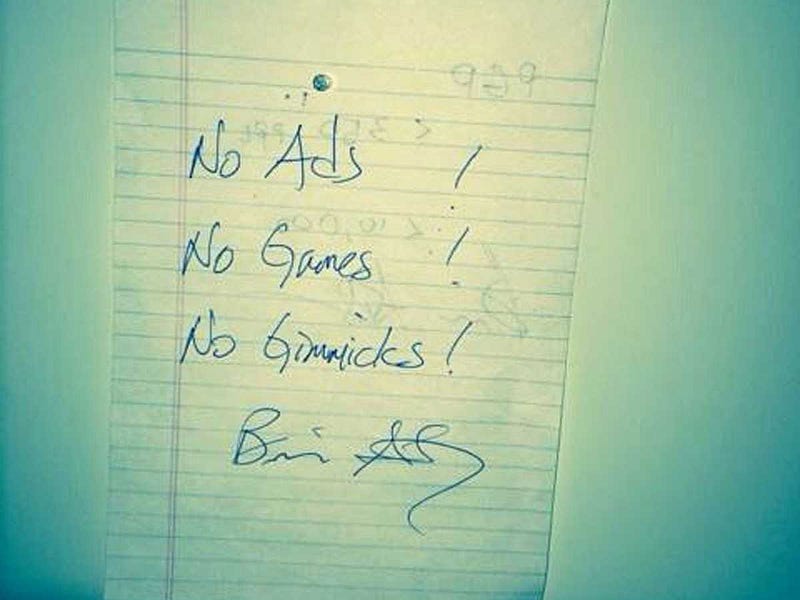
Growing exponentially, Brian’s principles on WhatsApp’s philosophy never changed.
He hung this paper with a handwritten note in his office to remind himself of them every day.