
Facebook Bans Holocaust Denial Content
One in four young Americans believes the Holocaust is a myth
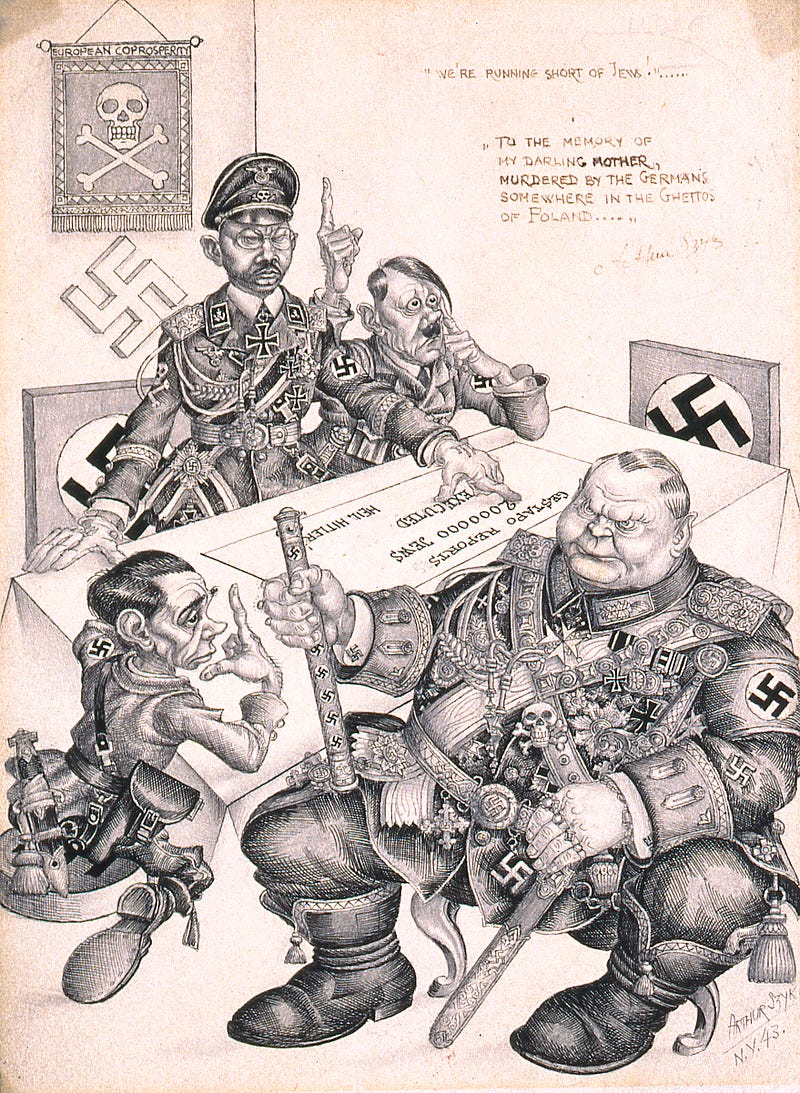
To the memory of my darling Mother, murdered by the Germans somewhere in the Ghettos of Poland…
— Arthur Szyk
In an interview with Recode in 2018, Facebook’s Mark Zuckerberg had to clarify his position about Holocaust denial content, after getting flak for his statements.
Mark Zuckerberg clarifies: ‘I personally find Holocaust denial deeply offensive, and I absolutely didn’t intend to defend the intent of people who deny that.’
Two years after, Facebook bans Holocaust denial content. While this decision is a welcome development, the delay comes at a cost that we may never recover from.
In a study, One in four young Americans believes the holocaust is a myth. The ages of those surveyed are from 18–39, the very people who grew up with Facebook.
In the same study, two-thirds, do not know that 6 million Jews were killed during the Holocaust.
How can Facebook not see the danger of allowing Holocaust denial content on its social media platform? Facebook has become a hate speech content mill and it fails to face the consequences of its lack of action.
It is far from what Mark Zuckerberg still thinks of Facebook, that is a happy place where people still share their dog’s photos. Most of the time, I want to ask Mark Zuckerberg, What’s on your mind?
Facebook is too naive and still believes in free speech and open conversation. It believes the conversation on the social media platform starts and ends there.
But hate has a life of its own, no switch turns it off. The real danger is when hate goes offline.
Holocaust is real, it killed more than 6 million Jews. One of the darkest times in the history of humanity. Like what is happening on Facebook, the Holocaust started as an idea, in the minds of a few. Anti-Semitism, hatred of Jews had a long history, and it didn’t start with Hitler.
One way or another, it is clear that Hitler came into contact with antisemitic ideas at an early age.
Hitler was a student of an idea, he took the idea and made it his own. A plan that killed 6 million Jews.
Facebook has been around since 2004, fake news, misinformation, and disinformation have become associated with the social network giant.
In the Netflix documentary, The Social Dilemma, director Jeff Orlowski, openly showed us the negative impact of social media and the business practices of big tech companies, especially Facebook.
Yet, Facebook Slams Netflix’s ‘The Social Dilemma’ as ‘Distorted’ and Sensationalist.

And when Facebook issues a document, What ‘The Social Dilemma’ Gets Wrong, not only is the social media behemoth tone-deaf, but it wants to kill the conversation about their culpability. When on the same document, they admitted the errors they committed in the 2016 US elections.
If Facebook is serious in its efforts to clean its platform of bad actors, it should take criticisms, not as an attack but instead, fix them.
With Facebook, hate is amplified, it spreads exponentially. How many of these young Americans will continue to in their adulthood believe in other extreme ideas?
Holocaust denial content is just the tip of the iceberg. Hate has been spreading on Facebook for years. Not only has it commodified its users, you who use Facebook every day. But it has commodified hate.
In the past, it will take Holocaust deniers and neo-Nazi propagandists, years before they convert unsuspecting young minds to their agenda. Today, all it takes is one post, one photo, or video and their message spreads like wildfire, in the process gaining foot soldiers to spread their lies and hate.
While Facebook claims there is no incentive for them to allow hate on the social media platform. Content is a commodity, if it is shared its value increases, and that is what hate is all about, the more it is shared, the more it spreads.
Big tech companies have a responsibility to change, and its leadership should be accountable. It is never too late until it is late.
The social dilemma is, will Facebook change?
First, they came for the Communists And I did not speak out Because I was not a Communist
Then they came for the Socialists And I did not speak out Because I was not a Socialist
Then they came for the trade unionists And I did not speak out Because I was not a trade unionist
Then they came for the Jews And I did not speak out Because I was not a Jew
Then they came for me And there was no one left To speak out for me


