THE CLEANER THE BETTER
Face Masks DO Work — For Some Things
I Have Lungs Because Face Masks
Here’s a story: When I lived in Asia I rode a small motorcycle to work most days. Like most of my bike-riding compatriots, I wore a face mask.
And like everyone else, when I arrived at work, I’d peel that thing off my face to find a mask-shaped patch surrounded by smoke-colored grime that took five, ten minutes of bathroom attention to remove.
And every day as I rewashed my face, I’d think: “Whew. Look what I didn’t inhale!”
Multiply that layer of grime and soot by hundreds or thousands, and imagine the quantity of soot my lungs didn’t have to process during my regular commutes.
And now that I’m looking down the barrel of a respiratory disease called Coronavirus, I’m utterly delighted my lungs are healthy. I’m old enough to be vulnerable. Wearing a mask all those years has upped my odds of survival.

Will a facemask protect you from Coronavirus?
Here’s a fact: It certainly won’t give you COVID-19. (Here’s the W.H.O.’s take on face mask use.) And wearing one may help flatten the curve. Here’s why:
- If the air is filled with particulate matter, breathing through a mask filters every particulate that is larger than the holes in the filter. Worst-case scenario, it may keep something unhealthy out of your lungs and make you better able to cope if you do get sick.
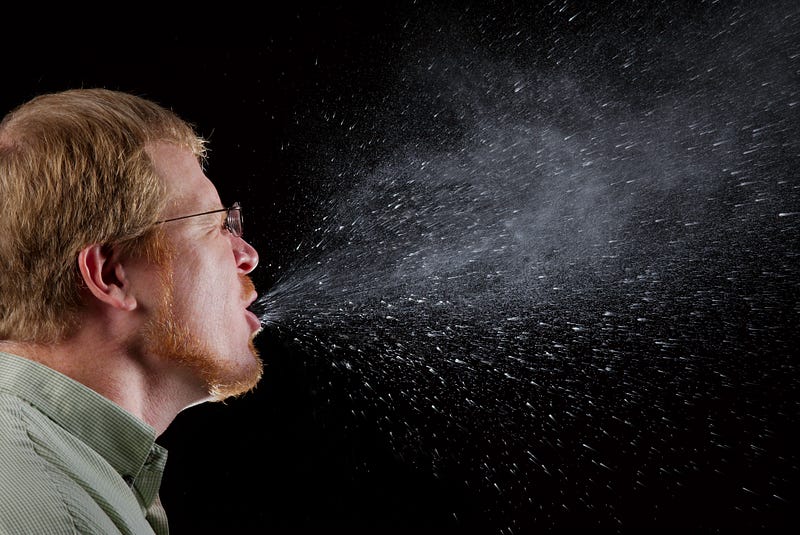
- Coronavirus is smaller than the holes of most masks, so it absolutely can pass through and infect you. But hey, Coronavirus also likes to stick to surfaces. And if you do encounter it, at least some portion of it is likely to cling to the surface of the mask, which quantitatively decreases the chance of it getting sucked into your lungs.
- There’s a reason we’re being told not to buy up all the masks. And we shouldn’t. Doctors and nurses need them more than we do. It’s a pro-social act to leave the masks for medical professionals. But note: Medical professionals need masks for a reason: They offer some protection.
- Wearing a mask means one less area of your face is getting touched. Can’t bite your fingernails or wipe your nose with your hands when they’re both behind a mask.
- If I’m coughing, a mask — any mask — keeps the people around me safer than no mask. It’s not a perfect fix, but it’s better than nothing.
- Generations of bank robbers know that “masks” don’t have to be medical-grade to be functional. A bandana is a perfectly fine mask. A t-shirt or dish towel cut into shape and tied behind your head is a perfectly fine face mask.
So forced by hunger or medical necessity to go out in public? Be prosocial. Wash your hands, chop up a piece of fabric, tie it over your mouth and behind your head, wash your hands again, and keep your venturing short. Mask-wearing certainly won’t make anything worse!

More from The Relationship Institute
Looking for a good therapist? Check out this article on How to Pick a Counselor — And Bypass the Bullies and Buffoons at The Relationship Institute.
More tips on holding onto boundaries while being a nice person. Read Just Say Yes. To Everything. Even Your Kids.
And read about a better alternative to venting in The Fast Fix for Spinning Thoughts.
How can you tell whether your family or team is functional? Ask yourself one simple question. (Oh, and here’s a hint: Functional people solve problems together; the broken ones eat their young.). Read more at Are We Having (Dys)Fun(ction) Yet?

The Relationship Institute uses a martial-arts metaphor to coach relationship, communication, and life skills. Visit our digital library, schedule training events, and sign up for our newsletter to receive free therapeutic advice for improving your relationships.
LauraMaery Gold, LMFT, is a licensed marriage and family therapist working with couples and parents, and writes for Relating magazine. She is also executive director of The Relationship Institute and the author of oh-so-very-many books on family concerns. When all seven of their kids became adults, she and her husband took up residence in a 400-year-old castle just outside of Paris.


