
Inside the Adelanto ICE Detention Center, Where the COVID-19 Pandemic Means Toxic Mist
Guards spray the disinfectant chemical around detainees, as though they aren’t there.
For Marvin Cua, word of the coronavirus came not from the news but from detention facility guards — the only people in the Adelanto ICE Processing Center who can come and go freely. One day, Cua recalls, the GEO Group guards announced that there was a pandemic outside, so visitors would now be prohibited.
Cua likes to sketch. He says the quiet scrape of pencil on paper puts him in his own world, far away from Adelanto, the immigration detention center near Los Angeles where he has been detained for seventeen months.
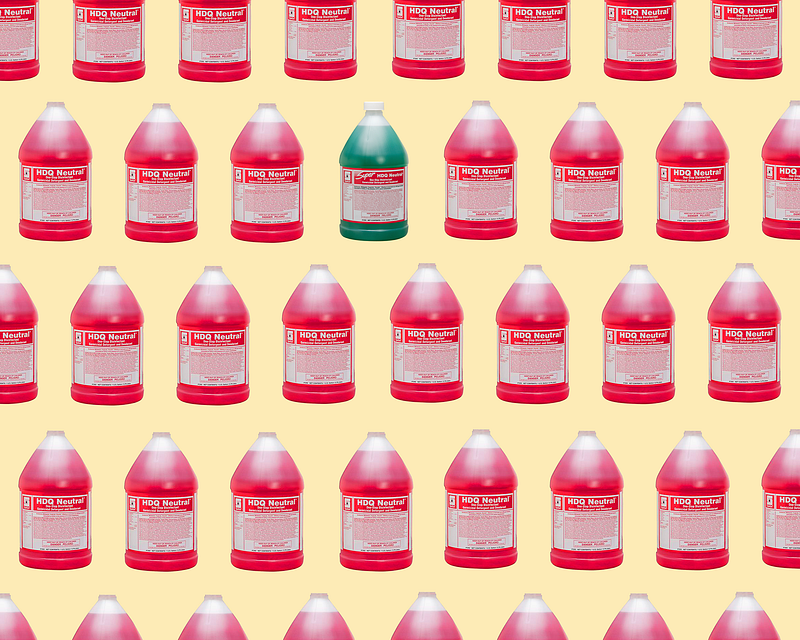
But in May, guards in Adelanto began to use an industrial disinfectant called HDQ Neutral as a coronavirus deterrent. The red liquid, sprayed every 15 to 30 minutes, coats the inside of the detention center like a perpetual morning dew. It has become nearly impossible, Cua says, for him to leave this world of confinement and enter his own, even for a moment.
Guards spray the red chemical around people, as though they aren’t there. Many detainees say that the facility is unventilated, and that the chemical hangs like mist, making it difficult to breathe.
Nobody wipes down surfaces after spraying them, Cua explains. When he sits down and folds his hands on tabletops, when he presses the start button on the microwave, and when he turns a door handle, he says his skin begins to burn so badly that he has to wash his arms and hands with running water.
Exposure to the chemical can cause severe dermatitis, rashes, and second or third degree skin burns, said Dr. Ranit Mishori, a senior medical advisor at Physicians for Human Rights. If inhaled, the disinfectant can cause irritation on the lining of airway passages and lungs. This irritation leads to coughing fits, at times bloody.
“You’ll be right there in peace, then, next thing you know, the officer is spraying all over the place,” Cua said.
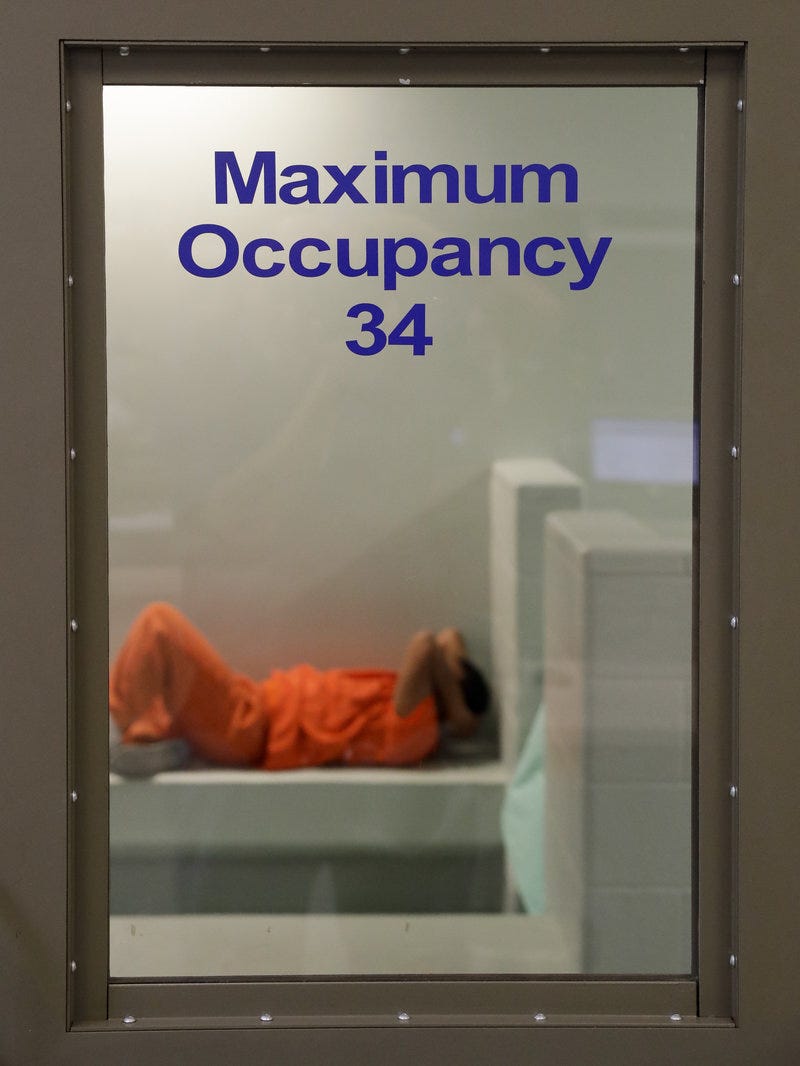
Adelanto has been in and out of ‘lockdown’ since March. During a lockdown, the nearly 1,000 people who are detained there must remain in their cells for 23.5 hours each day. In the minutes that remain, they may exercise or call family.
Many at Adelanto have begun to take showers during their allotted time, seeking relief from the pain caused by the spray, explained Margaret Hellerstein, a lawyer with the Esperanza Immigrant Justice Project. In order to make their physical condition more bearable, detainees forgo their chance at fresh air or to speak with loved ones.
“Adelanto, all the detention centers, they love this ‘Newspeak,’ you know,” said Hellerstein. “So it’s not a jail. It’s a ‘processing center.’ And it’s not ‘lockdown.’ It’s ‘modified programming.’”

When Cua arrived at his mother’s house in California for the first time as a thirteen-year-old, he did not know her. She had left Guatemala to seek employment in the U.S. when Cua was two, while he remained with his grandparents.
In California, Cua’s mother seemed to see him as though he were still the toddler she had left behind a decade before. Cua felt estranged. He struggled with mental illness, undiagnosed at the time, and experienced homelessness as a teenager.
In May 2017, Cua was convicted of vandalism and ordered removed from the country. He was released on bond, but after another minor conviction, was detained again. In December 2018, Cua was placed in Adelanto, which is owned and operated by GEO Group, the nation’s second largest for-profit prison company, which contracts with ICE.
If deported to Guatemala, Cua will be institutionalized at Frederico Mora, according to Cua’s lawyer. Guatemala’s only public mental health institution, Frederico Mora has been described by advocates as the most abusive psychiatric facility in the world. Investigators report sexual assault of sedated patients and physical restraints that amount to torture.
Because of his criminal record, Cua is not eligible for asylum. He applied instead, with a lawyer, for withholding of removal (WOR) and protection under the Convention Against Torture (CAT), which are like asylum but are harder to win and confer fewer benefits.
Six months ago, an immigration judge ruled in Cua’s favor, granting him protection under CAT based on his mental health claim. But as Cua was declared free, the Department of Homeland Security appealed the judge’s decision. Cua was refused another bond hearing, the only means by which he could leave detention.
Cua would have to face COVID-19 from inside Adelanto.
Bunk beds in Adelanto are just 2.5 to 3 feet apart, according to the ACLU lawsuit. Detainees say social distancing is not observed, and is often impossible inside the crowded detention center.
Guards began spraying HDQ Neutral in May, according to a complaint filed by advocacy groups. But according to Martin, a fifty-three year old detainee, the guards in Adelanto only began to wear masks the next month, in June.
Weeks after learning about the pandemic, Cua noticed guards bringing large, empty spray bottles into the detention center. They were soon filled with a chemical disinfectant called HDQ Neutral.
Mario Ramos, another detainee at Adelanto, explains that he thinks this is ICE’s coronavirus strategy. “Their mentality would say, ‘Okay, this is the way we’re going to control this virus.’”
“ICE continues to incorporate CDC’s recommendations for cleaning and disinfection during the COVID-19 response, along with already established infectious disease monitoring and management protocols currently in use by the agency,” wrote Alexx Pons, the spokesperson for ICE’s Los Angeles field office, in an emailed statement to Stories from the Border. Pons also wrote that HDQ Neutral has been used in ICE facilities for nearly 10 years.
In May, detainees began to cough up blood.
“The other day, I just got sprayed in the face,” Mario Ramos said.
Spartan Chemical’s safety regulations for the use of HDQ Neutral read: “Do not breathe mist, vapors or spray. Use only outdoors or in a well-ventilated area.”
If the chemical touches skin or hair, the manual instructs: “Take off immediately all contaminated clothing. Rinse skin with water or shower. Wash contaminated clothing before reuse.” In the event of inhalation, the manual advises: “Remove victim to fresh air and keep at rest in a position comfortable for breathing.” In case of any contact, the instructions warn: “IMMEDIATELY CALL A POISON CENTER OR PHYSICIAN.”
Guidance from the Environmental Protection Agency states, “EPA does not recommend use of fumigation or wide-area spraying to control COVID-19… Fumigation and wide-area spraying are not appropriate.”
According to Dr. Mishori, it appears ICE is violating those regulations. “If you overuse it or if you misuse it, you can cause a lot of harm,” she said. “The way they’re doing it is completely counterproductive.”
“Disinfectant formulations used at Adelanto are compliant with detention standards, registered by the Environmental Protection Agency (EPA), and are used according to manufacturer instructions for routine cleaning and maintenance of the facility,” wrote Pons. “Detainees are provided gloves and face masks and vacated from targeted areas before cleaning.”
“It’s like they never want to stop,” Ramos said. “It goes into your food, it goes into your pores.”
Spraying the chemical can also exacerbate existing lung conditions such as bronchitis and asthma. “You can have an uncontrolled asthma attack, or you can have difficulties breathing and shortness of breath, which sometimes can be life threatening,” Mishori said.
Hellerstein explains that one of her clients in Adelanto gets a nosebleed every single day from the disinfectant. Detainees have also reported nausea, burning eyes, headaches, rashes, throat irritation, blisters, and fainting. “It’s almost like being gassed,” Dr. Mishori said. “If you’re in an area and suddenly someone’s coming and spraying you, it could be incredibly scary, people start coughing, and people’s eyes start burning. Using chemical irritants is almost like using tear gas.”
“We are aware of and monitoring the allegations made at the Adelanto ICE facility,” Spartan Chemicals said in an online statement. “We note that U.S. Immigration and Customs Enforcement (ICE) has categorically denied the allegations.”
In addition to Adelanto, advocates have reported serious medical consequences from the use of HDQ Neutral at four other detention centers across the country: in Florida, Colorado, and Washington.
Four of these five centers are operated by GEO Group. The fifth, Glades County Detention Center, is operated by the county sheriff, under contract with ICE.
Armando Carmona, an advocate with the Inland Coalition for Immigrant Justice, said, “This isn’t about a bad guy or a bad guard. It’s not about bad management in one facility — it’s a systemic practice.”
In the weeks before the disinfectant was first sprayed in Adelanto, detainees had spoken up about dangerous COVID-19 conditions, including overcrowding, lack of social distancing, and the absence of testing and masks. On April 13, The ACLU filed a class-action lawsuit demanding the release of Adelanto detainees during the pandemic. The complaint said detainees were given only a dirty rag and a bucket of water to sanitize eating areas.
Some advocates say that the use of the disinfectant does not merely constitute a misuse of cleaning supplies.
“It looks like this is retaliation for people speaking out about the conditions inside and people speaking out about the harsh realities that they’re facing while being detained,” Carmona said.
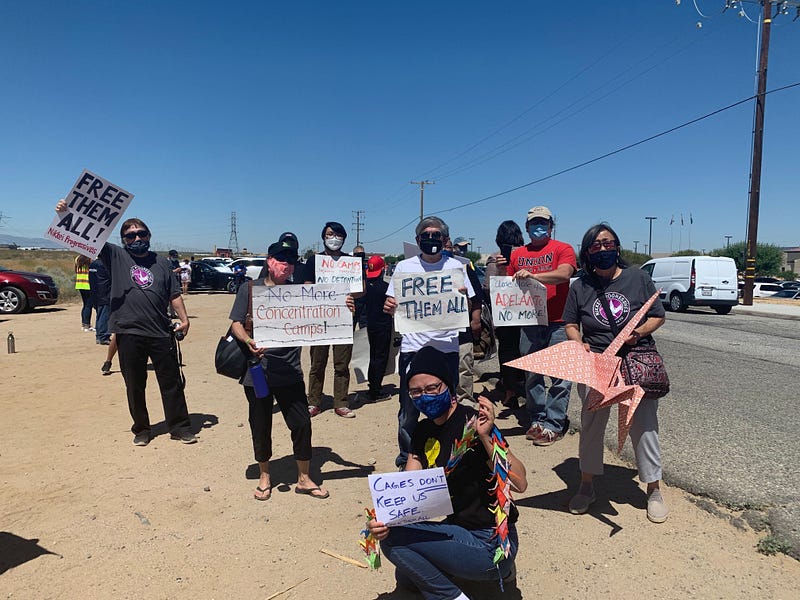
In early June, GEO guards met detainees in Adelanto with rubber bullets and pepper spray after California residents staged a protest against COVID-19 conditions outside the facility. As protestors called for detainees’ release, some detainees — confined to their cells for most of the day with restricted access to routine phone calls from family or counsel — refused to reenter their cells. The guards’ response, Mario Ramos said, was to, “shower us with rubber bullets.”
Advocates and attorneys who work in Adelanto and across the country said the use of HDQ Neutral is concurrent with increased attempts to prevent detainees from speaking up about detention conditions during the pandemic.
Wendy King, an advocate with Friends of Miami Dade Detainees, said detainees are punished for trying to make COVID-19 dangers public. “People have been pepper sprayed, put in solitary confinement, deported under mysterious circumstances in retaliation for sharing information about what’s going on.”
In one case, King said she was video-calling with detainees, who were holding up signs indicating how many people had tested positive for COVID-19 in the facility, a common protest strategy for those in detention. The video, which King said is monitored by guards, was suddenly cut off.
When Cua tries to go see a doctor, he says that he is sent to a nurse. The nurse then suggests he see a doctor. “They just have you going in circles,” he said. “Basically, we’re not going nowhere. The only time they take something seriously is when you’re actually, like, dying.”
Detainees report that medical care in Adelanto is ineffective. Ramos said he saw the doctor recently, about the harmful effects the disinfectant had on him. “I went and he said, ‘No, no, you’re fine. You’ll be fine. You’ll be fine. It’ll go away.”
“They’re telling us there’s medical attention for us here for 24 hours,” Ramos said, “but there isn’t no medical attention for us here.”
“Detainees in ICE custody have access to daily sick call and 24-hour emergency care,” ICE spokesperson Alexx Pons wrote. “This comprehensive medical care is provided, as determined by medical staff, to all individuals in custody to ensure timely access to services and treatment.”
The misuse of industrial disinfectant could help spread the virus within the detention centers, Dr. Mishori explained.
“This was bad at any time, but especially now when we’re in a global pandemic,” she said. “If you irritate the lungs, it causes uncontrollable coughing. You don’t want to have any coughing when there’s potential coronavirus around you.”
The walls of Adelanto, already towering, have closed in further around Cua.
“Sometimes I just feel depressed and I want to go outside, I want to do some exercise or I want to be at the table watching the TV, but you know they’re going to be out there, spraying this stuff,” he said.
About an hour and a half drive northeast of Los Angeles, Adelanto sits along a sandy road. Its parking lot, surrounded by desert, still fills each day, as guards come in and out of work and cases in Los Angeles rise. The government’s appeal on Cua’s victory will not be decided for months.
Julia Huesa contributed to this report.


