d">
<div>
<div>
<h2>Welcome to the era of FONKU: Fear of Not Keeping Up</h2>
<div><h3>If you are constantly anxious about not learning, not adapting, not being able to keep up - you are not alone: welcome…</h3></div>
<div><p>medium.com</p></div>
</div>
<div>
<div style="background-image: url(https://miro.readmedium.com/v2/resize:fit:320/0*eU02FOBf05bJcZNP)"></div>
</div>
</div>
</a>
</div><p id="6951">We have already started living in the future — it feels as if we are in a Black Mirror episode.</p>
<figure id="3712">
<div>
<div>
<img class="ratio" src="http://placehold.it/16x9">
<iframe class="" src="https://cdn.embedly.com/widgets/media.html?src=https%3A%2F%2Fwww.youtube.com%2Fembed%2Fke5AKVtvkdc%3Ffeature%3Doembed&display_name=YouTube&url=https%3A%2F%2Fwww.youtube.com%2Fwatch%3Fv%3Dke5AKVtvkdc&image=https%3A%2F%2Fi.ytimg.com%2Fvi%2Fke5AKVtvkdc%2Fhqdefault.jpg&key=a19fcc184b9711e1b4764040d3dc5c07&type=text%2Fhtml&schema=youtube" allowfullscreen="" frameborder="0" height="480" width="854">
</div>
</div>
</figure></iframe></div></div></figure><p id="2502">Charlie Brooker - creator and writer of Black Mirror - has said:</p><blockquote id="5b58"><p>2020 is too much like Black Mirror to keep making Black Mirror. The current state of the world is just a little bit too dystopian already for me to come along and fill you up with a whole new sense of dread. At the moment, I don’t know what stomach there would be for stories about societies falling apart, so I’m not working away on one of those.</p></blockquote><p id="2d49">These companies are now so powerful that they dominate our discourses on capitalism, privacy, free speech, censorship, market power, monopolies, and democracy. As these companies offer free services to lure us, it becomes difficult to stay away from their offerings. It might not be even possible to continue our day-to-day lives in the digital world outside of the ecosystem created by these companies.</p><p id="1004">Now, I want to take you a bit further into the future.</p><h2 id="1c15">Where are we headed next?</h2><p id="4f6c">As Moore’s Law is slowing down, we see the emergence of a cocktail of new technologies including big data, cloud, quantum computing, machine learning, and artificial intelligence. These new technologies will power a new era of exponential technologies in the next few decades.</p><p id="71e8">These technologies will also create the most powerful entities of the future- groups of trillionaires - industries, systems, and business models that will generate 100X more value than anything in the world today. These industries will be rapidly scalable, highly profitable, and extremely influential at the global level. We do not know which will be the companies of this era — they might be new startups that are yet to come.</p><p id="94ad">As artificial intelligence will power the biggest innovations of the next few decades, all the power and wealth will shift to those who hold these new technologies. The disparities between the rich and the poor will also be 10X or 100X more. Like Occupy Wall Street, we will witness movements such as ‘Occupy Silicon Valley’ or ‘Occupy Amazon’ or ‘Occupy Alphabet’. As a very small percent of the population will understand how AI works, future tech giants will get away with a lot more than what FAATMAN ever can. Moreover, we will be experiencing human rights issues with the proliferation of advanced surveillance systems such as China’s Social Credit System.</p><p id="54db">AI-powered technologies will accelerate automation and loss of jobs — McKinsey estimates that AI might eliminate 800 million jobs. Oxford University researchers predict 47% of jobs will be automated in the next 25 years. Robots, algorithms, and machines never get tired and can work 24×7×52. No food, water, desk, appraisal, promotion, or motivation needed. I believe all jobs carry the risk of some automation.</p><p id="e667" type="7">We should all ask ourselves: What are the skills that only I can do? Skills that cannot be automated or replicated or broken down into pieces? Skills that machines, robots, computers, or algorithms cannot replicate?</p><p id="9dc1" type="7">We can see that competencies such as emotional intelligence, empathy, and creativity will become more valuable in the long run.</p><h2 id="acb4">Ray Kurzweil on exponential change</h2><p id="4932">Raymond Kurzweil is an inventor and futurist. He has established Singularity University and he is a Director of Engineering at Google heading up a team developing machine intelligence and natural language understanding.</p><p id="13a1">Kurzweil is one of the most prolific thinkers predicting the scale and the nature of technological changes we will experience as AI becomes more and more powerful.</p>
<figure id="e461">
<div>
<div>
<img class="ratio" src="http://placehold.it/16x9">
<iframe class="" src="https://cdn.embedly.com/widgets/media.html?src=https%3A%2F%2Fwww.youtube.com%2Fembed%2F9Z06rY3uvGY%3Ffeature%3Doembed&display_name=YouTube&url=https%3A%2F%2Fwww.youtube.com%2Fwatch%3Fv%3D9Z06rY3uvGY&image=https%3A%2F%2Fi.ytimg.com%2Fvi%2F9Z06rY3uvGY%2Fhqdefault.jpg&key=a19fcc184b9711e1b4764040d3dc5c07&type=text%2Fhtml&schema=youtube" allowfullscreen="" frameborder="0" height="480" width="854">
</div>
</div>
</figure></iframe></div></div></figure><p id="0995">Here are some of his insightful quotes on exponential change:</p><blockquote id="570
Options
d"><p><i>“Our intuition about the future is linear. But the reality of information technology is exponential, and that makes a profound difference. If I take 30 steps linearly, I get to 30. If I take 30 steps exponentially, I get to a billion.”</i></p></blockquote><blockquote id="3849"><p><i>“Biology is a software process. Our bodies are made up of trillions of cells, each governed by this process. You and I are walking around with outdated software running in our bodies, which evolved in a very different era.”</i></p></blockquote><blockquote id="f7a1"><p><i>“By the time we get to the 2040s, we’ll be able to multiply human intelligence a billionfold. That will be a profound change that’s singular in nature. Computers are going to keep getting smaller and smaller. Ultimately, they will go inside our bodies and brains and make us healthier, make us smarter.”</i></p></blockquote><blockquote id="0b77"><p><i>An analysis of the history of technology shows that technological change is exponential, contrary to the common-sense “intuitive linear” view. So we won’t experience 100 years of progress in the 21st century — it will be more like 20,000 years of progress (at today’s rate). The “returns,” such as chip speed and cost-effectiveness, also increase exponentially. There’s even exponential growth in the rate of exponential growth. Within a few decades, machine intelligence will surpass human intelligence, leading to The Singularity — technological change so rapid and profound it represents a rupture in the fabric of human history. The implications include the merger of biological and nonbiological intelligence, immortal software-based humans, and ultra-high levels of intelligence that expand outward in the universe at the speed of light.</i></p></blockquote><blockquote id="8063"><p><i>“The singularity will be a merger of our bodies + minds with our technology. The world will still be human, but transcend our biology’s roots. There will be no distinction between human and machine — nor between physical and virtual reality. If you wonder what will remain unequivocally human, it’s this quality — our species inherently seeks to extend its physical and mental reach beyond current limitations.”</i></p></blockquote><blockquote id="7882"><p>Ray Kurzweil</p></blockquote><h2 id="0051">Preparing for Singularity</h2><p id="611c">Singularity is the point in time at which technological growth becomes uncontrollable and irreversible, resulting in an <i>‘intelligence explosion</i>’. It means the end of human civilization as we know it and the beginning of something new.</p><p id="601c">When singularity occurs, non-human intelligent agents (AI powered robots and machines) will continually upgrade themselves and enter a “runaway reaction” of never-ending and accelerating self-improvement cycles. They will invent technological tools that will be more sophisticated and advanced than anything we witness or imagine today.</p><p id="82c1">We will experience a new wave of the intelligence revolution materialized from worldwide efforts to map every neuron and connection in the human brain.</p><p id="434d">This will result in an explosion of intelligence. A powerful superintelligence far surpassing all human intelligence is expected to occur.</p><p id="783c">When technology advances far beyond our abilities to predict its outcomes, it is impossible to see what is coming next.</p><p id="81bd">Optimists are expecting the end of common human problems including poverty, disease, and mortality. This scenario is plausible given the sheer power of the virtuous iterative cycles created by AI.</p><p id="8935">Pessimists are expecting the end to humankind as a result of a mistake. This scenario is also plausible, given that AI will have enormous intellectual advantages over humans and the human brain might be as limited as a ‘pet’ brain or even an ‘ant’ brain in understanding AI.</p><p id="1acd">What is shared across views is that singularity will trigger a technological tsunami, resulting in unfathomable changes and new challenges to our civilization.</p><p id="7172">FAATMAN will probably be a nuisance — it will be the smallest of our problems in two decades or so. Some of these companies will simply be bankrupt or irrelevant. It is what the new AI super-powers will do that matters.</p><p id="e6c4">In any case, we need to keep learning and experimenting with AI technologies. We need to increase our literacy and depth of understanding of artificial intelligence. Curiosity is our only option to go forward.</p><p id="cb2e">Curiosity will give us leverage because we can then capitalize on what is novel, interesting, surprising, meaningful, and beautiful. We can then perhaps dance our way forward.</p><figure id="1eab"><img src="https://cdn-images-1.readmedium.com/v2/resize:fit:800/1*d-4ZkX0kY9vMqDJho3b3gw.png"><figcaption></figcaption></figure><figure id="7c55"><img src="https://cdn-images-1.readmedium.com/v2/resize:fit:800/1*gcMJQuAupTUbNCZvcSjKsw.png"><figcaption>“<b>The Future will be Weird” </b>Images created by Author.</figcaption></figure><figure id="c7ea"><img src="https://cdn-images-1.readmedium.com/v2/resize:fit:800/1*2TIZ9C7a7wvrZtF0qNGXXA.png"><figcaption></figcaption></figure><figure id="5f97"><img src="https://cdn-images-1.readmedium.com/v2/resize:fit:800/1*zXdKNCVzyUP9xBvAkNWS2Q.png"><figcaption>“<b>Curiosity is the Only Option Forward ”</b>Images created by Author.</figcaption></figure><figure id="d279"><img src="https://cdn-images-1.readmedium.com/v2/resize:fit:800/1*5rh-UYLBSnvhhqzcF5JPWg.png"><figcaption>“<b>Which Skills are Unique to Humans?” </b>Images created by Author.</figcaption></figure><p id="0448">Sincerely;</p><p id="0e02">Fahri</p><h2 id="33f7">Fahri Karakas is the author of Self-making Studio. You can explore more here.</h2></article></body>
FAATMAN dominates every landscape in our lives — not just tech
You have guessed it right: Facebook, Alphabet, Amazon, Tesla, Microsoft, Apple, and Netflix.

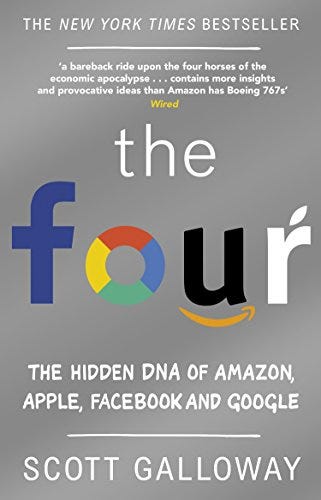
Photo by Rahul Chakraborty on Unsplash“The Four: The Hidden DNA of Amazon, Apple, Facebook, and Google”
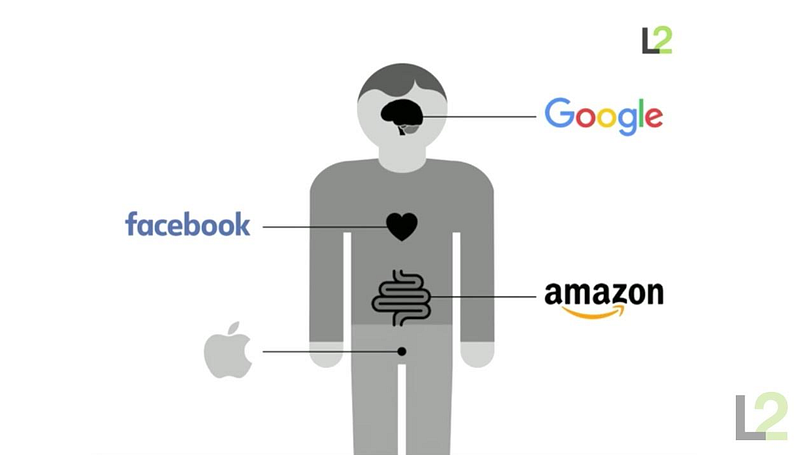
Scott Galloway wrote an influential book titled “The Four: The Hidden DNA of Amazon, Apple, Facebook, and Google” and asked the following questions for his book:
“The Four” by Scott Galloway (Google is after your brain, Facebook your heart, Amazon your guts (consumption), and Apple for sexual instincts).
How did these four companies (Amazon, Apple, Facebook, and Google) infiltrate our lives so completely that they’re almost impossible to avoid?
Why does the stock market forgive them for sins that would destroy other firms?
As they race to become the world’s first trillion-dollar company, can anyone challenge them?
Galloway deconstructed the strategies of these four tech companies and analyzed how they manipulate the fundamental needs that drive us. Galloway criticized the companies for avoiding taxes, invading privacy, destroying jobs, and dominating the market through anti-competitive practices.
Add Microsoft, Netflix, and Tesla to the mix (Big Four) above and you get the Silicon Valley titans or the largest fish in the pond. Now, there are seven companies that shape every aspect of our lives: Facebook, Alphabet, Amazon, Tesla, Microsoft, Apple, and Netflix. They are now called “FAATMAN” — one of the greatest acronyms of Big Tech.
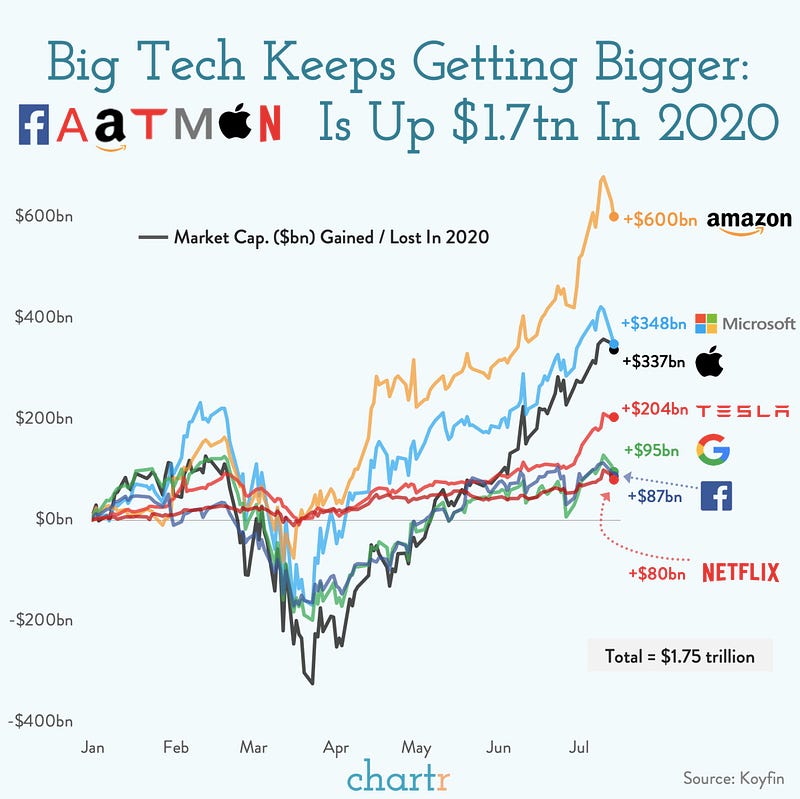
Chartrdaily has come up with a great chart that shows how much value these companies have gained value during the year 2020.
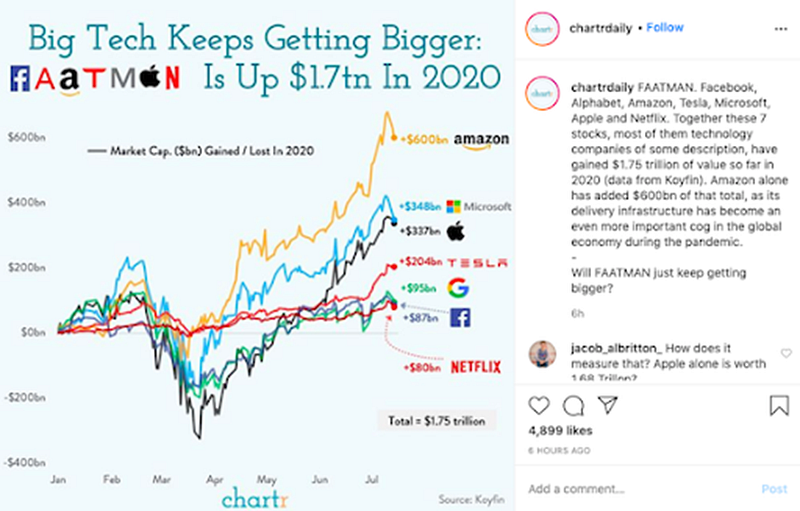
As the world is turned upside down by the biggest economic crisis accompanied by the pandemic of the century, these Silicon Valley companies have gained 1.75 trillion value so far in 2020.
Big tech companies (FAATMAN) now dominate the S&P 500 at around 22% of the S&P 500 Index. Big tech is so big that it is larger than five industries (consumer staples, utilities, energy, real estate, and basic materials) combined.
Software is indeed eating the world.
Multidimensional forces involving automation, 3D printing, AR/VR, machine learning, Industry 4.0, the internet of things, and blockchain are rapidly transforming the future of our lives.
We are now living in a world dominated by machines and computers. Algorithms — from Google search to Netflix recommendations — already dominate our lives. Our devices have become an extension of our bodies. As smart speakers and voice assistants (i.e. Amazon’s Alexa, Apple’s Siri, Google’s Assistant, Samsung’s Bixby, and Microsoft’s Cortana) are becoming a prevalent part of our everyday lives, they are also learning and getting smarter every day. As the voice revolution progresses, these devices are expected to gain much more power and even act as teachers and psychologists. Waymo’s self-driving cars are already on the roads — we know millions of driving jobs will be transferred from humans to machines in the next decade. Wal-mart has already added thousands of robots to its stores — we know millions of retailing jobs will also be transferred from humans to machines in the next decade.
Kurzweil states: “We won’t experience 100 years of progress in the 21st century — it will be more like 20,000 years of progress.”
I have written another article about the intense anxiety and fear that we will fall behind in our careers and lives because we do not adapt fast enough. FONKU (Fear of Not Keeping Up) is the pervasive apprehension that we are not doing, learning, and changing enough to keep up with the latest innovations and knowledge emerging exponentially related to our career fields.
We have already started living in the future — it feels as if we are in a Black Mirror episode.
Charlie Brooker - creator and writer of Black Mirror - has said:
2020 is too much like Black Mirror to keep making Black Mirror. The current state of the world is just a little bit too dystopian already for me to come along and fill you up with a whole new sense of dread. At the moment, I don’t know what stomach there would be for stories about societies falling apart, so I’m not working away on one of those.
These companies are now so powerful that they dominate our discourses on capitalism, privacy, free speech, censorship, market power, monopolies, and democracy. As these companies offer free services to lure us, it becomes difficult to stay away from their offerings. It might not be even possible to continue our day-to-day lives in the digital world outside of the ecosystem created by these companies.
Now, I want to take you a bit further into the future.
Where are we headed next?
As Moore’s Law is slowing down, we see the emergence of a cocktail of new technologies including big data, cloud, quantum computing, machine learning, and artificial intelligence. These new technologies will power a new era of exponential technologies in the next few decades.
These technologies will also create the most powerful entities of the future- groups of trillionaires - industries, systems, and business models that will generate 100X more value than anything in the world today. These industries will be rapidly scalable, highly profitable, and extremely influential at the global level. We do not know which will be the companies of this era — they might be new startups that are yet to come.
As artificial intelligence will power the biggest innovations of the next few decades, all the power and wealth will shift to those who hold these new technologies. The disparities between the rich and the poor will also be 10X or 100X more. Like Occupy Wall Street, we will witness movements such as ‘Occupy Silicon Valley’ or ‘Occupy Amazon’ or ‘Occupy Alphabet’. As a very small percent of the population will understand how AI works, future tech giants will get away with a lot more than what FAATMAN ever can. Moreover, we will be experiencing human rights issues with the proliferation of advanced surveillance systems such as China’s Social Credit System.
AI-powered technologies will accelerate automation and loss of jobs — McKinsey estimates that AI might eliminate 800 million jobs. Oxford University researchers predict 47% of jobs will be automated in the next 25 years. Robots, algorithms, and machines never get tired and can work 24×7×52. No food, water, desk, appraisal, promotion, or motivation needed. I believe all jobs carry the risk of some automation.
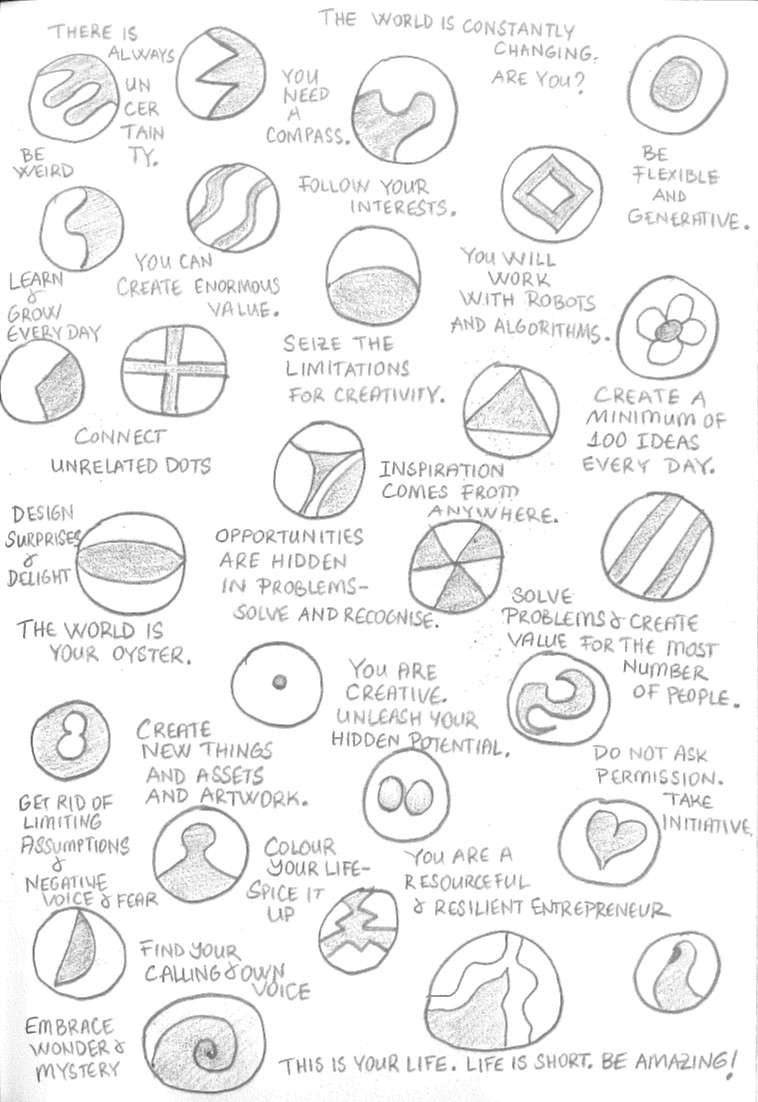
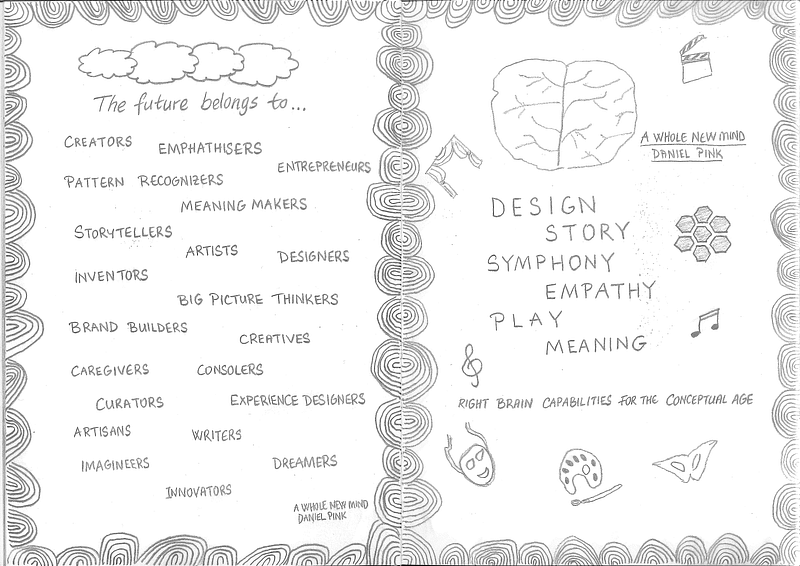
We should all ask ourselves: What are the skills that only I can do? Skills that cannot be automated or replicated or broken down into pieces? Skills that machines, robots, computers, or algorithms cannot replicate?
We can see that competencies such as emotional intelligence, empathy, and creativity will become more valuable in the long run.
Ray Kurzweil on exponential change
Raymond Kurzweil is an inventor and futurist. He has established Singularity University and he is a Director of Engineering at Google heading up a team developing machine intelligence and natural language understanding.
Kurzweil is one of the most prolific thinkers predicting the scale and the nature of technological changes we will experience as AI becomes more and more powerful.
Here are some of his insightful quotes on exponential change:
“Our intuition about the future is linear. But the reality of information technology is exponential, and that makes a profound difference. If I take 30 steps linearly, I get to 30. If I take 30 steps exponentially, I get to a billion.”
“Biology is a software process. Our bodies are made up of trillions of cells, each governed by this process. You and I are walking around with outdated software running in our bodies, which evolved in a very different era.”
“By the time we get to the 2040s, we’ll be able to multiply human intelligence a billionfold. That will be a profound change that’s singular in nature. Computers are going to keep getting smaller and smaller. Ultimately, they will go inside our bodies and brains and make us healthier, make us smarter.”
An analysis of the history of technology shows that technological change is exponential, contrary to the common-sense “intuitive linear” view. So we won’t experience 100 years of progress in the 21st century — it will be more like 20,000 years of progress (at today’s rate). The “returns,” such as chip speed and cost-effectiveness, also increase exponentially. There’s even exponential growth in the rate of exponential growth. Within a few decades, machine intelligence will surpass human intelligence, leading to The Singularity — technological change so rapid and profound it represents a rupture in the fabric of human history. The implications include the merger of biological and nonbiological intelligence, immortal software-based humans, and ultra-high levels of intelligence that expand outward in the universe at the speed of light.
“The singularity will be a merger of our bodies + minds with our technology. The world will still be human, but transcend our biology’s roots. There will be no distinction between human and machine — nor between physical and virtual reality. If you wonder what will remain unequivocally human, it’s this quality — our species inherently seeks to extend its physical and mental reach beyond current limitations.”
Ray Kurzweil
Preparing for Singularity
Singularity is the point in time at which technological growth becomes uncontrollable and irreversible, resulting in an ‘intelligence explosion’. It means the end of human civilization as we know it and the beginning of something new.
When singularity occurs, non-human intelligent agents (AI powered robots and machines) will continually upgrade themselves and enter a “runaway reaction” of never-ending and accelerating self-improvement cycles. They will invent technological tools that will be more sophisticated and advanced than anything we witness or imagine today.
We will experience a new wave of the intelligence revolution materialized from worldwide efforts to map every neuron and connection in the human brain.
This will result in an explosion of intelligence. A powerful superintelligence far surpassing all human intelligence is expected to occur.
When technology advances far beyond our abilities to predict its outcomes, it is impossible to see what is coming next.
Optimists are expecting the end of common human problems including poverty, disease, and mortality. This scenario is plausible given the sheer power of the virtuous iterative cycles created by AI.
Pessimists are expecting the end to humankind as a result of a mistake. This scenario is also plausible, given that AI will have enormous intellectual advantages over humans and the human brain might be as limited as a ‘pet’ brain or even an ‘ant’ brain in understanding AI.
What is shared across views is that singularity will trigger a technological tsunami, resulting in unfathomable changes and new challenges to our civilization.
FAATMAN will probably be a nuisance — it will be the smallest of our problems in two decades or so. Some of these companies will simply be bankrupt or irrelevant. It is what the new AI super-powers will do that matters.
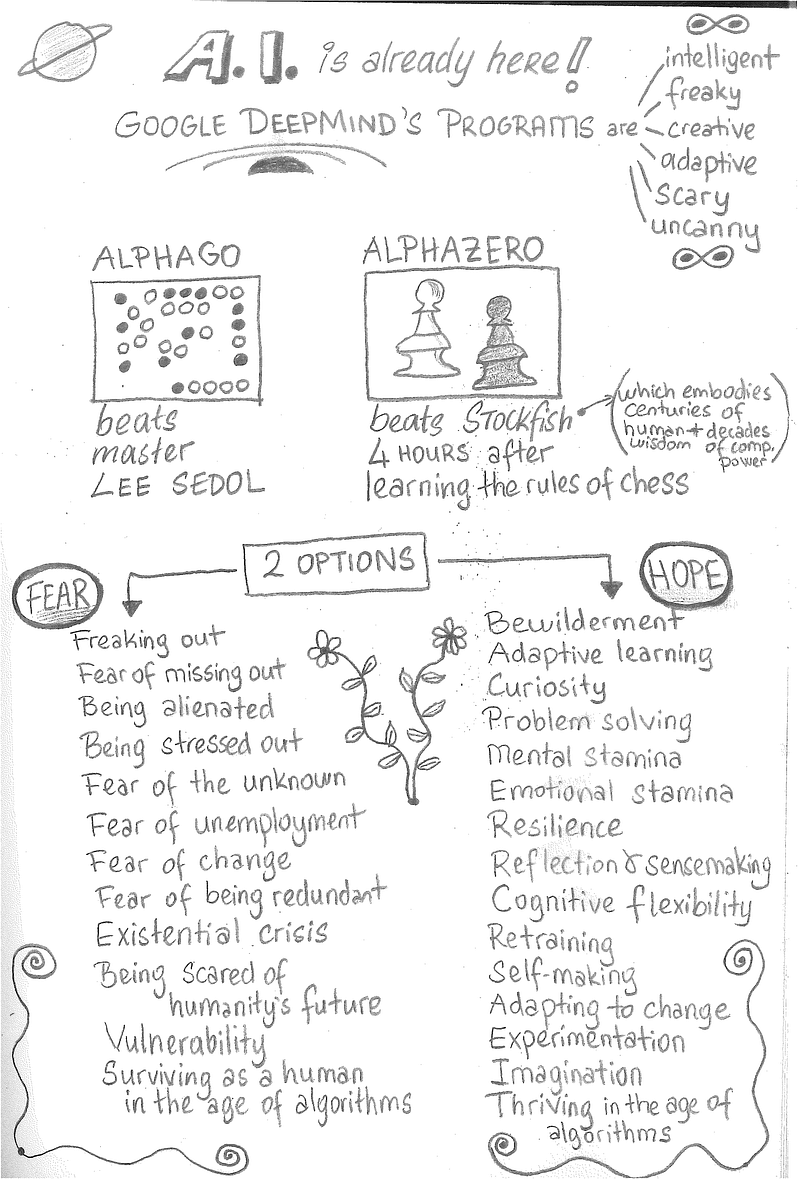
In any case, we need to keep learning and experimenting with AI technologies. We need to increase our literacy and depth of understanding of artificial intelligence. Curiosity is our only option to go forward.
Curiosity will give us leverage because we can then capitalize on what is novel, interesting, surprising, meaningful, and beautiful. We can then perhaps dance our way forward.
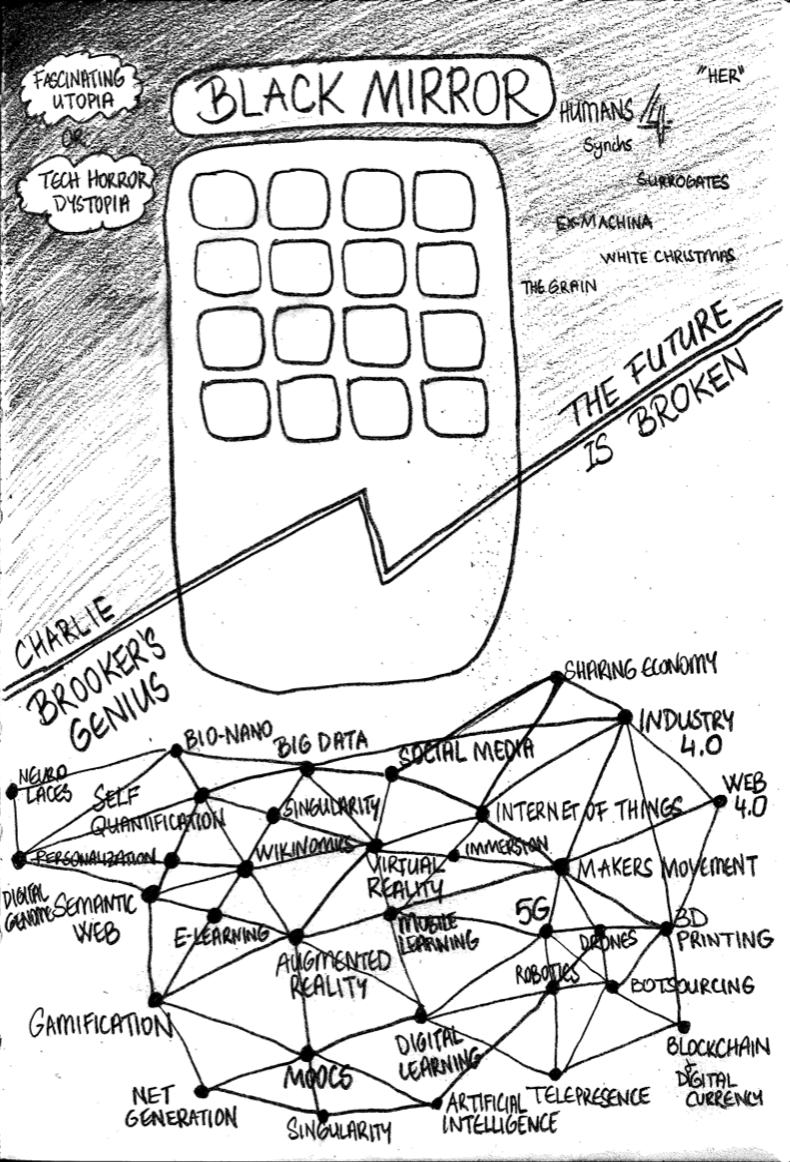
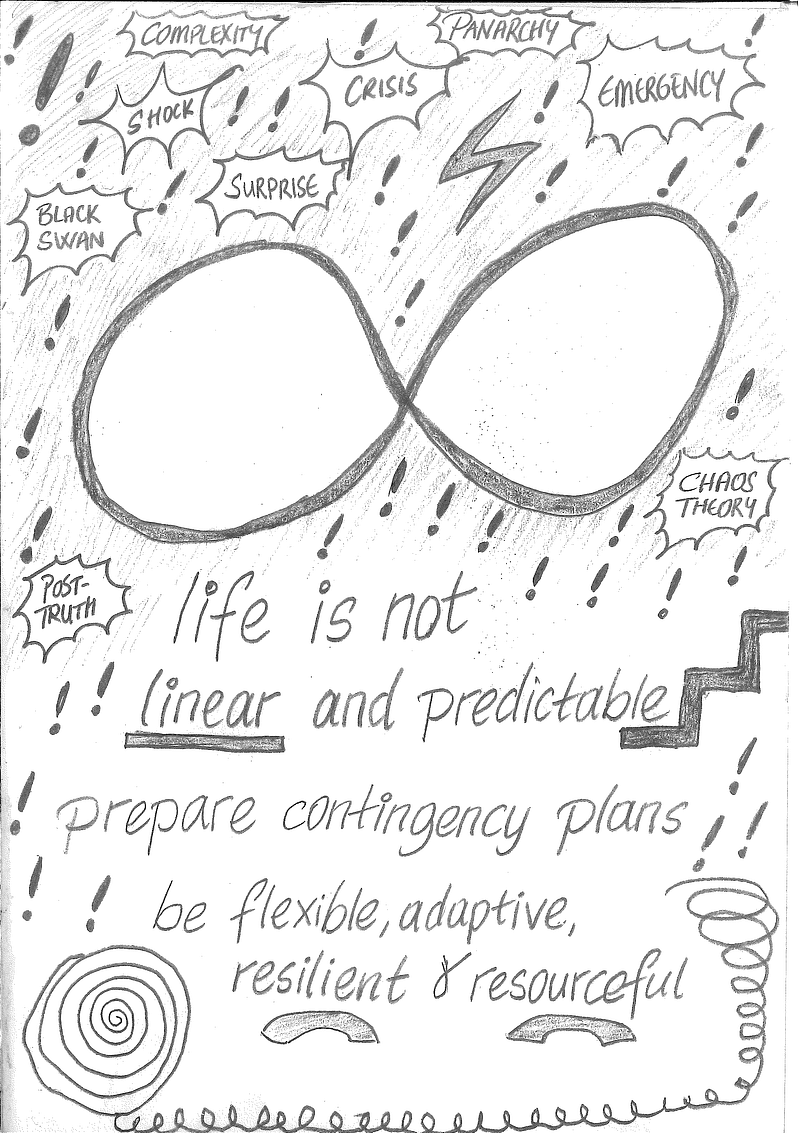
“The Future will be Weird” Images created by Author.“Curiosity is the Only Option Forward ”Images created by Author.“Which Skills are Unique to Humans?” Images created by Author.
Sincerely;
Fahri
Fahri Karakas is the author of Self-making Studio. You can explore more here.