
The Nuance
Why You Should Spend Time Walking Barefoot Every Day
Walking barefoot or in minimalist shoes can prevent multiple health problems
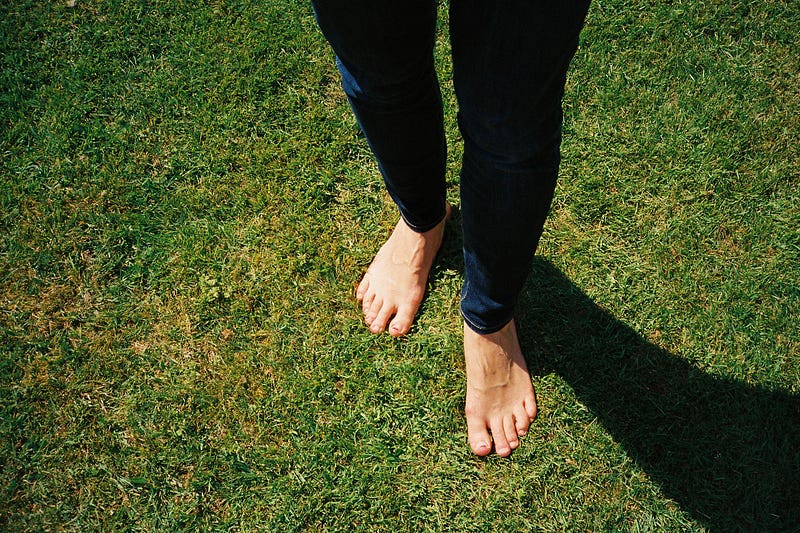
Where I live, in southwest Germany, there are a bewildering number of shoe stores that specialize in barefoot-style footwear. I’ve counted at least four Barfußschuhläden within a mile of my home.
I’ve asked my local friends about this, and they shrug and say things like “Freiburg is an eco-city” or “People here like to feel close to nature.”
I’d noticed. Last weekend, my kids and I were walking in the Black Forest when we passed a woman hiking barefoot. My eight-year-old is an inveterate gawker, and he stopped and stared at her as though she were insane. Patiently, smilingly, she explained to him the pleasures of walking barefoot, especially outdoors.
That encounter motivated me explore the latest peer-reviewed research on minimalist shoes and barefoot walking. After a few hours of reading, I started to think I was the crazy one for binding up my poor feet in thick layers of leather, rubber, and molded plastic.
A 2021 study found that people who switched to minimalist shoes for six months increased their foot strength by nearly 60%.
Kristiaan D’Août, PhD, is a senior lecturer in evolutionary biomechanics at the University of Liverpool in the U.K. He has published more than a dozen papers on barefoot locomotion and barefoot-style footwear.
When we spoke earlier this week, he told me that more work is needed to iron out the pros and cons of barefoot running. But when it comes to walking, it’s clear that more of us should spend time each day barefoot or in minimalist footwear.
The problems with conventional shoes are numerous and well-documented.
There’s the raised heel, which research has linked to both discomfort and assorted injuries. Most shoes are also too narrow, especially in the toe box, which D’Août says compresses the foot and over time can cause bunions and other deformities. Many shoes provide arch support, which seems useless — at best. “The idea that the arches of healthy people need supporting is something I’ve never found any evidence for,” he says. “Based on our anatomy, it’s probably a bad thing.”
He mentions an influential 2010 study from an evolutionary biologist at Harvard, Daniel Lieberman, PhD. That study concluded that a more natural running style, facilitated by running barefoot or in minimalist shoes, could “protect the feet and lower limbs from some of the impact-related injuries now experienced by a high percentage of runners.”
As Lieberman’s study highlighted (and later research supports), the thick cushioning in many modern shoes encourages a longer stride and heel-first ground contact, whether a person is walking or running. “Our bodies sense that we have this cushioning, and so we tend to have a much harder heel strike than we should have,” D’Août explains.
As time passes, the additional stress this places on the knees and hips can lead to pain or injuries. Conventional shoes also weaken our feet in ways that contribute to age-related balance and stability issues, as well as foot and joint ailments, he says.
Running aside, most of us would benefit from a daily walk barefoot or in minimalist footwear.
Separately, there are those who believe barefoot contact with the ground — often referred to as “grounding” or “earthing” — may provide important health benefits.
While this sounds implausible, to put it nicely, some studies, including a 2015 study from scientists at the University of Oregon and the University of California, Irvine, have argued that bare-skin contact with terra firma allows “free electrons” to move from the ground into a person’s body, and that this transfer may support improved immune functioning.
However, not all of the research supports going barefoot or wearing minimalist shoes in every circumstance. “Minimal shoes are more taxing on the ankle,” D’Août says. “If you’re susceptible to foot problems, they might not be the best idea.”
When it comes to running on flat, hard surfaces — something that may be good for your heart and overall health but ultimately bad for your feet and joints — researchers are still debating whether barefoot or minimalist footwear is superior to conventional running shoes. For runners, the “right” style of shoe may vary depending on a person’s weight, age, running habits, and injury history.
If you want to run in barefoot-style shoes — or just plain barefoot — D’Août says you should make the change gradually. “Start with one session a week and make it really short, just five-to-10 minutes,” he advises. From there, you can work your way up to longer or more intense runs. “The older you are and the more vigorous the activity, the more you need to take it slow,” he says.
Running aside, D’Août says most of us would benefit from a daily walk barefoot or in minimalist footwear.
For a 2021 study in the journal Scientific Reports, he and his colleagues found that when people switched to minimalist shoes for a period of six months — not for running or exercise, but for everyday activities — their foot strength increased by nearly 60%. “You could look at that as an improvement, but I think it’s more accurate to say that you’re gaining back the strength that conventional shoes take away,” he says.
Other researchers have likewise found that minimalist footwear improves foot strength and balance, and that kids also benefit from minimalist shoes. “I can’t see any evidence against minimal shoes except when someone’s too old to get used to them,” he adds.
He says there’s no evidence that “FiveFinger” style minimalist shoes are superior to those with a closed-toe look that can more easily pass for conventional shoes.
Also, you don’t have to wear minimalist shoes all the time to experience the benefits. If work or social pressures — or your personal sense of style — make minimalist shoes unappealing, you can still wear your conventional shoes. Just try to set aside time each day to walk barefoot or in minimalist footwear. (For example, you could wear them only during your commute, around the house, or for a walk each evening.)
“Prevention is better than a cure,” D’Août says. If you adopt minimalist shoes while you’re young and before lower-body health problems emerge, you’re doing your future self a huge favor.