
The Love Fails Theory of Borderline Personality Disorder
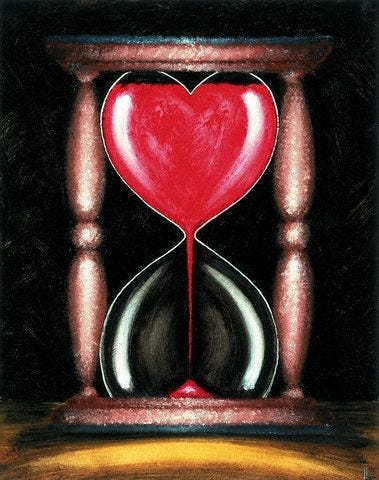
An invisible hourglass hovers over every relationship. When the sand runs out, love disappears. The inevitability of the end stares the relationship down from its beginning. This marks the tragedy of Borderline Personality Disorder.
The Borderline lives under the hourglass, believing it is more real than the relationships it ends. They know of the inevitable end without being able to see it or prevent it. And so they enter love the way people enter life: suddenly, completely, and with an assuredness of its end.
Religion is what governs our beliefs on inevitability and death. Borderline Personality Disorder is a religion of the failure of love. Just as religious people believe in an invisible yet real God, Borderlines have faith in an invisible yet real abandonment. But the god of failing love cannot be placated, will not answer prayers. The one sacrifice he demands is the relationship itself. The ritual of abandonment becomes a question not of if, but when. The Borderline anticipates the end from the beginning such that every moment in which love lives, it simply has not died yet.
The Borderline god most closely resembles Thanatos, the Greek god of death. How fitting that his siblings include Oizys (the goddess of suffering), Moros (the god of doom) and Apate (goddess of deception). Put them together, and you have betrayal: personalized abandonment.
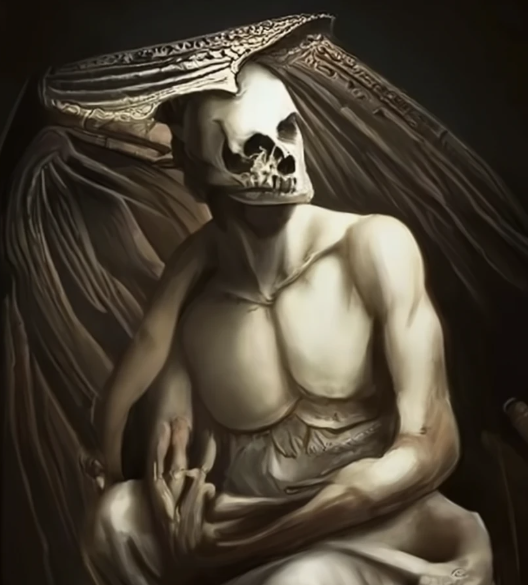
The Borderline god holds an hourglass that is arbitrary, invisible. Only the last grain feels different than its predecessors. Only the last grain is visible. All the grains lead to the last one.
Natural death is usually not so arbitrary as one typically knows when it’s getting closer — and is blithely ignored the rest of the time. The Borderline operates under no such delusions; the end is as real as it is invisible, already as real at the beginning as it will be at the end, so that all love is a debt that must be repaid by its loss.
This birth of Borderline Personality Disorder is childhood trauma: a deliberate lack of love. The practice of BPD is based on loss of love. To the Borderline, love is never as real as its loss. I understood this the day I buried my father: nothing in life had felt as real as death.
Hence the Borderline experiences a paradoxical love: illusory because it will disappear, vivid because of the Borderline’s passion. The intensity the Borderline feels in the presence of love is predicated on its inevitable disappearance. What makes it feel real is precisely what tells the Borderline that it is not.
Why couldn’t this be a triumph instead of a tragedy? Those given a year to live often pack more richness, meaning and experience than what they would have lived out in their banal fullness. Perhaps because, no matter our fear of our death or our sadness at others’, we recognize that it is Nature: whether in God’s presence or His absence, death is as natural as life.
Borderline Personality Disorder, however, is created not by Nature but by childhood trauma. There is nothing natural about beatings, molestations, abandonments. Before the child can learn what love is, they learn what it is not: not happening, not safe, not here. Love went away, and that remains the sordid truth of the Borderline childhood.
By the time adulthood finally offers love, the cognitive imprint of childhood trauma has hardened into the religion of love’s failure. For the Borderline, to believe in love is to defy one’s god: the highest principle one believes. They have to find the healthiest facet of their psyche to choose real love over their false god.
To believe in love, the Borderline would have to believe in a god of love. The Greeks called him, Eros.

Cleanthes aptly reminds us:
We choose our Fate by what gods we worship.
It was Freud who named the two fundamental drives in human nature as those of Thanatos and Eros: Death and Life. In Beyond the Pleasure Principle, he wrote on the death drive: ‘The purpose of life is to end.’ Borderlines embody the death drive in their relationships: the purpose of relationships is to end. To the Borderline, all love is born dead; it just happens to live a little while first.
The path of healing involves tears and therapy and soul-searching — but ultimately, a shift in identity as much as in belief. Instead of believing love is a mortal waiting to die, doomed to fail, the Borderline must see that it is one of the essential aspects of the human being that lives on. Love is not then an abstract principle or a failure waiting to happen. Love is who we are. The Borderline must learn that love is alive…because they are.
To follow me: https://medium.com/@myartman
Also read: the twin of this article: The Love Fails Theory of Narcissistic Personality Disorder.
Also related: How Borderlines See Love and The Bridge-Crossing Theory of Borderline Personality Disorder.


