
This Random Guy On The Internet Makes $1.3 Million In Annual Profit With Zero Employees. Here’s How.
How the ‘productized service’ business model will change the world.
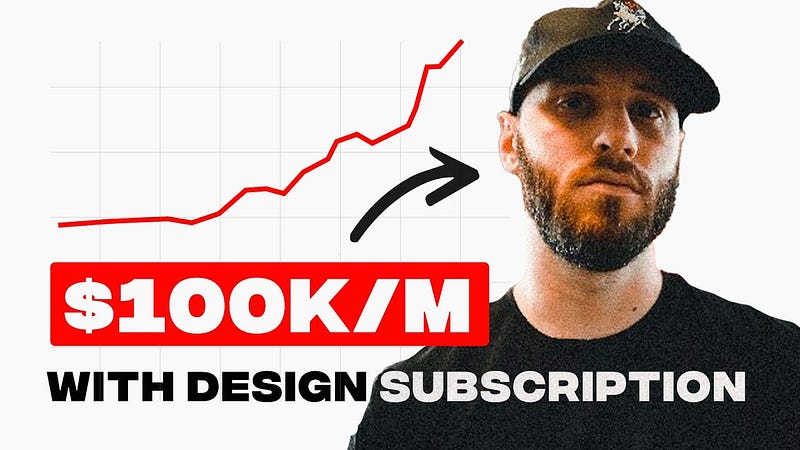
Without evidence, making money on the internet looks like a scam.
From NFT scams to crypto-bros the internet feels like a massive multi-level marketing scheme (you know the type). A virtual wild-wild west where everyone is trying to de3p-throat you with their product.
But, I’ve found my savior.
The knight in shining armor. The hero we didn’t even know we needed. Here’s what we can learn from him.
So, Michael… Who is this bloke?
Meet Brett from DesignJoy.

Most people have never heard of this guy before (me included).
I stumbled upon a random podcast with him on YouTube (thanks YouTube Algo), and got hooked on his story and vibe.
He is extremely humble and open. He’s one of the few entrepreneurs who seems like a normal guy who genuinely loves what he does.
No puffing his chest or repeating cliches that make you want to puke.
This is no overnight success story either. Brett is open about how long he worked as a designer in a traditional agency for years.
He learned the ropes of the industry but also identified all the problems he experienced in his own work as a designer.
This is where most people go wrong:
- They mistakenly believe they can do the Elon Musk and enter an industry they know nothing about and transform it into something else.
- They aren’t willing to put in the work to learn about an industry or sector, so they create products or services that don’t appeal to anyone.
Here’s what Brett did instead.
What you REALLY don’t need to do this:
- Credentials (Brett is self-taught).
- Permission (Launched on Product Hunt)
- Lots of capital (For less than $30)
- A massive team (Took him less than 12 hours)
What you do need:
- Growth mindset.
- Belief.
- Anti-fragility.
Glad I got that out of the way. Please continue.
Start (extremely) small and follow the data.
Brett started DesignJoy with:
- A simple $29 landing page
- A humble launch on Product Hunt.
He did this in one day, while he still had his 9–5 job.
This MVP:
- Attracted feedback.
- Paying customers.
- Data to iterate.
Most people spend too much time guessing what their clients want, rather than creating a prototype and testing assumptions.
Wrong.
Brett took the guesswork out of his service with real-world data.
Build in public. Test your assumptions. Collect data. Iterate. Repeat.
Reduce the time-to-value delay
The speed of value delivery is everything in the online world.
Everyone is accustomed to on-demand delivery.
Brett took this principle and sprinkled it throughout his business. From initial contact to delivery, most design agencies can take weeks or even months to get something to you.
Brett reduced this to 48 hours (or less).
No customer will ever say:
“please take months to deliver value. I am happy to wait.”
Speed is everything. It doesn’t need to be 48 hours, but reduce the time to deliver value ASAP.
Productize yourself and your skills through a service-based business.
Everyone’s obsessed with building the next Tesla or Apple.
Chances are it won’t happen. Soz bro.
But building a…
- Low start-up cost,
- Low overhead,
- No-inventory,
- No employee,
…service-based business is definitely possible.
Guess how much it cost Brett to run Designjoy?
$176. Yep. For less than $200 per month, he nets close to $100k profit.
How? He already had the skills and knowledge in design. He just productized himself into a business and offer.
And so can you.
You can create a service-based business by productizing the skills, knowledge, and interests you already have.
The best part? You won’t have much competition. Because no one is exactly the same as you.
Keep it simple, stupid
Reduce all bells and whistles in your workflow.
Brett runs a $1m+ profit service business on:
- Trello Board + Airtable (client & workflow management)
- Webflow (service delivery)
- Figma (design)
- Shutter Stock (photos)
- Zoom (come on, you know what Zoom is)
LOL. It seems absurdly simple.
A confused prospect doesn’t buy. The DesignJoy process is so simple to understand, even a design-illiterate idiot like me can understand it.
KISS = Keep. It. Simple. Stupid.
Avoid or minimize meetings at all costs
Brett made all communication with clients asynchronous.
This is a fancy way of saying ‘not in real-time.’
The only face-to-face interaction is a 15-minute Zoom call Brett gives to new clients to onboard them to Trello and the design process, and that’s it.
He sets the expectation that you can’t call or request a meeting.
By doing this, Brett:
- Maximizes his time on high-value tasks.
- Protects his energy.
Your customer avatar might need more communication touchpoints than this, but the principle remains.
Do the bare-ass minimum when it comes to live meetings.
Talent doesn’t matter (as much), but positioning does.
Brett openly admits he isn’t the best designer.
There are people out there far more technical than him. But after a certain point, talent reaches diminishing returns.
The ROI of being in the top 15% of any skill compared to the top 1% diminishes rapidly. A random person on the sidewalk can’t appreciate the difference in technicality to pay more.
So what makes him stand out?
Answer: Positioning + Offer.
DesignJoy is the Netflix of design. A subscription service business model that doesn’t charge hourly. You get unlimited requests and revisions. This is unheard of in the Designer space.
He has created a grand slam offer that even Papa Hormozi would be proud of.
Solve your own problem, then solve that problem for others
Brett has taken everything he knows and created an online course full of frameworks, mental models, and strategies.
People get mad at this. I don’t get why.
“He sells an online course” is said in the tone as if he sells coca!ne to kids.
I personally love that we live in a day and age where people who have tried and tested what works and succeeded are openly sharing their secrets with us.
People roll their eyes at someone charging $150 for a course with relevant information, data, and formulas that work, but would happily buy $100k+ to do an MBA from professors who have never run a business in their life.
LOL. Idiots.
Document what you learn. Wins. Losses. Successes. Everything. Package it into a course to help others do the same thing.
What can we take away from Brett’s story?
Brett is an ordinary guy.
But what looks extraordinary is really someone doing ordinary things for an extraordinary length of time.
Brett still worked his 9–5 job for 3 years while running DesignJoy. He only quit when he was making $80k profit per month. This took time.
That’s how he’s been able to make $1.3m+ in profit while only working 5–6 hours per day from home. He is so open about his process you can steal from it:
- Start extremely small.
- Reduce time-to-value delay.
- Keep it ridiculously simple.
- Spend time on high-value tasks.
- Focus on positioning and offer.
This won’t be easy, but it's definitely not as hard as you think it is.
👉 Learn how to build your six-figure one-person business alongside your 9–5 job with my 5-Day One-Person Business Builder Crash Course (paid).


