
Extreme Watercolour Painting
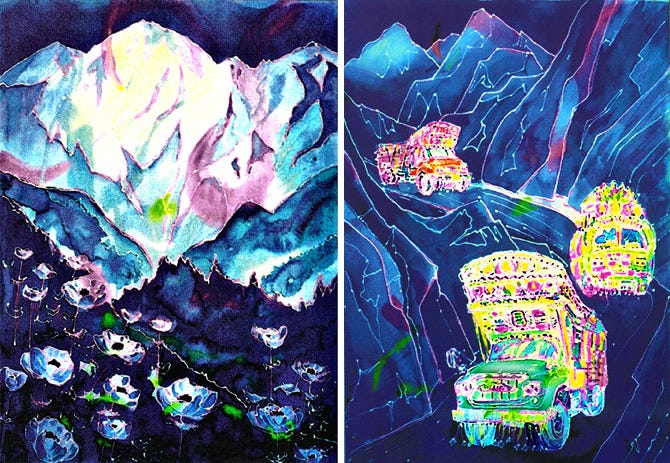
Watercolour is only extreme under certain circumstances. The painting must be done on location, and you must go on location in a taxi. And it only applies in certain countries.
When we lived in Dubai and my husband worked for Emirates Airline, I had easy access to many such countries.
I’ll explain the concept of extreme watercolour painting using three of these, beginning with Pakistan.
To my surprise, my husband had agreed to accompany me on a painting ‘trek’ in the mountains there. We’d drawn up a fairly tight schedule: a flight to Islamabad, with side trips up to Gilgit in the Himalayas and Chitral in the Hindu Kush, to see some of the highest mountains in the world. Various intriguing possibilities had been considered — nothing requiring oxygen tanks of course, but definitely covering some spectacular territory. The man who checked us onto the Islamabad flight at the Dubai airport was most helpful and particularly pleased when we mentioned the mountains — his exact part of the world as it turned out. In his enthusiasm, however, he overestimated our age and said we really must plan to stay at the Pearl Continental Hotel — five stars! — at Bhurban in the Murree Hills. Without being too scathing about it, I allowed that we might try something a little more challenging. Then I shouldered my painting pack as effortlessly as possible and, with a friendly wave, marched carefully up the boarding stairs.
Our trek began to unravel at the Islamabad airport when we arrived at the check-in for the flight to Gilgit. We thought we were early, arriving two hours before take-off, but soon learned that the other folks there, about one and a half planeloads’ worth, had arrived on average two days before take-off time. Apparently, most of the flights to Gilgit are canceled sooner or later, and the local frequent fliers become quite skilled at getting on any flights that actually do take place. After a while the lady behind the counter divulged that each flight has two seats reserved for foreign tourists and that, although we couldn’t possibly get on this one, if we went immediately to the booking office — which happened to be in the ‘nearby’ city of Rawalpindi — our chances were excellent on the next one.
Some hours later we returned to the airport in time to take our two foreign tourist seats on the next flight, only to learn the flight we couldn’t get on before had been canceled so our seats on this later flight had been taken over by skilled frequent-fliers. No problem — our foreign tourist reservations could be switched to the first flight the next day. At the office in Rawalpindi, of course.
We phoned the Pearl Continental — five stars! — in Bhurban. We were told the only way up there was in a taxi.
About one hour into the precipitous three-hour drive, we decided against making the planned trips to the airport each day to check on flights — if we ever made it to the top, we’d be up there for the duration. Besides traversing several washouts — one of which was still underway — we had to get past the most beautifully decorated fleet of trucks in the world. These trucks were huge, slow, and ever so paintable. Each time we passed a spectacular one, we had to stop so I could take its picture as it inched past us. Then, of course, we were behind it again. Adding to the excitement of having to pass each of the especially great-looking trucks two or three times was the frequent arrival of equally huge and beautiful trucks coming down on the return trip to Islamabad. At speeds approaching free-fall. Eventually, that extreme painting trip worked out, and so did the pictures.
My next extreme location painting adventure was in Vietnam where, unlike Pakistan where women don’t normally travel unaccompanied, I was on my own.
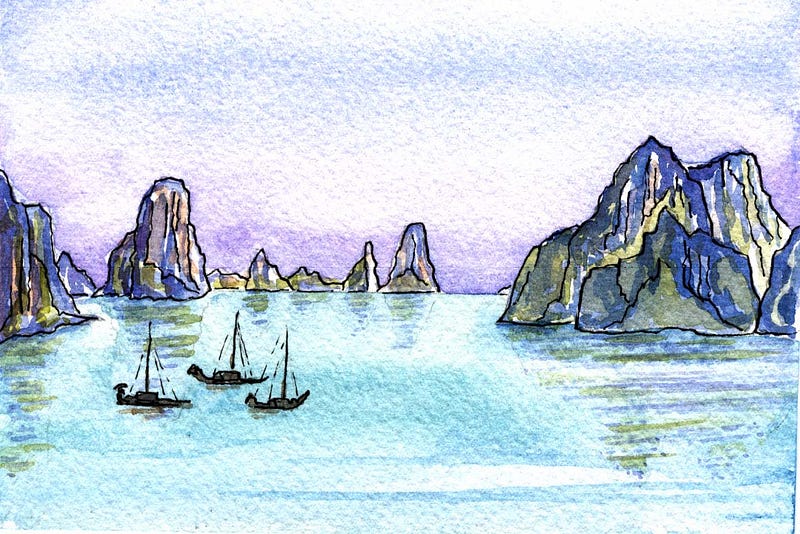
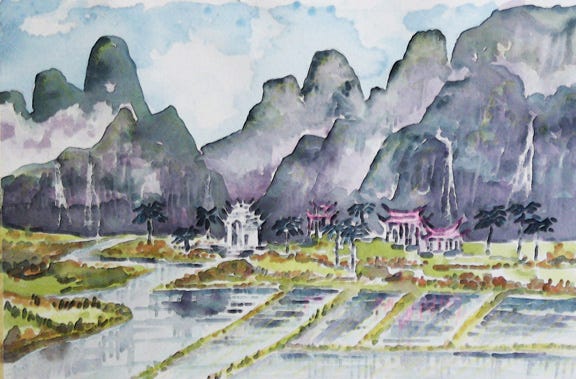
When I landed in Hanoi, I selected one of the airport taxi drivers who were surrounding me and showed him the list of eleven places I wanted to be taken to. He determined this was going to take several hours, ascertained that I would pay in American dollars (a very reasonable number of them, I should mention) and off we went. My objective was to see the lakes of Hanoi, the seascapes of the Gulf of Tonkin, and the mountains.
Everywhere one goes in Vietnam, north or south, city or country, driving or walking, requires the negotiation of mixed flows of bicycles, motorcycles, cars and buses. Really mixed flows. At first, I was terrified.
Cyclists are not expected to confine themselves to slow lanes, and the motor vehicles, some of which have all the acceleration of a well-oiled grocery cart, are not about to lose precious momentum by slowing down unnecessarily. When I calmed down a little, I realized that as long as we didn’t do anything the rest of them couldn’t possibly anticipate, like come to a stop, we would eventually get where we were going. They simply wove us into their pattern.
People have said I captured the tranquility of the landscape in my paintings, which is pretty amazing, as there wasn’t much of that to capture.
And then there’s India.
First, I will tell you about the signs on the backs of the big trucks there. They say ‘Please Honk’. I am not making this up — there is a reason for the signs. Nobody has side mirrors, because when you’re operating four or five lanes of traffic on every two-lane road, there’s simply no room for such whimsy. And the truck drivers you’re stuck behind would like to hear about it if you’re interested in passing. I grew quite fond of those signs. As long as I was staring at one, the accident I expected at any second would be a simple rear-ender.
My first inkling of how terrifying the traffic would be was a collision in which my taxi was involved near the Red Fort in Delhi. None of the four participating vehicles were going very fast, and we all slowed right down while the grinding and bashing was going on. But nobody actually stopped!
After that I began to notice that everyone had scrapes and grooves on most of their doors and fenders. My driver confirmed my suspicion that it was not common practice to have these things repaired right away. (Because a few strategic gouges make an important statement about the likelihood you will ever yield the right-of-way.)
After a scary day of taxiing around Delhi, we set out the next morning on the 250-kilometre drive to Agra, home to a full afternoon’s worth of magnificent Mughal architecture, ending up at the Taj Mahal. It is said that no matter how much you may have heard about this serene and perfect place, it will not disappoint you. And it’s true. We left as the rising full moon made the most of its opalescent splendor.
For reasons that escape me, I had made a hotel reservation for the night in Jaipur, another 260 kilometers away. (That’s about 1000 miles. No, seriously, it’s only about 160 miles, but it seemed like at least 1000 that night.)
In India they drive on the left, where I have never felt comfortable. But that uneasiness is nothing compared to the way it feels to be on the right in India, which is where we were most of the time because my driver was passing everything on the road — camel caravans, bicycles, still-smoldering wrecks, cattle, Please Honk trucks, paan-encrusted buses, jewelry salespersons, small restaurants, vehicles being repaired (protected by a row of boulders rolled onto the road), other terrified tourists, plus about a million of the regular things you’d expect to find on a highway.
We made a brief stop at ‘the Emperor’s Dream City,’ Fatehpur Sikri. Did I relax and paint this wondrous place? Not a chance! I was barely able to do one extreme location sketch. Then we negotiated the remaining distance to Jaipur, arriving a little after midnight. I’m pretty sure that less than half of the other users of the road had lights. And I’ve never been so scared in my life.
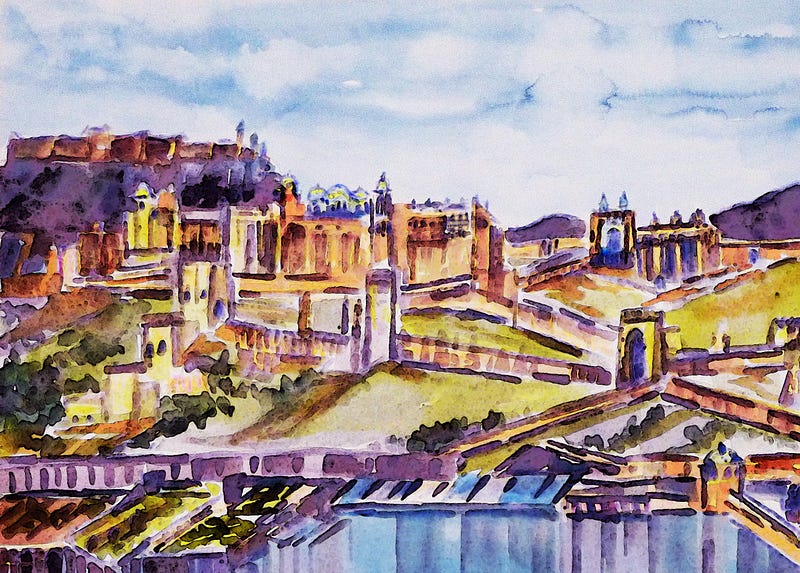
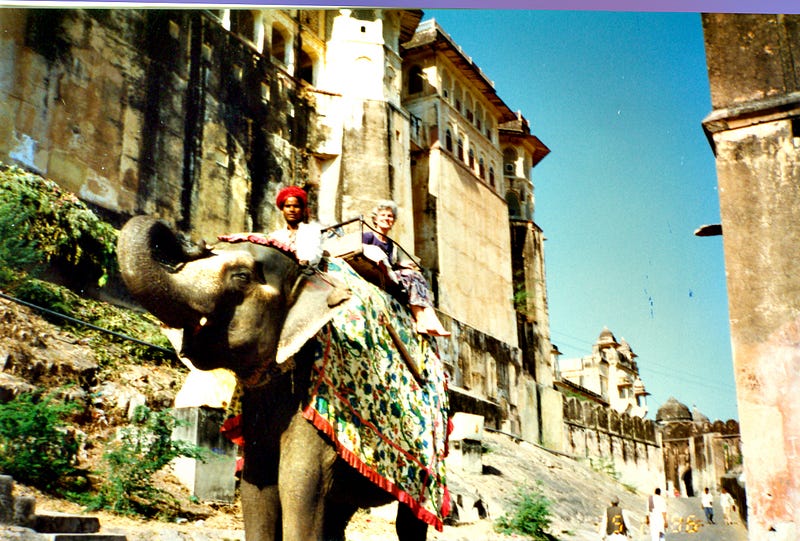
Happily, the next day in Jaipur was wonderful. I had plenty of time to start the Amber Fort painting, then ride up to the main gate in a relaxed manner.
And we got back to Delhi before dark!