
Extractive vs Generative Q&A — Which is better for your business?
The arrival of ChatGPT hints at a new era of search engines, this tutorial dives into the 2 basic types of AI based question answering
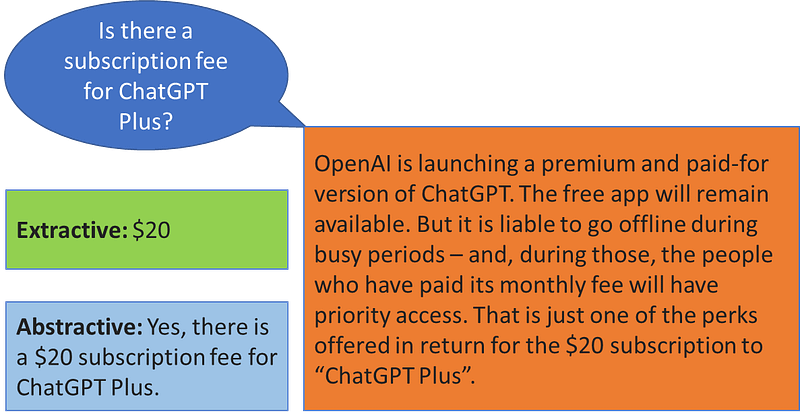
Transformer models introduced in 2017 have led to a breakthrough in solving hard language related tasks. Variations of the original transformer architecture in models like BERT, GPT, etc. trained on large amounts of text data have produced state of the art results on language related tasks.
One of the greatest benefits of AI is in the ability to perform tasks that previously needed domain expertise and careful perusal — faster and at a fraction of the cost. I believe this will revolutionize industries in the coming decade.
A typical task is extracting information from text. Question Answering is a powerful information extraction tool, whereby models can be trained to extract specific bits of information through complex queries. Think about the potential time and money saved by AI models in answering hard questions from legal documents, instead of asking an experienced lawyer or hiring an intern to pour over the document for hours. Let’s take a dive into the 2 basic types of AI based QA: Extractive vs Abstractive.
Extractive QA
The BERT transformer model was released in 2019 by the Google Language team. BERT was trained on unlabeled text data by masking words and training the model to predict masked words based on context. This masked word prediction is a common test, administered to gauge language proficiency.
After training the model, BERT was later fine-tuned on multiple tasks. In particular, BERT was fine-tuned on hundreds of thousands of question answer pairs from the SQUAD dataset, consisting of questions posed on Wikipedia articles, where the answer to every question is a segment of text, or span, from the corresponding passage.
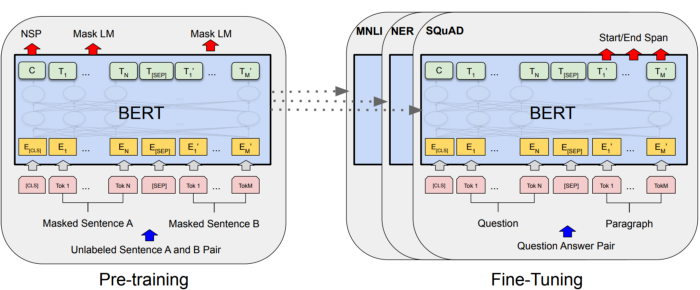
The architecture of BERT and BERT-like models compose one-half of the original transformer architecture proposed in the 2017 paper, known as the encoder. In this model, E denotes the token embeddings wherein the original sentence of length M is converted to a length M’ (BERT used the WordPiece embeddings). The final hidden vector T can be used to predict which part of the text represents the start of the answer and the end of the answer using a softmax.
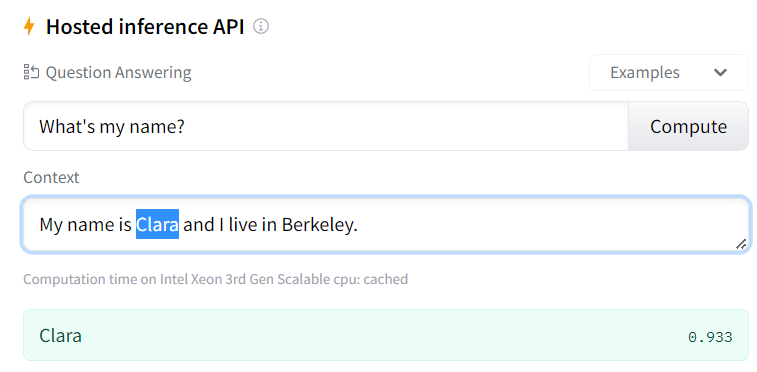
RoBERTa is a variation of BERT that modified key hyperparameters during training and improved overall performance. Let’s look at the output of a fine-tuned RoBERTa model on huggingface released by deepset. As you can see below, in extractive QA the answering you are limited to text contained within the original context:
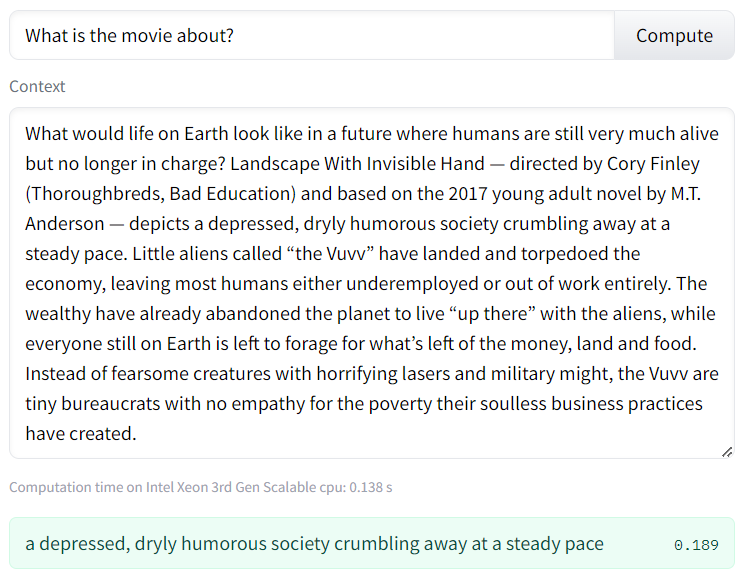
However, the answer is not always the best. As you can see below, for a movie review the answer I would have chosen would have been “What would life on Earth look like in a future where humans are still very much alive but no longer in charge”
The solution to getting more relevant results is fine-tuning. In the article below, I have discussed how to fine-tune extractive question answering models on the HuggingFace hub using custom data. Fine-tuning based on just a few thousand examples can vastly improve performance, sometimes by more than 50%.
However, extractive QA does not do so well in cases where the answer is not explicitly in the context like below.
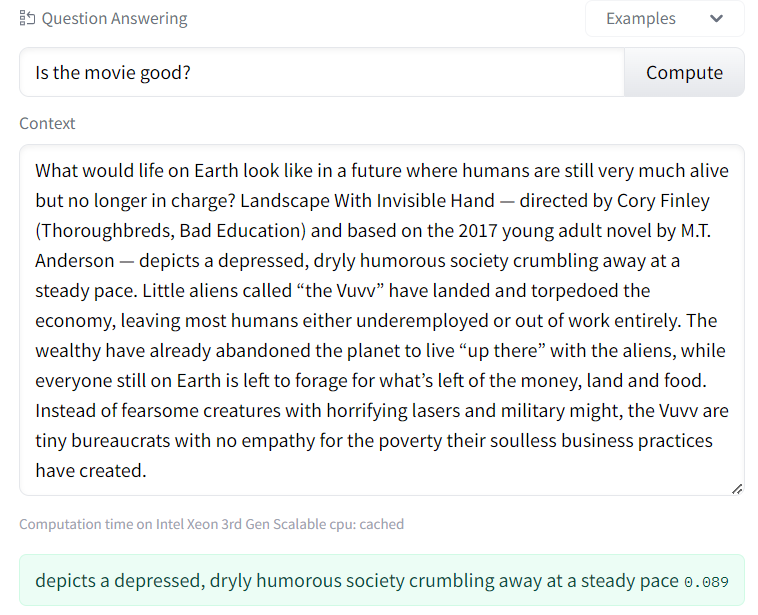
This issue can be circumvented by appending “ANSWERNOTFOUND” and fine-tuning on these cases so that the model does not yield an answer when it is unsure.
Abstractive QA
While ChatGPT has taken the whole world by storm recently, the original GPT model was released before BERT. GPT models use the decoder layer of the original 2017 Transformer. GPT models are trained to predict the next word in a sequence in an unsupervised manner. Next, they are fine-tuned in a supervised fashion. For QA, GPT models are presented during fine-tuning with multiple answer choices across numerous examples, and they are trained to pick the right choice. One important difference at inference is that GPT models output one token at a time and thus are generative, rather than extractive.
Currently, OpenAI has 4 major language models that they offer API access to:
- Ada ($0.0004 / 1K tokens — Fastest)
- Babbage ($0.0005 / 1K tokens)
- Curie ($0.0020 / 1K tokens)
- Davinci ($0.0200 / 1K tokens — Most powerful)
For reference, 1K tokens is basically 750 words that you send in to the API to process. So let’s see how this model does for similar questions:
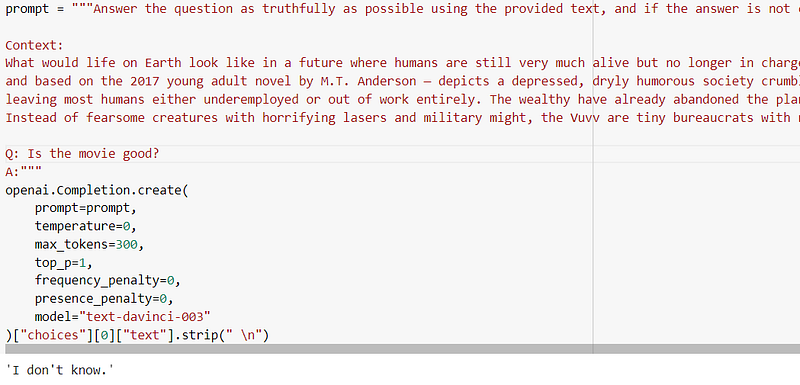
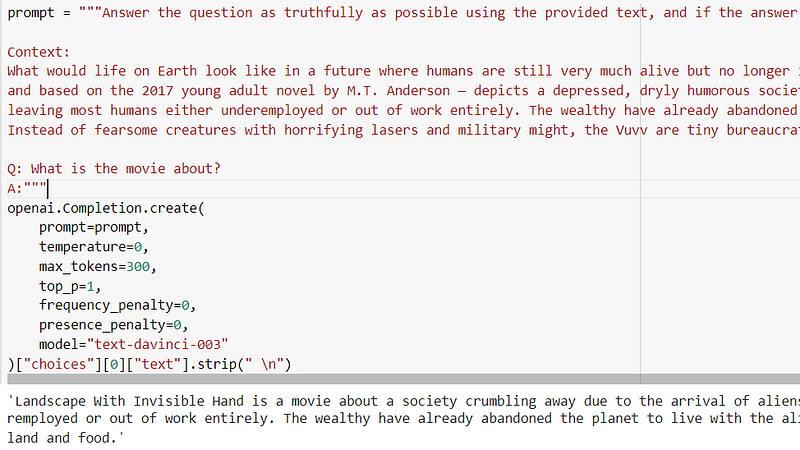
As you can see, the Davinci model does pretty well in summarizing movie plots as well as saying “I don’t know” when the answer is not clearly in the context.
Which Model is Better — Abstractive or Extractive??
You might be tempted to say that OpenAI’s abstractive QA is clearly superior to extractive QA models. However, that is where the business case matters. I’ll break it down below:
Cost
The Davinci model is clearly more expensive, at a large enough scale. It amounts to 0.02$ per 1K tokens which might as well be 0.02$ for 1–10 queries. Whereas hosting a model from Hugging Face on AWS might amount to a fraction of the cost, at 0.5 cents to 1$ per hour running thousands or more queries every hour.
Output
If you are interested in building a chat bot type interface and expect free response answers, abstractive QA is the way to go. Your users might not be satisfied by dry extractive answers that paraphrase the text. However, if you are doing post processing on the answers obtained — say storing numbers in a database, abstractive QA might be a hindrance as you need to use additional logic to strip out extra words.
Customizability
OpenAI API usage requires reliance on OpenAI servers. While they do make it possible to fine-tune their models on custom data, it is not possible to host these models on separate infrastructures like AWS. But you can take open-source models on Hugging Face and create APIs on AWS, and not have to rely any more on Hugging Face for model serving. This is powerful in that it allows companies to keep all the infrastructure in-house and rely only on cloud providers like AWS.
One thing I would like to point out is that Hugging Face does also support abstractive QA models. In fact, they released a text2text generation model Flan T5 on the model hub recently. But I have noticed that this model does not perform as well on QA tasks as the Davinci GPT-3 model. Very soon, I expect Hugging Face to also host open-source fine-tuned models like the Davinci GPT-3 model.
I hope this article was a useful walkthrough in using AI for question answering. In conjunction with existing methods for information retrieval and searching through large amounts of data, AI based information extraction can help extract needles from haystacks, and greatly improve efficiency in extracting essential details from large amounts of data, previously possible only through human comprehension.
UPDATE: https://www.answerchatai.com/ — our QA engine using generative AI to answer questions and extract key knowledge from custom text is now live! Answer domain specific questions 3 easy steps!
- Upload a URL or paste a text and hit the search button
- Ask a question specific to the context and hit query
- Get your answer!
Feel free to use and let me know your feedback!
If you are not yet a Medium member and want to support writers like me, feel free to sign-up through my referral link: https://skanda-vivek.medium.com/membership
For weekly data-based perspectives subscribe here!


