
Exploring the Fractal Nature of Vedanta Philosophy’s Sacred Texts
Upanishads have dialogues where disciples question and masters answer, sparking new questions and understanding. Fractals of endless insights
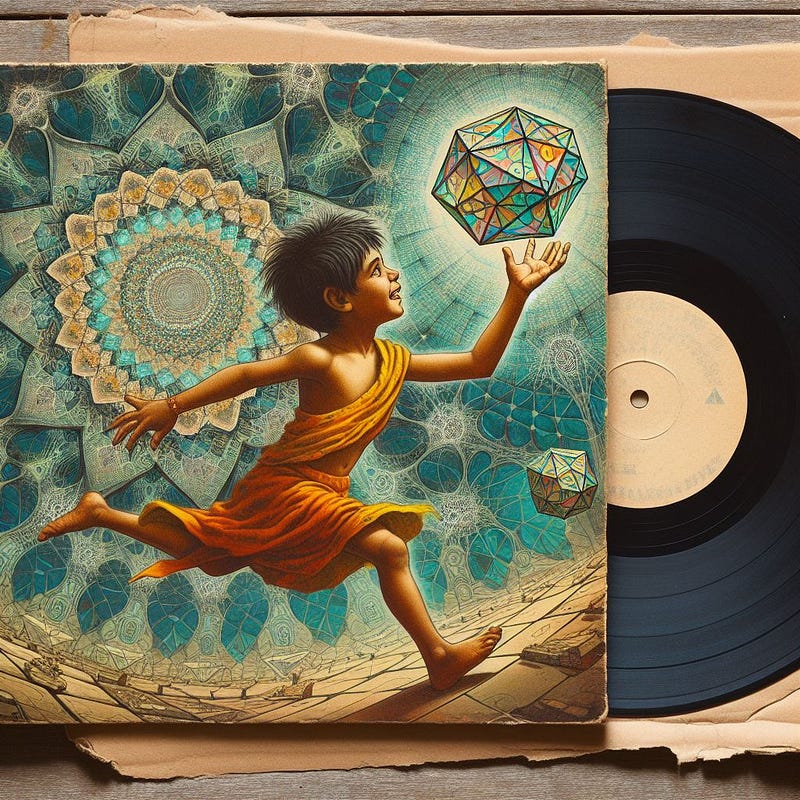
Images
In this article, I aim to explore the affinities between the fractal nature of Vedantic texts and some key concepts such as Jigyasu Bhava, the perpetual spiritual curiosity.
I realize that such topics can come across as dry or abstract for many, accustomed as they are to very different forms of dissemination. For this reason, I wanted to experiment with a new approach capable of engaging a wider audience by stimulating their creativity and desire to discover.
I generated some images inspired by the style of graphic novels and the iconic album covers of the 1970s, environments that evoke atmospheres of lightness and wonder. On the other hand, music has a close correlation to what I am presenting, as you will discover by reading. The result is the depiction of a happy Indian child in the fractal universe, to signify how even the deepest spiritual quest can maintain a playful spirit free from rigid schemes.
I also wanted to give concreteness to the concepts through vintage textures and materials, almost as if wanting to “touch them with one’s hands”. These are not merely decorative illustrations, but a device to introduce topics usually considered “complex” and inaccessible to many, in an engaging way. Certainly, the images alone do not explain anything: it is now my task to delve deeper into the parallels between Vedanta and fractals, adequately contextualizing the conveyed message. I hope a more “pop” approach can make these topics accessible to a wider audience, arousing their curiosity.
Texts of Vedanta
The fundamental texts of Vedanta, such as the Upanishads, the Bhagavad Gita and the Brahma Sutras, can be interpreted as real fractals of fractals, both for their structure and for their contents. Fractals are geometric objects that present self-similarity, that is parts of their structure repeat recursively on different scales. Also, fractals have infinite complexity, since enlarging the details more and more emerges to infinity.
The Upanishads have a dialogic and interrogative structure: a disciple asks questions and a master answers, but opens new questions and levels of understanding. It is a fractal proceeding, made up of endless insights. The Brahma Sutras condense the Upanishadic message into brief aphorisms, which are then resumed and expanded in the Bhagavad Gita. Also at the content level, there are fractal structures.
The concepts of Brahman, the impersonal Absolute, and Atman, the individual Self, reflect each other. Brahman is the undifferentiated totality but manifests itself in every creature as Atman. Atman is the innermost core in every being, but it is also identical to Brahman, the ultimate Reality. There is an infinite reference between macrocosm and microcosm.
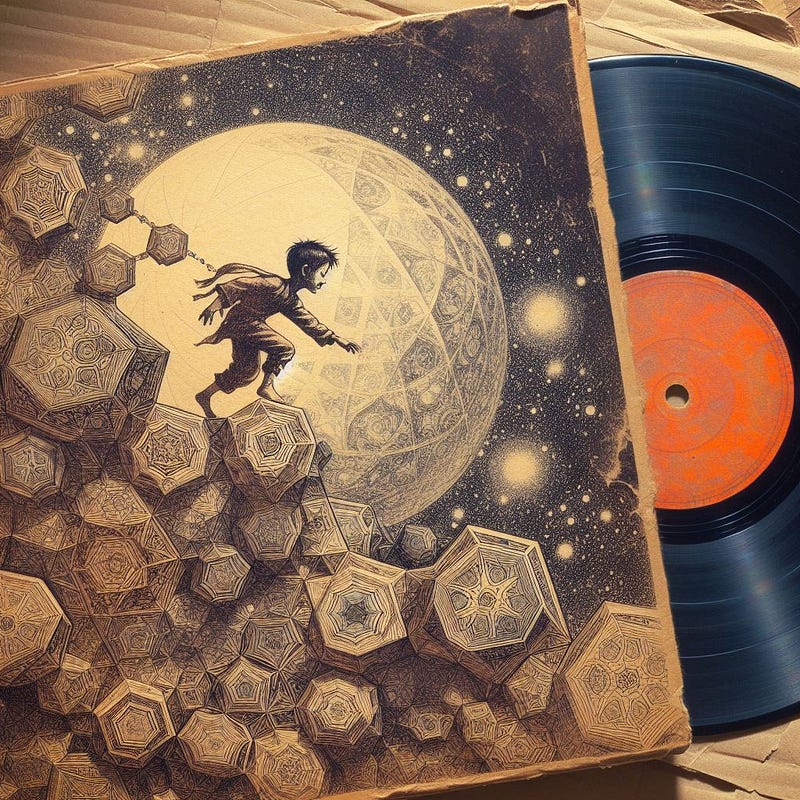
In the Bhagavad Gita, the relationship between the One and the many, between totality and parts, is developed in a fractal key. Krishna claims to be the essence in every creature, the light in every luminary. Divine immanence and transcendence reflect each other mutually.
Also, the three paths of action, devotion and knowledge are presented as distinct but interdependent, each containing the others in nuce. They are like fractals converging towards the same ultimate Reality.
These ideas find a synthesis in the Brahma Sutras, which condense them in an almost aphoristic way and then unfold them again in the Upanishads and Bhagavad Gita. The Vedantic texts thus have a spiral, fractal structure, which continuously takes up the same themes on different levels and with different angles.
We can also define Jigyasu Bhava, the thirst for spiritual knowledge, as a kind of “fractal curiosity.” It never exhausts itself in definitive answers but always generates new questions. The disciple’s research, motivated by Jigyasu Bhava, is similar to the exploration of fractals, where every “zoom” on a detail opens up new scenarios.
Jigyasu Bhava pushes the researcher to contemplate the ultimate Reality from ever higher and deeper perspectives. It is a thirst to know Brahman that has no satiety because the nature of Brahman is infinite. When one thinks he has understood Brahman, he immediately realizes that there is still much more to discover.
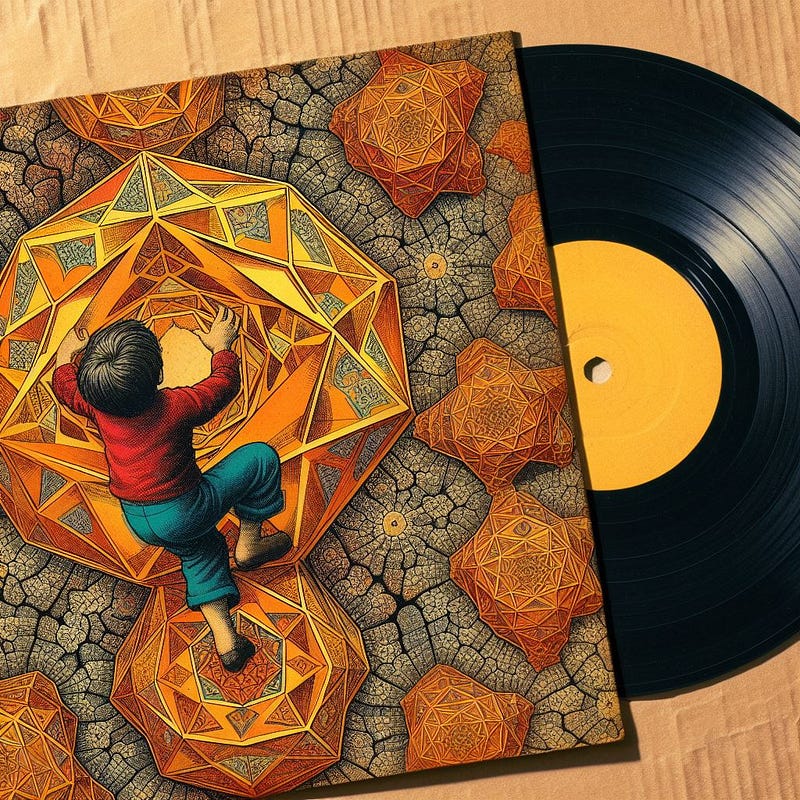
Jigyasu Bhava dissolves preconceptions and limited visions, just as the study of fractals reveals ever-new geometries beyond Euclidean forms. The desire to know the truth gradually leads to transcending the sense of limited ego. The fractal curiosity of Jigyasu Bhava leads the researcher to see himself in all beings and all beings in himself, just as fractals contain self-similarity. One discovers that one’s essence is identical to the supreme essence of Brahman.
However, unlike the rational exploration of geometric fractals, Jigyasu Bhava has a dimension of wonder, marvel and devotion. It is a thirst not only intellectual but also existential, involving the being in its entirety.
The Vedantic texts nourish precisely this “fractal curiosity” since their wealth of meanings is inexhaustible. Each reading reveals new levels, generating that virtuous circle of question and answer, research and revelation, which leads to the knowledge of the ultimate mysteries of existence.
The Upanishads state that Brahman is “subtler than the subtle and vaster than the vast,” indicating the infinite depth and vastness of ultimate Reality. Jigyasu bhava is the desire to dive fearlessly into this ocean, exploring its depths. The Vedantic texts provide the map, but the territory always remains beyond.
The fractal nature of the Upanishads, the Bhagavad Gita and the Brahma Sutras generates a vertiginous effect, as meanings open up on each other, in an endless web of references. But it also produces a catalyzing effect: the more they are read and meditated upon, the more Jigyasu Bhava is ignited, pushing to know Brahman more and more deeply, until final enlightenment.
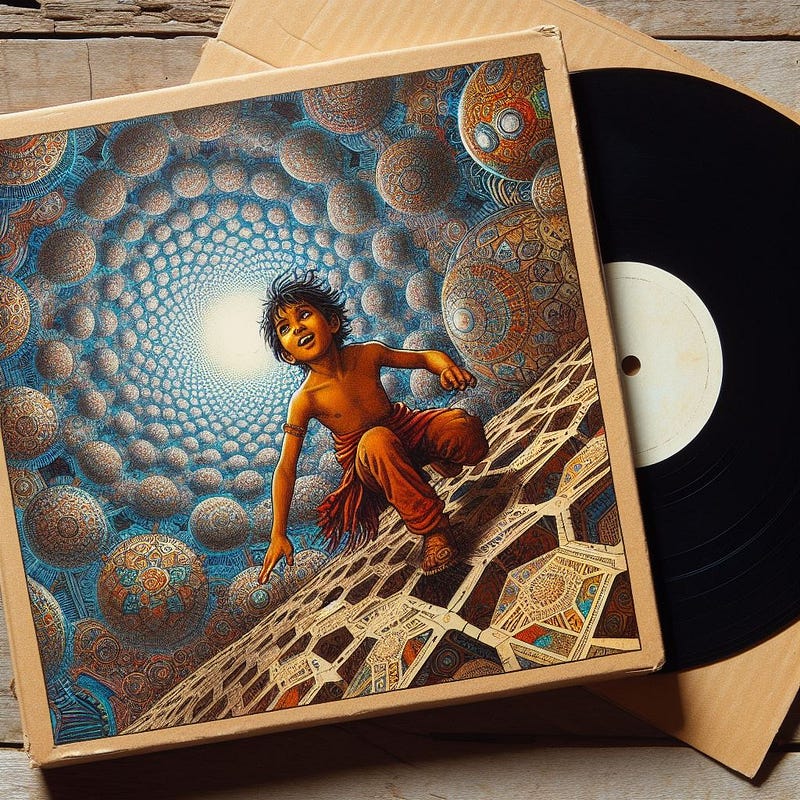
Mathematical fractals tend to infinity. In the same way, the “fractal curiosities” inspired by these texts lead towards the infinity that lies in the heart of every human being.
“Subtler than the subtle, greater than the great, the Atman is hidden in the heart of every creature. He who is free from desire sees the glory of the Atman through the grace of the Creator.”
(Katha Upanishad 1.2.20)
These verses eloquently express how the Atman, the individual Self, is simultaneously subtler than the subtle and greater than the great. This apparent contradiction recalls the self-similar nature of fractals, which present structures that replicate at different scales.
As in a fractal where every part contains the whole, Atman encompasses infinity while being located deep in the heart. A paradox that refers to that divine geometry whereby the Whole is present in every fragment.
The Upanishadic texts invite one to contemplate with wonder this admirable correspondence whereby the microcosm reflects the macrocosm. The quote also captures how such vision is accessible only to those who are free from the veils of ignorance, immersing themselves in the grace of the Absolute from which everything emerges in a sublime fractal geometry.
Thanks for reading.
For more information, follow my Vedanta Substack:


