
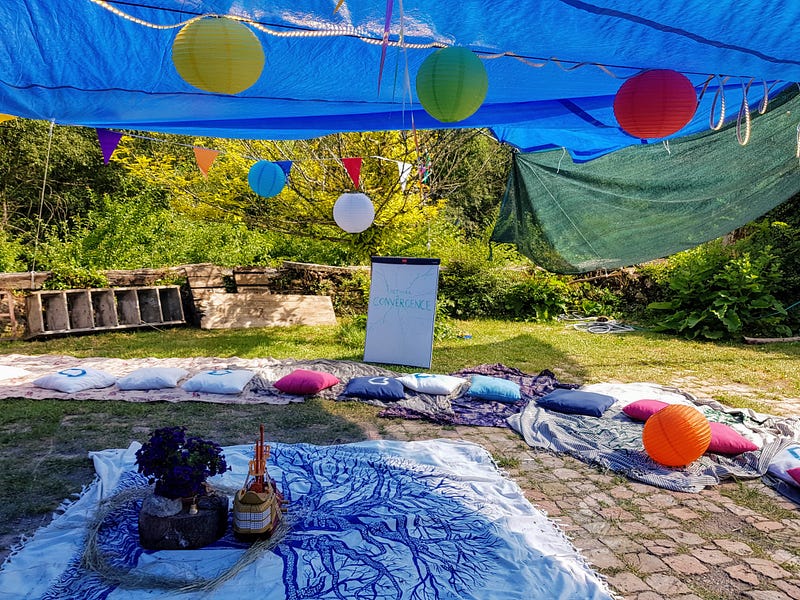
Exploring the ecosystem
Reflections from the Network Convergence retreat
Last week I spent five days in the beautiful Catalonian countryside with 40 others for an event called “Network Convergence.” Organised by four networks, Enspiral, Ouishare, PandoraHub and Greaterthan, the invitation for the gathering was this:
What if networks and business communities collaborated to help each other achieve maximum impact and spread ideas? Shared lessons in how to govern? Collaboratively scaled products and services? Provided a North Star for other collectives, communities, cooperatives and networks just starting out?
In the spirit of producing commons for networks around the world, here is a sprinkling of some of what I learned and reflected on.
Networks vs. ecosystems
In one Open Space session, Matthew Schutte from Holochain explained the difference between networks and ecosystems. In a network, information is passed around in the same form, whereas in an ecosystem, an agent can receive information in one form and transform it, even if they weren’t capable of receiving the information in its original format.
If we take organisations, there is always a tension between efficiency and resilience. A pyramid structure has afforded us great efficiency, but it doesn’t create very resilient structures, especially in complex contexts. For alternatives, we can look to nature. Bees don’t find honey by sending the entire hive in one direction — that would be disastrous if none was found. Instead, individual bees take individual risks — some succeed and pass on what they’ve learned, some fail — but the hive survives. One organisation I wrote about in 2015 was inspired by nature. Matt Black Systems, a small aerospace engineering company in the UK, has developed a particular model of self-management involving an extreme of lean — cells of one. Each employee can afford to take creative risks because they are part of a resilient, anti-fragile whole system that can take the hit if a poor decision is made.
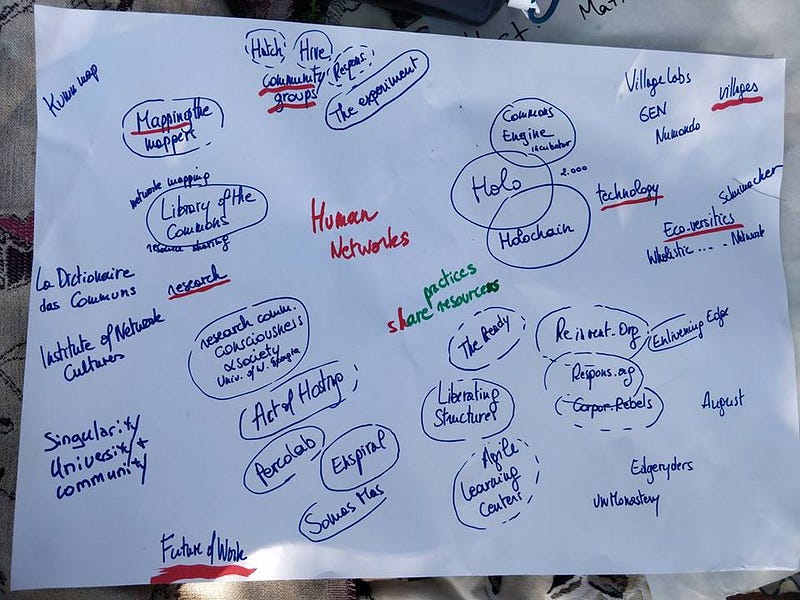
The production of commons
In an ecosystem, agents share information with each other to survive and thrive — like the bees in a hive. In The Hidden Life of Trees, Peter Wohlleben writes about how trees communicate with each other — sharing nutrients and even warning each other of impending dangers. So at our Network Convergence, we had many conversations about how we could learn from each other’s networks, observe patterns, share what has worked and hasn’t worked. Christine Lai, who is a collaboration catalyst and connector for networks like Village Global, The Ready, and Delivering Happiness, likes to call this “mycelium.” Mycelium are fungal threads that form networks underground in order to pass on water and nutrients in a symbiotic relationship with trees and other green plants. How can we by mycelium, then, and distinguish the lifeblood of thriving networks and the practices that make a difference, in order to share them with and nourish our wider ecosystem?
Three Network Convergence practices to learn from
Sharing Economy
Inspired by the Art of Hosting community, we concluded the Network Convergence using a “pay what feels right”, sharing economy structure. We all had access to the full budget for what the whole event cost and were told three possible tiers of individual contributions: one which would result in covering costs, another that meant more funds could go to paying those who produced the event, and finally, an “abundant” option which would result in additional funds which the group could later decide on how to distribute using Cobudget. These were just three possibilities — people were invited to choose a number from zero to whatever, going with what felt right and possible for them. (To read more about Sharing Economy, see this post.)
This practice allowed us to think about how we create and share value, and to consider ourselves as part of an ecosystem, rather than passive consumers of an event, by sharing the responsibility for renumeration.
Intercambio
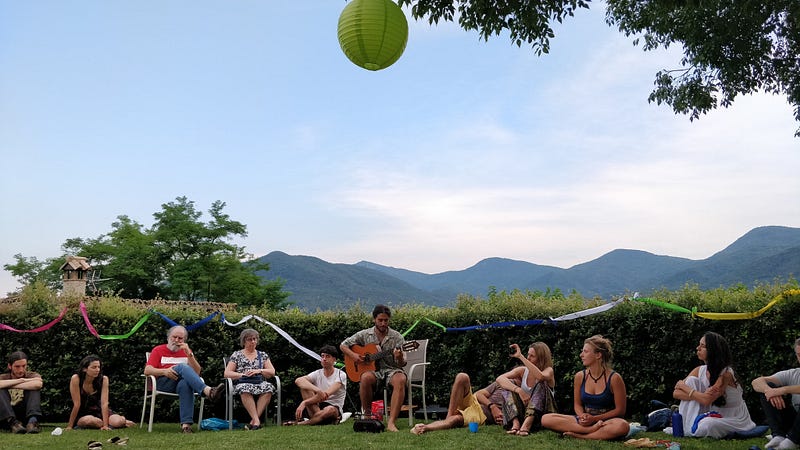
One of the most powerful parts of the convergence for me was the intercambio. It would have been easy for us to be retreat tourists, flying in from places like the US and New Zealand to converge in the local village of Mieres, creating our own bubble for several days, patting ourselves on the back and then returning home. Instead, Pandorahub created a beautiful afternoon where we hosted around ten villagers at our accommodation and sat in a circle to exchange gifts from our different cultures. Some examples of gifts were: a telling of the history of Mieres, songs, poems, tickets to a local theatre performance, food, dance, a bike tour, hand-crafted gifts — each with a story about its origin and meaning. It was a moving demonstration of what makes us unique and what unites us in our humanity. I think this is a really respectful and rewarding practice that would add a lot of value to any retreat or event and challenges us to think of place as more than just a temporary venue.
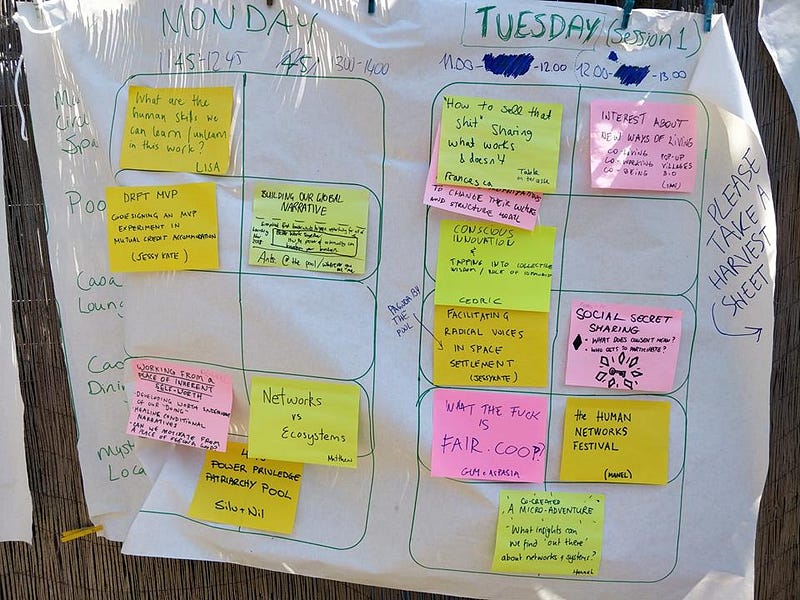
Co-created agenda
There were some structured activities, like the intercambio and a Greek agora we created in the middle of a forest, but the backbone of the event was designed using Open Space Technology. We had several marketplace sessions where people could propose sessions — a topic, a question, an experience — and we had the autonomy to move freely between sessions (The Law of Two Feet). On the first day, we were also divided into Home Groups and assigned a day in the schedule for which we were responsible. Duties included facilitating the morning circle session and setting the frame for the day, and designing a session based on the theme we’d been given (for example, “Body and Soul”). This meant that the responsibility of designing and holding the agenda for the event was distributed amongst the group, and, as with the Sharing Economy, shifting our mindset from passive to truly collaborative.
Shadow sides
In one of the sessions, social alchemist Michel Bachmann facilitated an exercise from Social Presencing Theatre called “The Village.” It’s a silent and physical exercise that can reveal insights about the dynamics of a group. We observed that the climate of our group at the Network Convergence was very harmonious and playful and consequently, some people craved more depth. Could we have been bolder in our discussions? Could we have asked ourselves tougher questions? Facilitator and coach Ria Baeck summed it up as “we weren’t wild enough.” Perhaps this is symptomatic of the kinds of networks we represent where our well-intentioned commitment to caring for each other can produce a culture of “violent politeness”. Perhaps it was because it’s a fairly nascent community and we needed to build trust and connections first.
Another point raised was the issue of privilege. There was a powerful Open Space session, I’m told, about “Privilege, Power, and Patriarchy” on the first day. Some people continued the discussion but perhaps it didn’t get the airtime it deserved and there haven’t, as yet, been any action points regarding who wasn’t at the convergence, why that is, and what can be done to change that.
Network Convergence commons
In terms of action points, some of the commons we have agreed to produce are:
- A network map, perhaps using Kumu, of those who attended
- A networks manifesto
- A Network Convergence playbook to support anyone who want to host such an event
- Out of an Open Space session I hosted: a post about the human skills that would be valuable for us to learn (and unlearn) in order to thrive in self-managing ways of working (watch this space!)
- Data about demographics and earnings of people working in networks like these (the survey results of just our small group revealed a huge gap between lowest and highest income, but we were fairly balanced on gender)
And one existing, curated list of resources shared by one of the attendees: