
Exploring My French Canadian Heritage: A Journey Through the Five French Mother Sauces
Sauce one — Béchamel
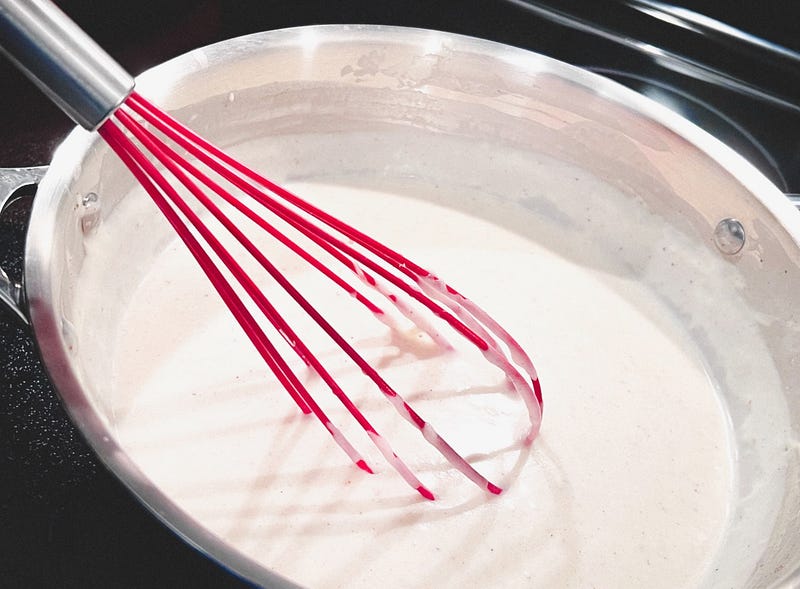
If you follow me, you know I cook for my wellness. Not always my physical health — some recipes have high-calorie counts! But for my mental wellness. There is much to be said about the wellness aspects of cooking and how it helps you manage your mental wellness.
Accordingly, I recently challenged myself to learn the five French Mother Sauces. My reasons are not just learning to cook but reconnecting with my French Canadian heritage. Many of you know I recently challenged myself to learn the five French Mother Sauces. Yes, French and French Canadian cuisines are different. Still, I was looking to start something where lots of instruction was available.
Learning the five French Mother Sauces seemed like as good a place as any for someone who believes the process is as necessary as the result. I want to know more than the recipe for each sauce; I want to understand the technique and the subtleties. How do small changes in practice and ingredients affect the end result?
I also wanted to learn about the origin of these sauces. It is funny we call them the French Mother Sauces since at least one of these, Espagnol, is Spanish in origin. But in the end, they are the French Mother Sauces because the French took the time to classify them and establish the list.
For no particular reason, I chose to start with Béchamel sauce. While the recipe is quite simple, it was interesting that there are a hundred ways to make this sauce. But we’ll discuss that later. Let’s start at the beginning.
Let’s get cooking
Béchamel sauce is a classic French sauce made from a simple combination of butter, flour, and milk. Like all Mother Sauces, chefs use Béchamel as a base for other sauces.
The origin of the name “Béchamel” is a matter of debate among culinary historians. Some believe it was named after Louis de Béchamel, a French cook and steward to King Louis XIV. That makes sense to me, given the matching names. Still, others argue that it was named after François Louis Bracq, who was maître d’hôtel to King Louis XV. Regardless of its origin, the sauce has been a staple in French cuisine for centuries and remains popular today.
Italian white sauce, also known as “besciamella,” often contains nutmeg and Parmesan cheese, which are not often used in Béchamel sauce. But otherwise, Béchamel sauce is like Italian white sauce. They are both made from a base of butter, flour, and milk. Some critical differences exists between the two sauces, especially their viscosity. Italian white sauce is usually thinner and more fluid than Béchamel sauce, which is thicker.
Is Béchamel used in French Canadian cuisine? I’m still trying to figure that out. I don’t remember anyone mentioning Béchamel sauce when I was young. In contrast, I remember my aunts saying “Sauce Blanche” or White sauce. Were they referring to the Italian sauce? More likely, they knew they were talking to an 8 or 9-year-old that would understand that White sauce was white!
I do not want to discuss complete recipes in my blogs, but for those interested, I’ve based “my” recipe on Wolfgang Puck’s MasterClass.
While I won’t mention the whole recipe, one of the critical factors in making a good Béchamel sauce is the temperature of the milk used. Some recipes call for cold milk, while others call for hot milk.
Despite what various YouTubers say, neither hot nor cold milk will lead to lumpy sauces. The real difference is the feeling you have when making the sauce. You see, Béchamel thickens only when it is close to boiling temperature. As such, the argument for using cold milk is that it allows the sauce to thicken more gradually.
But cold milk was trickier for me — I kept thinking the Béchamel wasn’t thick enough and wanted to add more roux. On the other hand, using hot milk will result in a sauce that sets more quickly. Some find this more intimidating but seeing the near-instant results was reassuring to me. If the sauce is too thick, I can add more hot milk and see the results immediately. So it’s hot milk for me.
There is no right or wrong answer about the temperature of the milk used in Béchamel sauce. As with most things in life, the best approach is to experiment and find the best method for you. If you are a beginner cook, you may want to start with cold milk, giving you a little more time to work with the sauce before it sets. If you are impatient like me, or an experienced cook, you may prefer to use hot milk for a sauce that thickens right away.
How to use Béchamel
So now I have a great Béchamel — how should I use it? I mainly found Italian recipes when looking at things to make with Béchamel. Of course, there were some French recipes, like Jacques Pépin’s creamy spinach. Still, there were so many more interesting Italian recipes. I opted for one of my favourites, meat Cannelloni.
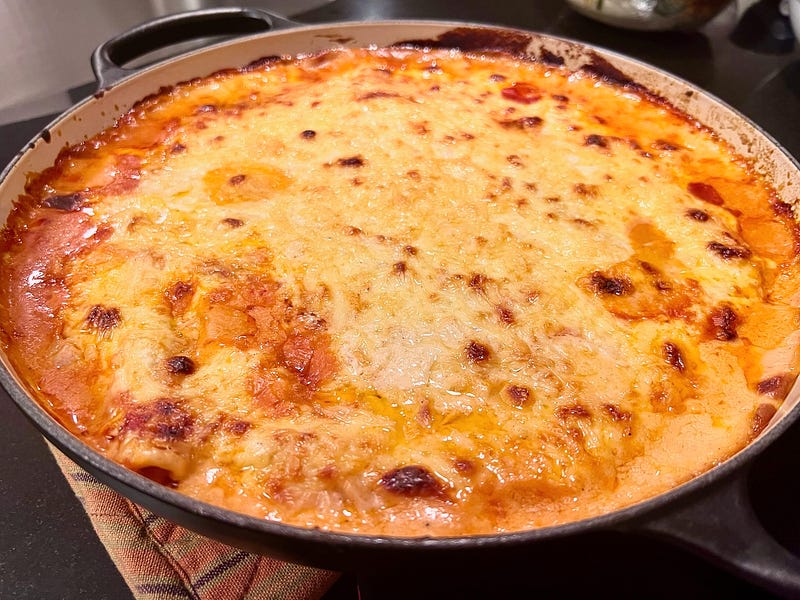
So I’ve learned my first French sauce, at least to an above-average level of understanding. Béchamel’s history still confuses me. It may well be a variation of Italian white sauce. But does it matter? It is delicious.
Does this help me reconnect with my French Canadian heritage? Perhaps. While I don’t remember any of my favourite childhood meals containing Béchamel, or White sauce, I may have a clue.
I remember two similar recipes that my Grand Mother and aunts used to prepare — Ragout de Boulettes and Ragout de Dinde (Meatball and Turkey stew). While these did not use true Béchamel, they both started with a dark roux made from browned flour. This roux produced a thick meaty sauce. The techniques I’ve learned here will no doubt be beneficial. Thoughts?
Béchamel sauce is a classic (French?) sauce made from a simple combination of butter, flour, and milk. It’s like Italian white sauce but contains no nutmeg or Parmesan cheese and is usually thicker. The debate over whether to use hot or cold milk in Béchamel sauce is a matter of personal preference. The best approach is to experiment and find what works best for you.
The wellness factor
Cooking is a great way to manage my mental health. It provides me with a creative outlet, helps reduce stress, creates a sense of accomplishment, and gives me a sense of purpose and structure. I use cooking to focus on the here and now instead of worrying about the future or the past. It provides a break from negative thinking patterns. Finally, it is something I can do, and I can feel it. There is something so satisfying about feeling a sauce thicken, then drizzling it on your plate. Are you feeling stressed? Give cooking a try.