
Exploring My French Canadian Heritage: A Journey Through the Five French Mother Sauces
Sauce three — Espagnole
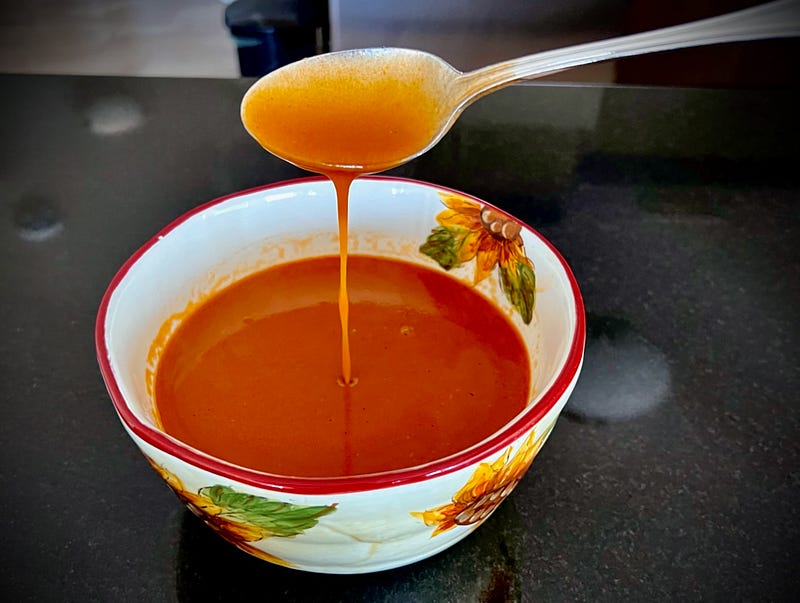
With two French Mother Sauces under my belt, it was time to try for a third; Espagnole. After reading lots and studying up on this sauce, made from brown stock, tomato purée and mirepoix, I thought it would be easy. But then I came upon this quote by Escoffier:
“Stock is everything in cooking, at least in French cooking. Without it, nothing can be done. If one’s stock is good, what remains of the work is easy; if, on the other hand, it is bad or merely mediocre, it is quite hopeless to expect anything approaching a satisfactory result. The cook mindful of success, therefore, will naturally direct his attention to the faultless preparation of his stock.” — Auguste Escoffier, from Chapter I, Basic Principles of Cookery.
Escoffier is right, of course. Stock is the foundation of the sauces. When I made Béchamel sauce, I used milk to dissolve the roux, not stock. When I made Velouté, I chose a chicken Velouté; all I needed for the stock was the chicken carcass I would cook. But Espagnole sauce is prepared by combining roux with brown stock. And while I’ve made pan sauces before, I’d never made a good brown stock.
Further, I could not forget Escoffier’s words, so I wouldn’t use store-bought beef stock.
Estouffade — brown stock
So back to “The Escoffier Cookbook and Guide to the Fine Art of Cookery.” How does one make brown stock? The Escoffier Cookbook serves more as a guide here. In truth, professional chefs cooking for the masses use Escoffier’s book. The over ten pounds of bone and meat required to make brown stock, or “Estouffade,” were too much for me. But I need to be adaptable. I modified the recipe to desired amounts and available ingredients. But Estouffade is still not for the light-hearted.
About 30 hours later, I was ready to take on Espagnole sauce. I won’t get into making Estouffade in this post, but let’s say I will never use store-bought stock again! “Stocks are the foundation of cooking, especially French cooking.”
A sauce with a dark roux — is this what my Grand-Maman used to make?
But let’s get back to the Mother Sauce at hand, Espagnole. The sauce was named after the Spanish, who were the first to bring tomatoes to Europe in the 15th century. French cuisine uses Espagnole sauce as a base for several other sauces, such as demi-glace, Chasseur, and Madeira.
I was excited to try Espagnole sauce because it used a dark roux. I remembered that my Grand-Maman used toasted flour in her sauces. A dark roux would be similar. I was getting excited.
Having done this now, I recognize dark roux has a nutty taste, but it is less intense than what you get from toasting the flour. On the other hand, the butter in the roux makes it easier to darken. When I tried toasting flour, it stayed white for a long time before turning brown and almost burning a minute later.
Starting a roux with equal amounts of butter and flour means a lot of extra fat. As such, another advantage of toasting the flour is you can make a leaner sauce. I distinctly remember my Grand-Maman toasting the flour, not the roux. But I don’t think she worried about the fat content. She cooked at a time when people were much more active. Fat probably wasn’t a concern.
So why not use a roux? Was butter too expensive? My Grand-Maman would have had access to lots of fat from the meats she cooked. There was likely no reason to add butter. I’ll have to dig into this further.
Putting the sauce together
With my wonderful Estouffade and a darkened roux ready, it was time to put the sauce together. Like Velouté, you don’t need much technical prowess to make Espagnole sauce, but you need time.
While the sauce was simmering, I read more in Escoffier’s book. Escoffier said, “put the pot to a cool side of the fire….” There I was, thinking it was hard to cook without all the shiniest cookware and gadgets. Meanwhile, Escoffier was looking for the “cool side of the fire!” I still like my kitchen gadgets and Le Creuset pots and pans, but this makes me think. You don’t need to be high-tech to cook well.
I wondered if my Grand-Maman would have cooked that way. As a child of the 70s, I never saw her cook on a fire or even a wood stove, but she must have done so.
Time to try the sauce
I’ve read a lot about Mother Sauces. One topic that comes out regularly is how they taste. In particular, many authors say all the Mother Sauces are delicious — however, the daughter sauces are where the magic happens. But Espagnole is a bit different. Nobody seems to dislike Espagnole, but they say it may be bland. Most will suggest taking Espagnole directly to a Chasseur or Demi-glace sauce.
Nonetheless, I decided to try the sauce “as is,” and it was fine. When I first tried Béchamel and Velouté, I was immediately impressed at what I had made. When I salted and tasted some of my Estouffade, or brown stock, I told myself I wouldn’t ever buy stock in the supermarket again. The Espagnole sauce, on the other hand, was just fine. It is deep and earthy, and I can see how it would be a fantastic base for a Chasseur sauce.
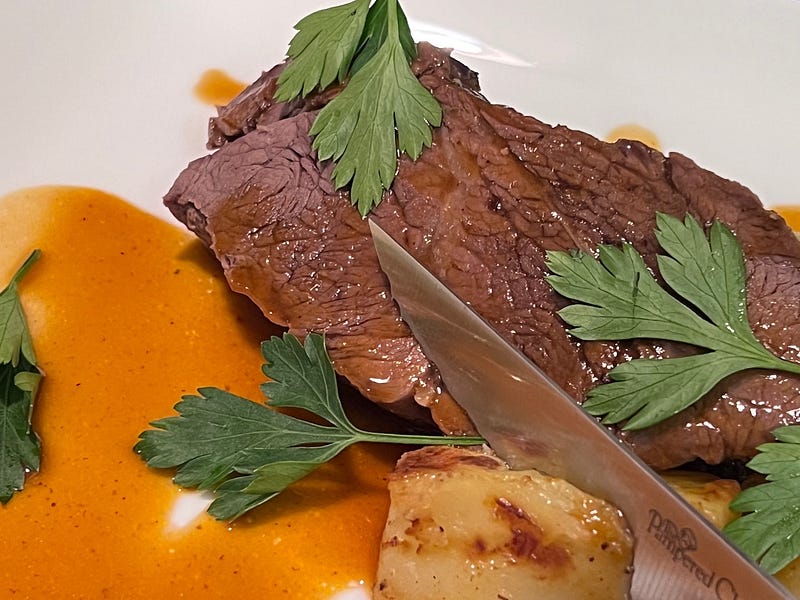
Despite the darkened roux, Espagnole sauce was also very different from my Grand-Maman’s brown sauce. She made her sauce from darkened flour, which was much earthier and nuttier than my Espagnole sauce. Espagnole is also very red, unlike the brown sauce I remember.
Still, Espagnole sauce is the sauce that has taught me the most so far. I had never made a proper Estouffade before, and until you make one, you can’t know what a difference it will make to your cooking. While the Espagnole sauce was OK, I’ve recently used my Estouffade in many dishes. I’m already looking forward to my next two-day adventure, trying to improve on Estouffade.
Going back
Today, I wished I had learned to cook from my Grand-Maman. I’m also sure she would have been thrilled to teach me. But in those days, I would barely stop running long enough to eat, let alone learn to cook. Even the best teacher in the world can’t teach someone that doesn’t want to know.
While I approached Espagnole sauce, with its dark roux as a front runner for the brown sauce I loved as a child, Espagnole is a very different sauce. I’m no closer to making my Grand-Maman’s brown sauce, but I am closer to my childhood memories.
I’m not sure if it’s this entire project that has me thinking about those memories. Or is it reading about Escoffier, cooking on an open fire? Is it because I want to taste a good “Ragoût de boulettes.” Regardless, I’m closer to my family than I’ve been in a long time. I’m moving in the right direction.
Cooking has become a great way to manage my wellness, providing me with a creative outlet. This time of year is stressful at my day job. Cooking helps reduce stress, creates a sense of accomplishment, and provides a sense of purpose and structure.
Are you feeling stressed? Give cooking a try. Better yet, cook and write about it. I’d love to hear about your exploits.


