avatarMaximiliano Veiga

Free AI web copilot to create summaries, insights and extended knowledge, download it at here

1398

Abstract

comprehensive details.</p><h1 id="4eab">Zero-Shot Chain-of-Thought</h1><p id="4767">In this variation, no samples are utilized, a practice known as <a href="https://arxiv.org/abs/2201.11903"><i>‘Zero-Shot Chain-of-Thought</i></a><i></i>. The first prompt is expanded with an instruction: “<i>Let’s think step by step.</i></p><figure id="8b2d"><img src="https://cdn-images-1.readmedium.com/v2/resize:fit:800/0*GwG7vf4hDW2RNOHI"><figcaption>Image Source: <a href="https://arxiv.org/pdf/2205.11916">Kojima et al. (2023)</a></figcaption></figure><blockquote id="2e10"><p><i>Technically, the full Zero-Shot-CoT process involves two separate prompts/completions. In the below image, the top bubble on the left generates a chain of thought, while the top bubble on the right takes in the output from the first prompt (including the first prompt itself), and extracts the answer from the chain of thought. This second prompt is a self augmented prompt.</i></p></blockquote><h1 id="ef1e">Tree of Thoughts</h1><p id="52d3">The paper <i><a href="https://arxiv.org/abs/2305.10601">Tree of Thoughts: Deliberate Problem Solving with Large Language Models</a></i> takes a further step by introducing a framework that generalizes over chain-of-thought prompting. It encourages exploration of thoughts that serve as intermediate steps for general problem-solving with language models.</p><figure id="1192"><img

Options

src="https://cdn-images-1.readmedium.com/v2/resize:fit:800/1*EoT8WQUkwCMlh3ldWpKYDg.png"><figcaption>Image Source: <a href="https://arxiv.org/pdf/2305.10601">Yao et al. (2023)</a></figcaption></figure><blockquote id="982a"><p><i>Tree-of-Thought improves prompting of large language models (LLMs) by generalizing the concept of Chain-of-Thought prompting and introduces a tree search across language model thoughts, including state evaluation and backtracking. Experiments on toy tasks show large improvements over both classic and Chain-of-Thought prompting.</i></p></blockquote><p id="b062">The ‘<i>Tree-of-Thoughts</i>’ technique capitalizes on this self-evaluation mechanism. By allowing the model to generate multiple initial potential thoughts and select the most promising one, it mimics the iterative reasoning process humans employ. Subsequently, the model generates alternatives for subsequent thoughts, a process akin to human deliberation.</p><p id="2532">Large Language Models, operate by generating text token by token. Initially, they lack a clear endpoint and may veer off course, much like a person might when faced with an open-ended question. However, once they’ve produced text, they can evaluate their own responses for coherence and correctness. Generating text of higher quality with a reduced hallucination rate comes at the expense of using more tokens.</p></article></body>

Exploring Chain-of-Thought Prompting

The ‘Chain-of-Thought’ pattern represents a technique for enhancing the reasoning capabilities of AI models. The technique is simple yet powerful, aiding AI models in understanding reasoning.

Few-Shot Chain-of-Thought

Let’s examine the image below, sourced from the paper Chain-of-Thought Prompting Elicits Reasoning in Large Language Models’. As always, including samples in the prompt (Few-Shot Prompting) proves beneficial. While the left column lacks the exact answer, the subtly modified prompt in the right column facilitates the model in discovering the solution.
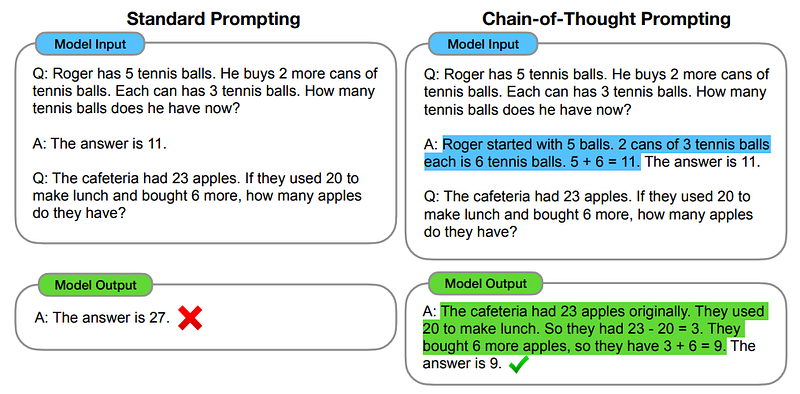
Image Source: Wei et al. (2022)

The key lies in delineating not only the answer within the sample but also the logical progression of thought leading to that answer. This approach guides the model on how to tackle similar questions effectively. For further insights, explore Learning Prompt for comprehensive details.

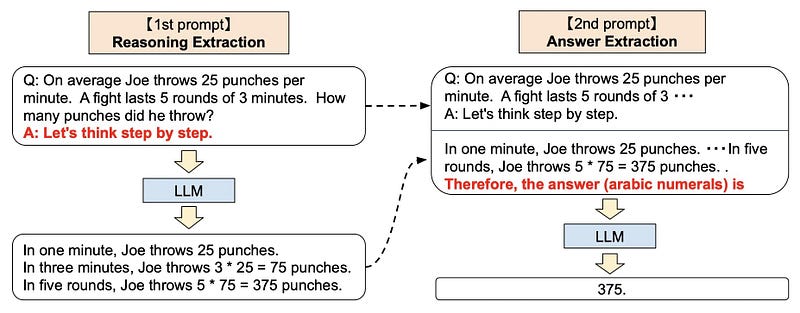
Zero-Shot Chain-of-Thought

In this variation, no samples are utilized, a practice known as ‘Zero-Shot Chain-of-Thought. The first prompt is expanded with an instruction: “Let’s think step by step.

Image Source: Kojima et al. (2023)

Technically, the full Zero-Shot-CoT process involves two separate prompts/completions. In the below image, the top bubble on the left generates a chain of thought, while the top bubble on the right takes in the output from the first prompt (including the first prompt itself), and extracts the answer from the chain of thought. This second prompt is a self augmented prompt.

Tree of Thoughts

The paper Tree of Thoughts: Deliberate Problem Solving with Large Language Models takes a further step by introducing a framework that generalizes over chain-of-thought prompting. It encourages exploration of thoughts that serve as intermediate steps for general problem-solving with language models.
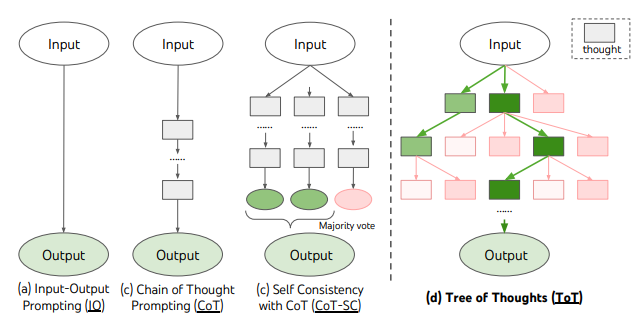
Image Source: Yao et al. (2023)

Tree-of-Thought improves prompting of large language models (LLMs) by generalizing the concept of Chain-of-Thought prompting and introduces a tree search across language model thoughts, including state evaluation and backtracking. Experiments on toy tasks show large improvements over both classic and Chain-of-Thought prompting.

The ‘Tree-of-Thoughts’ technique capitalizes on this self-evaluation mechanism. By allowing the model to generate multiple initial potential thoughts and select the most promising one, it mimics the iterative reasoning process humans employ. Subsequently, the model generates alternatives for subsequent thoughts, a process akin to human deliberation.

Large Language Models, operate by generating text token by token. Initially, they lack a clear endpoint and may veer off course, much like a person might when faced with an open-ended question. However, once they’ve produced text, they can evaluate their own responses for coherence and correctness. Generating text of higher quality with a reduced hallucination rate comes at the expense of using more tokens.

Chain Of Thought
Llm
Prompt
Prompt Engineering
Learning
Recommended from ReadMedium