
Experiment. Have Fun. That’s How We [Actually] Write Our Best Words.
Agree?

You don’t have to be a wordsmith to write online.
I say this for 3 reasons.
- Fiddling with words is time-consuming (your writing).
- Your effort is asymmetric to your results (can be dismal).
- Everyone else is doing their best to bury your work with their writing.
To win this Internet game, you need speed, ideas, words of persuasion, and experience.
I think what you are thinking. What BS. Isn’t this obvious? But how do I even get those?
This is the short answer.
Experiment.
How to experiment with our words
There are [simply] too many variables in writing.
The first step is to list them down on paper. All of them.
Here’s mine.
- Genre
- Headlines
- Subtitles
- Introduction
- Headers of sections
- Body of texts
- Conclusion
- Image
The next step is creating a shortlist for improvement.
Why a shortlist? Well, easy. We are short of time. It is impossible to work on all variables at the same time.
I work on 3 in any given month.
For this article, I will focus on,
- Genres,
- Headlines,
- Body of text.
1* Experimenting with [limited & identified] genres
Hang on a second. You are not telling me to experiment with writing in all available genres?
No, I won’t.
That said, no one, no one, can stop you from trying.
That is [exactly] what I did during my first year of writing online.
It backfired. I died a spectacular death, buried under thousands of words I spat into the Internet.
Here’s why.
- I spent way more time researching than on the [actual] writing,
- My opinions and perspectives got watered down,
- Readers tap out.
It is silly. Really.
Spray and pray rarely get the job done. What you want is to hit the Bull’s Eye.
I was pissing and dissing words into the wind.
I’m stupid. You’re not. Don’t be like me.
The moment of epiphany came when I sat down to reflect.
I asked myself 3 questions.
- What do I [really] know?
- What am I interested in?
- What do readers want?
[Actually] My original list is longer. I have, like, 10 points? I trimmed it.
I ended with these final podium finishers.
Then, I stared at them for a long time.
Then, it dawned on me that 1 leads to 2, and 2 leads to 3.
They are a daisy chain. I needed answers for Question 1. The rest will fall in place.
So, I went on a scribbling spree.
Business, entrepreneurship, finance, economics, investing, money, life lessons, psychology, startup, retirement, gobbledygook, sh!t in my head, rants, tantrums, bad days, yadda, yadda…
I trimmed them to 3.
- Retirement.
- Business.
- Money.
Since then, every article, story, long-form, and short-form from me is an experimentation of an identified topic with depth.
Retirement stories include,
- How to retire with $1 million?
- No, we don’t need 1 million to retire.
- Is 1 million in retirement funds enough for today?
1 genre, 3 topics.
Same words, different spin.
Different perspectives expose different layers of depth.
Try it. You will be amazed at the number of articles you can produce.
I do this for business and money genres as well.
2* Headlines — Perform controlled experiments
Play with a word or two.
Yes, you read that right.
Change one or two words in your headlines. Watch how it performs.
- 3 Things I Hate to Think About When I Retire [Dead Broke] at Age 70.
- 3 Things I Will Hate Myself for When I Retire [Dead Broke] at Age 70.
- 3 Things I Think About When I Retire Dead Broke at Age 70.
Dickle with impactful words. Position them differently. Analyze the home runs.
A popular alternative is to play with numbers.
- How to Write an Online Article that Makes You $101.
- 40 Practical & Realistic Money Life Lessons I Learned in 40 Years.
- Are You Earning Next to Nothing from Your Content? Why Are You [Still] Here?
You can explore 2 permutations here.
- Compare headlines with numbers against those without (compare similar headlines).
- Compare headlines with numbers against those with dollars (does $ work for you).
Your analysis may confuse you.
Let me explain why with screenshots.
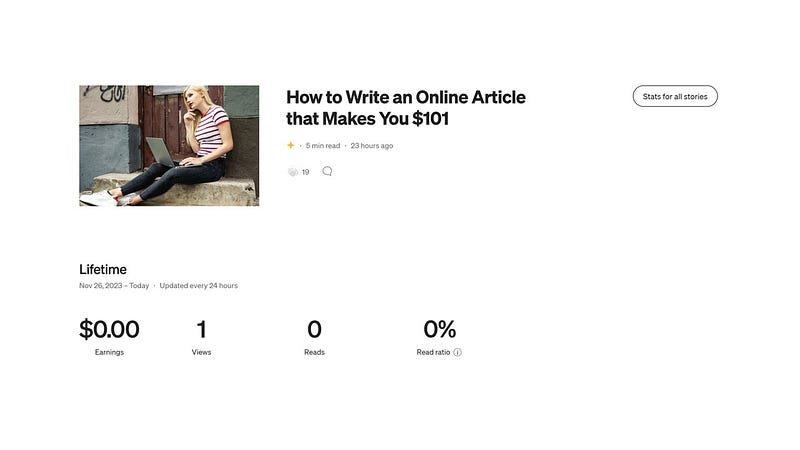
Next one.
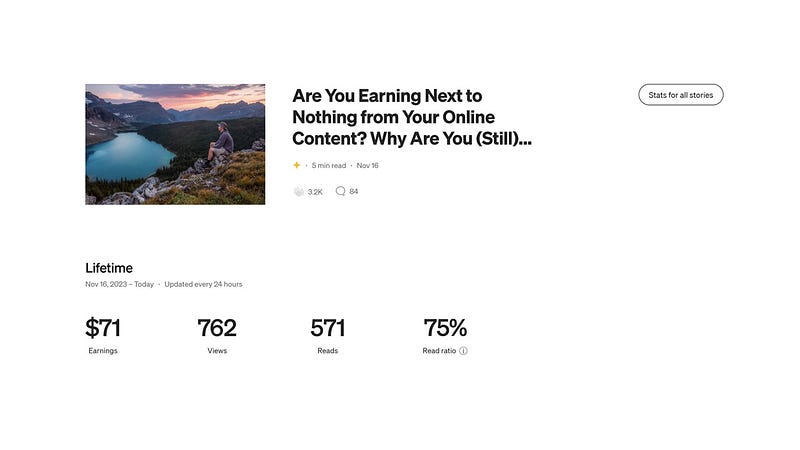
As you can see, I do better with headlines without the dollar sign. Is that surprising? Hell’ ya.
It proves one thing.
What works for others doesn’t work for me.
And I know this [only] because I experiment. You should, too.
3* Body of texts
I think in breaths.
It may surprise you, but our inner voice pauses when it reads.
It came to me when I was reading Jordan Belfort’s The Wolf of Investing. I was subvocalizing his paragraphs. And then, [just so suddenly] it dawned on me that I got breathless.
I caught myself by surprise.
Like, does our inner voice… breathe?
Maybe, just maybe, it does.
I was staring at a long paragraph and wondering… hmm, has it got to do with this wall of text?
And so, I started reading it out loud.
It turns out that I became breathless at the exact spots I did when my inner voice was reading 10 minutes back. Wow. Fascinating!
And then, I went back to my desk and started visualizing how walls of text affect our reading tempo.
And writing, too. I don’t want my readers to be breathless. They will swipe left.
I imagined this.
XXXX.
XXXX YYYY ZZZZ.
XXXX YYYY ZZZZ. YYYY. XXXX YYYY ZZZZ.
I realized this way of writing works well for building momentum. You see me using this a lot at introductions.
And then, this.
- XXXX,
- YYYY,
- ZZZZ.
Here, I am counting.
Note. Using bullets is not [just] about using bullets or manipulating white spaces. You can visualize speaking and concurrently counting with your fingers.
Port it over to our writing. It works.
Go 1, 2, and 3. Then A to B, B to C.
It flows rhythmically.
Now, the last one.
XXXX YYYY ZZZZ. XXXX XXX. YYY. ZZ.
This is an elaboration with a strong finish.
Here’s one example.
Short sentences are punchy. You don’t stretch your breath. It is like sprinting. Right? Right.
Here’s the next one.
Add shorts after a long sentence to create an impact. Do you agree? Why? Why not?
In short, fiddle around and experiment with sentence length. The goal is to help your readers read better.
The close
Successful online writing has nothing to do with our ability to write per se.
It has to do with active experimentation.
Change things up. Have fun.
Find your sweet spot. And then, you excel.
Like this story? Hit Subscribe!
Oh, oh, you can buy me a cup of black too! Thank you!