
Experiencing Rain in an Arabian Desert Nation
Rain in the Desert, its Disruptions, and Signs of Climate Change
Given the nature of this occurrence, I thought it fitting to start writing this article via the voice-to-text feature in my Google Docs.
Rain in the desert does not happen all the time, but when it does, it’s always a spectacular thing to experience. Living in some areas of Gulf regions, thunderstorms are a rare occurrence.
I woke up this morning hearing thunder, thinking my ears could be deceiving me. But I thought again, I know what thunder sounds like. Sure enough, as I cleared my head and opened my eyes, I heard thunder again, followed by lightning. In my excitement, I sprung out of bed and opened my window curtains to see light falling rain.
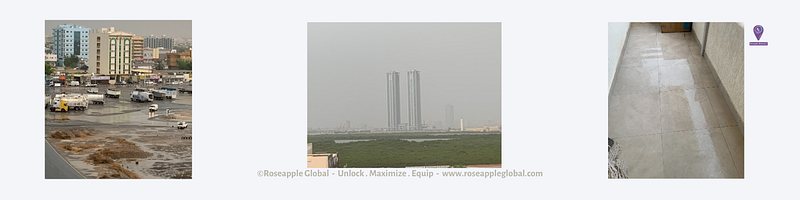
I left my bedroom and went to my balcony. When I stepped outside, I had a clear view of cloudy, dark grey, overcast skies. Looking out, I viewed the wet roads which were collecting water. There were many puddles surrounding the bare ground around my building. Much of the open land was soaked.
Because I like rainy days, I returned to my room, drew my window curtain open fully and sprung back into bed. I stared out the window, listening to the thunder and watching the lightning and gazing at the rain beating against my window pane. Rain is one of those things for me that is soothing. However, I am not particularly fond of thunder or lightning accompanying any thunderstorm.
So why am I writing about rain? Well, it’s because I live in the Arabian Desert and in a country where the annual rainfall is between 140–200 mm per year, as noted by the World Bank Climate Change Knowledge Portal. Most of the rain in the country occurs in December and January and in the northernmost Emirates. The rainfall is a result of natural occurrences and scientific endeavors known as cloud seeding. The rainfall can be higher in mountainous regions along the United Arab Emirates (UAE) — Oman border. These rarer showers bring a day of cooler temperatures, a respite from the heat in the late autumn and winter months. However, this rarity from nature also comes with some challenges.
While I am thrilled that it’s raining, I can hear the thunder and see the lightning. I know what I am in for since this country is not accustomed to rain, and the local population is relatively unfamiliar with driving in it. When I got up and onto my balcony, I saw cars speeding down the road. I was shaking my head and thinking about the likelihood of accidents or stalled cars if drivers attempt to drive through standing water.
I took a moment and gathered my thoughts, including mental capacity — it was not going to be a good driving day. I slowly grimaced at the thought of heading out to work on the roads that I knew were not going to be easy to navigate as the rain got heavier. There is a high potential for street flooding.
Why? Because the country isn’t built for rainy weather due to its topography and lack of infrastructure for it. It is sandy, and such soil is limited to absorbing extensive water in a short period. Once it gets saturated, that’s it. The water has to find somewhere to go; thus, the grounds become ponds.
Most roads don’t have ground drainage systems or run-off drains; thus, water backs up easily and quickly. In addition to flooding, they can become muddy. How is this? On a regular day, there is general drifting sand or dust on the road. But with the rain, it becomes muddy and, in some cases, causes slippery driving conditions.
And so, as the rain continues to pour and I prepare to head to the office, I slowly start dreading the prospect of driving and navigating the flooded streets. I thought about taking a taxi, but I opted to brave the experience.
However, when I arrived at work, I smiled when I saw university-age young adults outside standing in the rain, getting wet or stomping in it with their bare feet like I did when I was a child. It is an interesting phenomenon how rain can bring out the playfulness or curiosity of people who are not accustomed to having it.
The sad part of today is I was planning an outdoor campus-wide event — an awareness walkathon. Given the forecast for rain all day, it is unlikely to occur. Looking at the progress of the rain in the morning and what was predicted for the afternoon, the event was canceled. I was quite sad about canceling that event. I was looking forward to it because it is a cause that is near and dear to my heart.
I usually support this cause every year in some capacity, be it awareness or financial donations — this year, it was creating a walkathon for my institution to bring awareness and support. The rain disrupted the event, but many on campus wore pink and shared social media posts about their support. Unfortunately, due to a variety of scheduling and timing matters, it could not be rescheduled.
However, I am thrilled about the rain despite schedule disruptions and the headaches of driving on flooded roads. It is an exciting time when it rains, at least for me. However, I’m sure that not everyone does.
So, while I selfishly love that it’s raining right now, I also have in the back of my mind that this rain is also damaging. This rain could be due to gross misuse and changing weather patterns of our planet, and that saddens me.
The other thing about it raining today or in the desert, in general, is that it’s a great reminder that the climate is changing as the average global temperature is increasing. That being said, there was no indication of rain yesterday when it was above 90 degrees. But suddenly, overnight and into the early morning, there was a huge thunderstorm.
If you’re living in a coastal region and among mangroves, it might be a bit more understandable to have rain. Even so, rain is still a rarity here.
But after this rain, I am excited to see what you find in flora. It may pop up because there was rain for most of the day.
So, we still have to think about climate change. We still have to think about creating a sustainable environment for our planet because this rain is a sign that the climate has changed. Things have shifted, and a perspective on maintaining an environment that will sustain our lives comes to mind.
I do whatever I can to recycle, repurpose, and support learning on how to protect our planet as long as I am on it. I understood the importance and impact of the rain, but I am not sure everyone understands that such an isolated thunderstorm happening today means we have damaged our planet.
With a heavy sigh and this thought in my mind, I will leave this message and remind us that whatever small action we take can help keep our Earth a sustainable, livable environment for those of us who are present and for generations to come.
Since I am not new to living in the Gulf region, catch my experience from 15 years ago:


