
Experiencing a Pandemic in an Alt-Right Town
Is this a public health crisis…or a political one?
The shelves are empty at our local grocery stores. That, in itself, is not particularly noteworthy, being as common as it is in this time of pandemic.
What’s interesting to me is the human drama playing out alongside this, like the tall, strapping men strutting around the store in jeans and dirty white t-shirts, handguns strapped to their belts, where everyone can see them.
“I like to bring this in to scare the libtard assholes in this town,” one of them conspiratorially (and loudly) said to a diminutive female store employee who eyed the weapon, nervously, while I watched from the end of the aisle.
I have no doubt that he had a concealed weapons permit. He might be a bully and a jerk, but the people like him in this town aren’t stupid. Not about guns. They aren’t going to give anyone an excuse to take away their firearms.
But you’d hope that in a global crisis like the COVID-19 pandemic, people might come together and support and help one another. It’s not very reassuring to find out that community members bring guns to the grocery store just to intimidate others and make a political statement.
Unfortunately, that’s the reality in a predominantly alt-right town.
I live in the Pacific Northwest of the United States, a place that most people in the country assume is liberal-leaning. Those who don’t live in this region are often surprised to discover that while Washington and Oregon are blue states, that’s only because the counties that house our metropolitan hubs, and are therefore the most densely populated, are blue. Geographically speaking, most of Washington and Oregon are actually red.
This is a deep point of contention in this region. Despite Washington and Oregon’s reputations as being the capital of hipster fashion, bicycle commuting, and tree hugging, you won’t find much of that outside of the metro areas like Portland, Seattle, and Eugene. In the central and eastern regions of these states, you will find mostly conservative residents, some who identify as moderate Republicans, but many who lean into alt-right philosophies. There’s also a fast-growing population of libertarians.
The bitterness here of these residents, who feel ignored by liberal senators and governors, runs deep. So deep, in fact, that there are groups passionately working to remedy the problem by redrawing state boundaries in order to make parts of eastern Washington, eastern Oregon, and northern California part of Idaho, or to fully secede in order to create an independent northwestern nation outside of the U.S. and Canada.
Despite Washington and Oregon’s reputations as being the capital of hipster fashion, bicycle commuting, and tree hugging, you won’t find much of that outside of the metro areas like Portland, Seattle, and Eugene.
My family moved here in 1993, when I was a senior in high school. I was fully aware that the liberal perspectives my family and I had on life and politics was not the norm here. My classmates were hunters, cowboys, rodeo queens, and gun advocates.
This didn’t bother me. I’d grown up with cousins, aunts, uncles, and grandparents who were all Republicans (though their lifestyles were very different). I knew there were a variety of political beliefs in the country and that we’d never all agree on everything. I didn’t even mind that the kids at school called me a dumb hippy.
In 2008, though, I began to notice things about the political views in this region that scared me. Barack Obama had just been elected president and people were bitterly complaining about having a black leader. They’d lose everything, these white men said. Obama wouldn’t protect their interests because as a black man, he couldn’t understand what was important to white people. Further, this country was made by white men and should be run by white men.
That was the first time that I started seeing the ugliness that was just beneath the surface of this region — and maybe all across the country, too.
Within days of the confirmation that COVID-19 had officially arrived in our state, our governor began outlying a plan to prevent the spread. Social distancing was strongly recommended, and as the days went on, she closed our schools, closed the dining areas in restaurants, and pleaded with residents to stay home.
This was met with immediate and aggressive pushback. I couldn’t believe what I was hearing and seeing from local news stations and on social media.
It’s a hoax, people were saying. Some went so far as to accuse our governor (who has weathered at least one petition-based campaign to have her removed from office) of orchestrating a conspiracy created by the Democrats to destroy the economy and sabotage Trump’s chances of reelection.
As you can imagine, this vitriol spread like…well, COVID-19, angering citizens, many of whom refused to follow the recommendations for social distancing. They said the virus wasn’t real — the entire thing was made up by the liberal media.
Of course, this is not surprising, considering Trump called the virus a hoax created by the Democrats at a rally in February. Fox News anchors used words like “conspiracy theory” and “scam” in stories about the virus. So it’s no wonder people in very conservative regions like the one in which I live are ignoring the advice of Democratic officials and the CDC.
They said the virus wasn’t real — the entire thing was made up by the liberal media.
Four years ago, this would have surprised me. Even after eight years of witnessing people spew hateful and racist rhetoric about President Obama, I thought such beliefs were part of a niche minority, something that might sadly always remain somewhere in the darkest corners of our nation, but that would never gain enough power or momentum to rise up.
Little did I realize what was coming in 2016.
Suddenly people in town where posting signs on their lawns saying “Build the wall!” They were proudly displaying bumper stickers that read, “Kick the brown people out!” People started calling the liberals in this town “commies” and “socialists.”
When I bought my first house in 2017, the neighbors across the street introduced themselves, and as we talked, I noticed that every single piece of clothing they were wearing was screen-printed with AK-47s — even their socks. A few days later, while doing the dishes, I almost dropped a plate when I heard a gun go off. I ran outside to find the neighbor who lives on the farm behind me standing in his field next to my garden, shooting his handgun, aiming for the gophers that were sprinting across his field. Kids were playing in the street less than twenty feet away.
Later that fall, one of those boys who often played in the street stopped to talk to me over my garden fence and tell me about how he liked to throw marshmallows at his neighbors to make them go home. “They’re Mexicans,” he said, with disgust.
At the time, I wondered what would happen in this neighborhood if there was a natural disaster or, you know, a zombie apocalypse. I knew everyone would have their AK-47s ready to go. But would they help one another? Or would it be every man for himself?
Regions like this are filled with small, family businesses that are often the first hit in an economic blow. Restaurants, shops, and salons immediately felt the financial hemorrhage of social distancing. Other businesses and many community members have been actively doing everything they can to support these people. Social media campaigns cropped up, directing members of the community to support these venues by ordering takeout or donating money. Small grocery stores even began giving bags of food away to community members who had lost their jobs and needed help to support their families.
I found this very heartening except for one worrisome factor: these acts of support were made in response to the hoax that was destroying our economy — not to the virus.
One of the downtown shops who was giving away bags of food posted about their efforts to help community members, stating that it didn’t matter what had caused this economic collapse. “Whether it was a government conspiracy or liberal media hoax,” they said, “the result is undeniable. Our community has been hit hard and we want to help.”
Other small, local businesses posted on Facebook, encouraging people to ignore the social distancing recommendations in order to support our town’s economy.
“Whether it was a Democrat-led government conspiracy or liberal media hoax,” they said, “the result is undeniable. Our community has been hit hard and we want to help.”
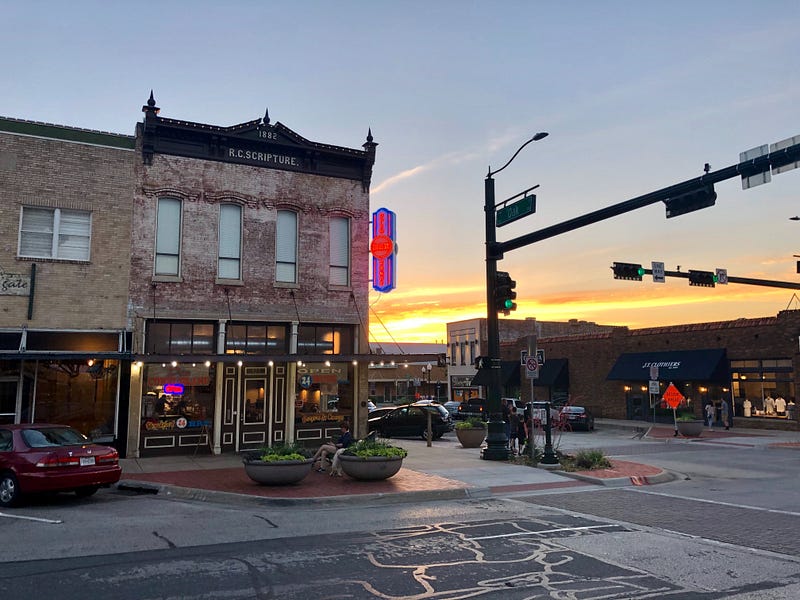
Our governor finally issued an executive order on March 23rd that closed many businesses and instituted a fine for those not following social distancing orders. And of course, this order was met with a fresh wave of anger and defiance. Lines outside the restaurants waiting to order takeout are long. The grocery stores are still crowded with people, even at nine o’clock at night. Many still share photos of their covert get-togethers on Facebook and Instagram.
Until March 25th, GPS data collected from cell phones by Unacast ranked my state and several of its counties in the “Bottom 5” of places that were failing to adhere to restricted mobility, an indicator of social distancing. That’s right, as in the bottom five of all the states and counties in the entire nation.
Thankfully, the strict measures taken do appear to be working. Current evidence suggests that we are flattening the curve, though many community members still believe that the virus is a hoax and over the past weekend, rallies and protests were staged at City Hall where over 200 people gathered, in violation of the executive order, to declare that they will be re-opening their businesses over the course of the next week and if the governor wants to stop them, she’ll have to “get through all of us.”
Let’s just say that I won’t be surprised to see people walking up and down the streets of downtown holding firearms over the coming weeks. Though it’ll only be from the safety of my computer or TV screen because I’ll be home, practicing social distancing.
For better or worse, this is my community. A community in which people wear handguns to the grocery store. A community in which people share food with families in need in order to protect them from perceived government conspiracies. A community in which people are genuinely struggling to pay the bills and whose stimulus checks aren’t even enough to pay their rent in this inflated housing market.
A community that is a tiny glimpse into the current state of the nation, for better and worse.
People are afraid. They are struggling. They are ready to fight and don’t know what to punch.
Maybe that’s one of the most poignant lessons that will come from this — the deep distrust we have in our government, and tragically, in one another.
© Yael Wolfe 2020
You might also like:


