
Experiences of an Old Nomad: Buduburam, Ghana
Sometimes you never know how good you have it, until you do.
Some of my most poignant memories are of the times I spent going back and forth from the west coast of Florida to Ghana and Uganda between 2010–2015. Those trips began with research but ended in complex bonds of relationship and honesty that sometimes made the professional and the personal difficult to untangle.
A trip to Ghana was my second to the continent of Africa. Ghana was the start of many trips between 2010–2015 to learn about local populations and refugee experiences.
Why Ghana?
Having worked with resettled refugees in the US since 2002, I wanted to understand the refugee journey in a way I never could from reading research articles. My first opportunity was in Ghana in 2010 when I got the opportunity to spend time at Buduburam Refugee Camp, about 27 miles west of the capital of Accra. This stay was facilitated by a former leader from my Florida university who took a consultant position at the University of Ghana.
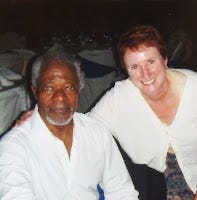
The trip began with several days on the University of Ghana campus with my gracious hosts, attending a couple graduate classes and a lively party held by the former Secretary-General of the United Nations, Kofi Annan, who was the chancellor of the university.
From Accra to Buduburam
I remember wondering what I had gotten myself into when my colleague and his wife dropped me off at Buduburam in the care of Nsia, a teacher there, and her husband, Daniel [note: names are pseudonyms].
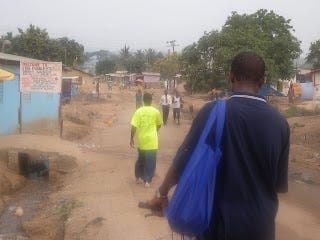
Buduburam has been home to as many as 42,000 refugees, mostly from Liberia and Sierra Leone. When I visited, the streets were rutted dirt roads, and homes were small shacks built of whatever materials families could find.
I visited a number of schools at the camp, from a newly built UN school to several whose most modern technology consisted of an old chalkboard in each classroom. Many camp children couldn’t attend school because their families couldn’t afford to buy a school uniform. Others were frequently truant because they had to spend time begging for food.
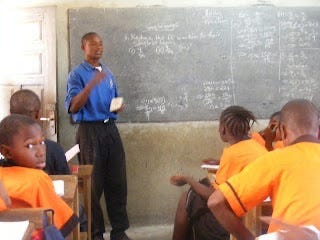
Classes were disciplined and efficient. Because most children could not afford textbooks, learning was by rote and repetition. It looked something like this:
[Teacher loudly stating]: TWO PLUS TWO IS FOUR!
[Students repeating]: TWO PLUS TWO IS FOUR!
[Teacher REPEATING]: TWO PLUS TWO IS FOUR!
[Students repeating]: TWO PLUS TWO IS FOUR!
[Teacher]: Mary, stand up. [She stands.] What is two plus two?
[Mary]: TWO PLUS TWO IS FOUR!
[Teacher]: Good! Sit! Joseph, stand up! [Joseph stands.] What is two plus two?
[Joseph]: TWO PLUS TWO IS FOUR!
These children had no time for homework when they returned to their homes, and no supplies such as pencils and paper. They had to memorize what they learned.
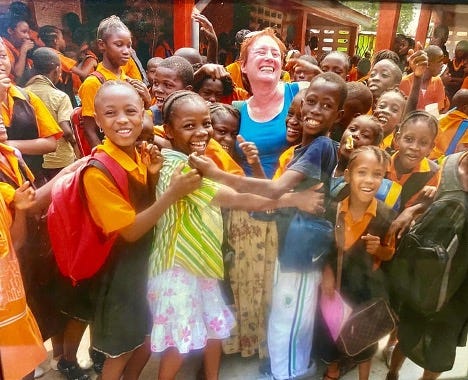
But trust me: these kids were happy to be in school. They worked hard to pass their exams, and they valued education. The refugee children I worked with in the US were the same, struggling to learn English and recognizing the privilege of being in school. I couldn’t help but compare them to the many privileged American students I worked with who thought they deserved A’s simply for showing up and who disrespected their teachers and their education.
In an art class I was able to ask the students to draw what made them happy. I watched as a 12-year old boy drew a highly detailed picture of a classroom filled with students. I was so impressed with his work that I gave him my email and asked if he could use the Internet café at the camp to stay in touch. This was Tom.
The next day, he introduced me to his best friend, another excellent artist named Philip.
Both Tom and Philip were forced to move back to Liberia in 2015. I helped them complete their secondary studies there. I remain in touch with Tom, 13 years later, and I put him in touch with a university professor colleague who hired him to be a guest lecturer for his online class. It pains me that he has so little opportunity for his future. He is a talented and wonderful human being.
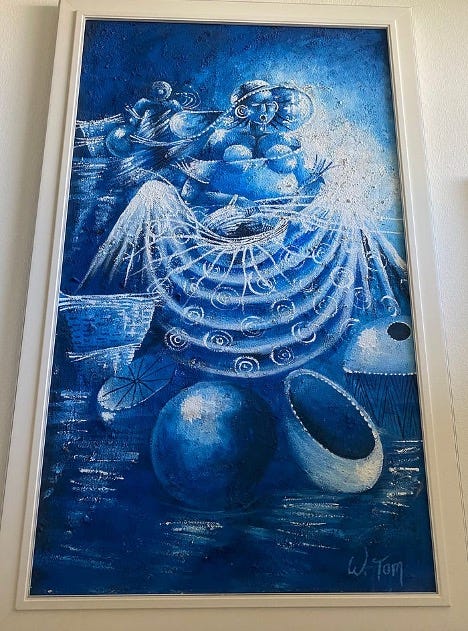
Two more of Tom’s paintings hang in my home. If you’d like more examples or to buy any of Tom’s work, contact me!
The Day to Day
Aside from long days at schools, I spent time with Nsia and Daniel. That first day, Nsia asked me, “Do you like meat?” Foolishly, I answered in the affirmative. We went to the market where carcasses had been hanging all day in the 90-degree heat, swarmed with flies. Somehow I managed to stay well until I returned to the comfort of my colleagues’ university housing in Accra, where I became very sick.
One Sunday morning, Nsia came into my bedroom with a live chicken and said, “You like chicken?” Grateful that the bird had not been hanging dead all day in the open hot air, I nodded my head. She sent me off to church with her husband while she stayed home to kill and prepare the meal. We also had the cassava that we had pounded the day before to make fu-fu.
The things we take for granted. On a Saturday, I brought my laptop out to write some notes. Daniel was clearly interested, so I asked if he wanted to use it for a while. He enthusiastically agreed. Then I saw he had no idea what to do with it. He had never seen or used a keyboard, nor had he ever held a laptop computer.
Daniel and Nsia
Daniel was a challenge. Whenever Nsia was not in the room, he tried to touch and kiss me. She sent me off with him to a local village to buy food, and he constantly tried to hold me. I told him that this was not ok in my culture, and he insisted it was fine in his.
Culture or not, it was not ok with me.
Nsia was very gracious. She insisted on having a Ghanaian dress made for me, and she brought me to meet neighbors. One evening the three of us traveled to a village to visit the home of a pastor and his family. This family had a toddler who took one look at me and began to scream uncontrollably. He had never seen a white person before. I’m sure I looked like a monster to him.
I Had No Idea
I don’t remember much about my flight back to the States from Ghana; I was still recovering from what I guess was food poisoning.
But I will never forget how I felt when I lie in my bed that first night.
In Buduburam, I had a bed with a foam mattress, maybe two inches thick, on top of wooden slats. I know it was a generous offering of my hosts to give me this room. It was hot, and there were no windows. By my last day there, my body hurt so much that I wondered how I would get up.
Getting in bed when I returned was one of the most memorable moments of my life. I literally wept as I realized how comfortable it was. I would have never known this without the experience of sleeping in Buduburam in a room lovingly provided by my hosts.
Sometimes, we have no idea.
I found a blog I wrote about this experience. My last two paragraphs are worth repeating:
Whether you believe in a god or, like me, are an agnostic, there is but one thing you need do to feel yourself enveloped within the thick, warm, soft feathers of an angel’s wings: spend a week at a refugee camp, travel over 30 hours back to your home, and then pay the slightest bit of attention to your bed. Never has the cushion of my mattress felt so gentle and caressing to my tired limbs as it did last night, nor have I felt so grateful and aware of what I consider “simple pleasures” — a thermostat, my cat jumping on my bed to awaken me, my morning tea, my CD player filled with my favorite Irish tunes. Life is beyond inequitable. I can’t begin to imagine what it would take to bring countries such as Ghana to the standards I take for granted. Yes, there are some modern shopping malls, nearly everyone has a cell phone, there is electricity, and some homes are rather luxurious. But for the average Ghanaian — and certainly for the Liberian refugees at the camp — a life like mine looks light years away. May I at least have the good sense to be grateful for what I have.


