
Art Appreciation
Deciphering 4 Masterpiece Paintings with Enigmatic Narratives
Why interpreting women in art is not always easy

Interpreting paintings undoubtedly relies on an accurate reading of the contents of a work. But what happens when appearances are misleading?
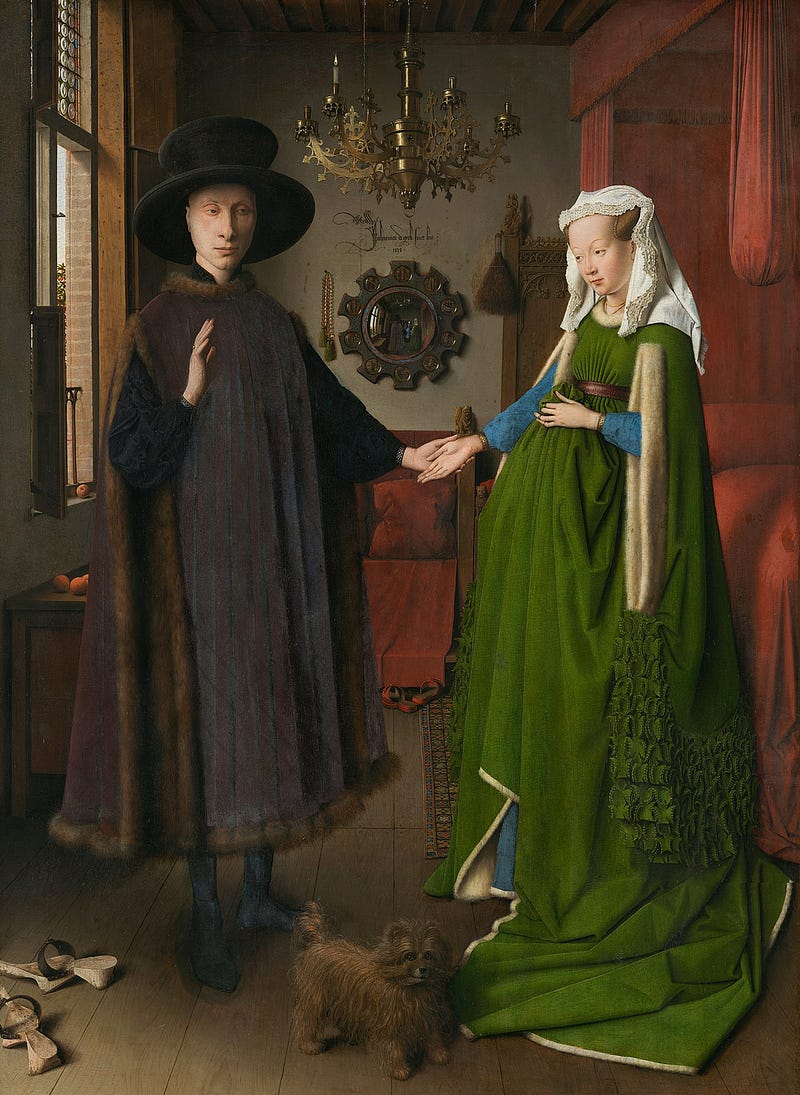
Take the case of the remarkable Arnolfini Portrait by Jan van Eyck, which shows a couple inside a private room, appearing to make an oath to one another — perhaps as part of a marriage ceremony.
.jpg)
The image is abundant with symbolic suggestions that urge the viewer to connect the dots into a story, from the mysterious mirror on the back wall to the presence of a single flaming candle in the chandelier above the man’s head — whilst a recently burnt out candle sits above the woman’s.
Perhaps most noticeable is the woman’s swollen form, giving the distinct impression that she’s carrying a baby.
The precise meaning of the painting continues to divide historians. One intriguing reading is that this is a commemorative object in honour of the woman who has recently died. With the appearance of being pregnant, the idea is that she died in childbirth, hence the extinguished candle and the ashen face and dark clothing worn by her husband.
But despite looking pregnant, both in her form and posture, the evidence suggests this is not the case.
She is wearing an elaborate green wool overdress with a long train, and gathers up the excess material to her stomach. Since it is thought that the man was a cloth merchant, so the abundance of cloth worn by his wife would be an appropriate demonstration of their wealth and professional success.
Moreover, such long dresses were not uncommon among wealthy and noble ladies of the period, thereby making the shape of the dress a matter of fashion rather than pregnancy.
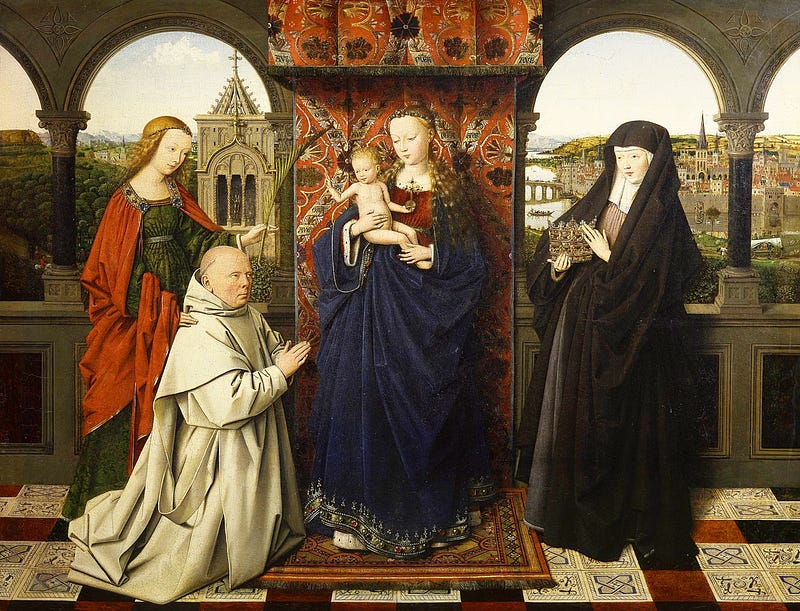

A similar dress can be seen in another Van Eyck painting, of the Virgin Mary and Christ Child with saints, in which Mary’s long blue gown is likewise drawn up at her midriff section. Of course, Mary isn’t pregnant in this painting.
Interestingly, the female saints on either side seem to wear high-waisted garments, with the one on the right, Saint Elisabeth of Hungary, also having the appearance of a “bump”. But since she gave up her reign to become a nun — hence why she is proffering a crown—again it seems highly unlikely that the artist would depict her as carrying a child.
Subtle depictions of a pregnant Virgin Mary do occur in art, most often in Netherlandish scenes of The Visitation, when Mary — assumed to be around seven months pregnant at the time — met with Elizabeth, mother of John the Baptist. But in these works, with their specific context, there is usually no ambiguity over whether Mary is pregnant or not.
Expecting or Just Fashionable?
Arriving at a precise interpretation of a work of art can be difficult, especially when artists of the past often loaded their work with allegorical prompts that encouraged the viewer to generate their own narrative. Yet it’s important to take account of historical conventions rather than apply our own modern-day perspectives.
Another example is the art of Johannes Vermeer, who made several paintings in which the form of the woman’s outline makes a pregnancy reading possible.
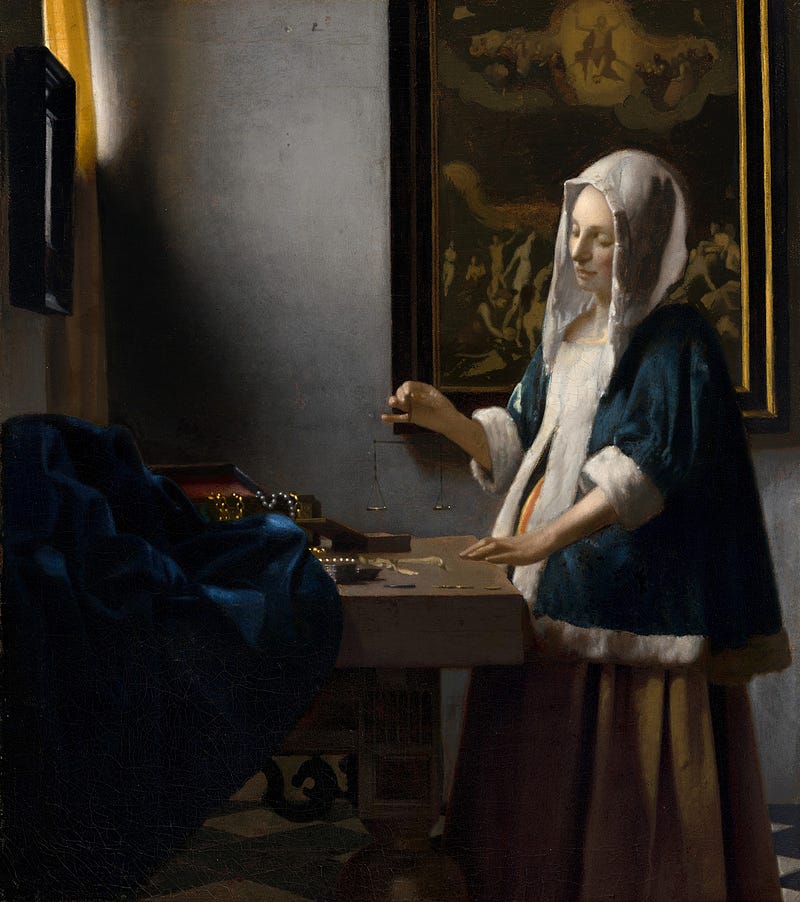
Woman Holding a Balance, made in about 1664, shows a finely dressed noblewoman holding a pair of weighing scales in one hand. She is measuring the weight of her jewellery — apparently contemplating her material wealth.
So how do we read a painting like this?
The woman is wearing a blue jacket trimmed with white fur, probably made from squirrel, mouse or cat. Beneath her jacket, she is dressed in a yellow garment with a skirt. Again, from the shape of this garment, she appears to be pregnant.
Now notice on the wall behind her a framed depiction of the Last Judgement — the moment when the souls of the saved and those of the damned are finally sorted. The addition of this second image suggests a deeper meaning to Vermeer’s painting: that with the weighing scales in her hand, the woman is echoing the moral balancing act between good and bad conduct, with particular emphasis on the morality of luxury and wealth.
And if the woman is pregnant — as some historians assert — then this reading could go a step further. We might say that she is measuring the fortunes of her unborn child, both good against bad. Alternatively, a pregnant woman dressed in blue may in fact represent the Virgin Mary — just like in the Van Eyck painting. If the child she is carrying is meant to be Jesus, the painting would refer to her anticipation of Christ’s life and his role in saving humanity.
So is she carrying a child or not?
Compelling as this possible reading is, historians are split on whether or not she is with child. When Woman Holding a Balance was auctioned in 1696, some 35 years after its making, the object was described as “A young lady weighing gold, in a box, by J. van der Meer of Delft, extraordinarily artful and vigorously painted.”
In other words, a more-or-less contemporary account made no mention of her being pregnant. Moreover, by looking at other Dutch paintings made by Vermeer’s contemporaries, historians have discovered that the female fashion of the 17th century tended to advocate a rounded shape. Her short jacket and thickly padded skirt perhaps only create the impression of a rounded stomach, and since clothes were seen as a declaration of women’s place in society, this sense of abundance was an indicator of wealth.
There is no consensus to the answer. Some have proposed that the woman pictured was Vermeer’s wife, Catharina Bolnes, who is known to have bore 15 children.
Others argue that pregnant women were very rarely the subject of 17th century Dutch art, especially genre scenes like this one. Indeed, in most periods of recent history — with the exception of English pregnancy portraits from the 1560s to approximately 1630 — images of pregnancy were unusual, perhaps because they suggested visible evidence of a sexually active woman.
And since Vermeer was working to sell his paintings in the commercial setting of the Dutch art market, it seems unlikely that he might adopt such an unconventional theme.
Tempting Narratives
Perhaps what tempts us into assuming pregnant women when there is good evidence to suggest otherwise is because of the narrative possibilities that such a reading opens up.
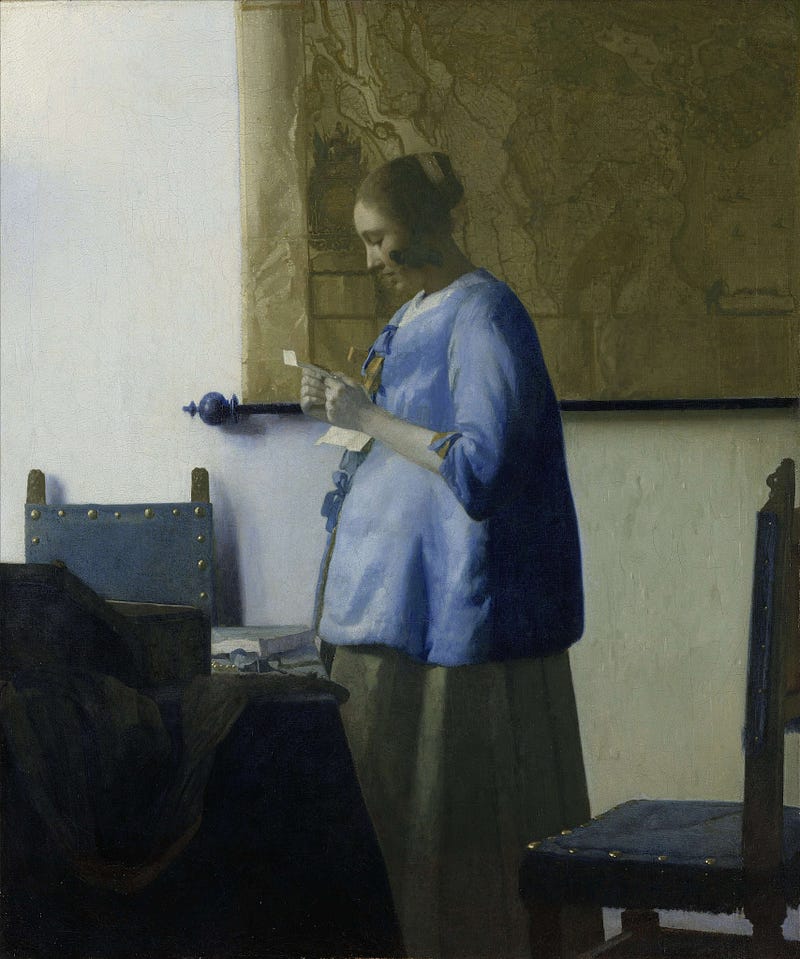
A painting like Vermeer’s Woman in Blue Reading a Letter, in which a woman is shown in the pose of clutching a letter with two hands, can become all the more tantalising if we see her as pregnant.
In Dutch art, a woman reading a letter often had connotations of a missing lover, which is a possibility also indicated by the empty chair beside her. Here the sense of drama is heightened by the chance of her being pregnant — since the letter could be seen as from the unborn child’s father, or perhaps bringing news of the father’s untimely death.
What’s interesting about the artworks we have considered is that the narrative clues in them tend to be just that: hints and suggestions — leaving room for the viewer to come up with their own version of events. As such, these works present a pleasing combination of specific codes and openendedness — into which we can insert our own heightened array of potential storylines.

If you liked this, you may also be interested in my book How to Read Paintings, an examination of some of art’s most enthralling images.
Would you like to get…
A free guide to the Essential Styles in Western Art History, plus updates and exclusive news about me and my writing? Download for free here.
Join me…
On Instagram for more great paintings on the go!