
Exotic Food And Exotic Disease: Part 2
Do you know the risks of your eating behavior?
Welcome back to the exotic. If you have missed the first part, please make sure you read that.
Because without that, this one might not make the same impact, I want this article to have.
Let’s start the day with the exotic foods of the day. YAY.
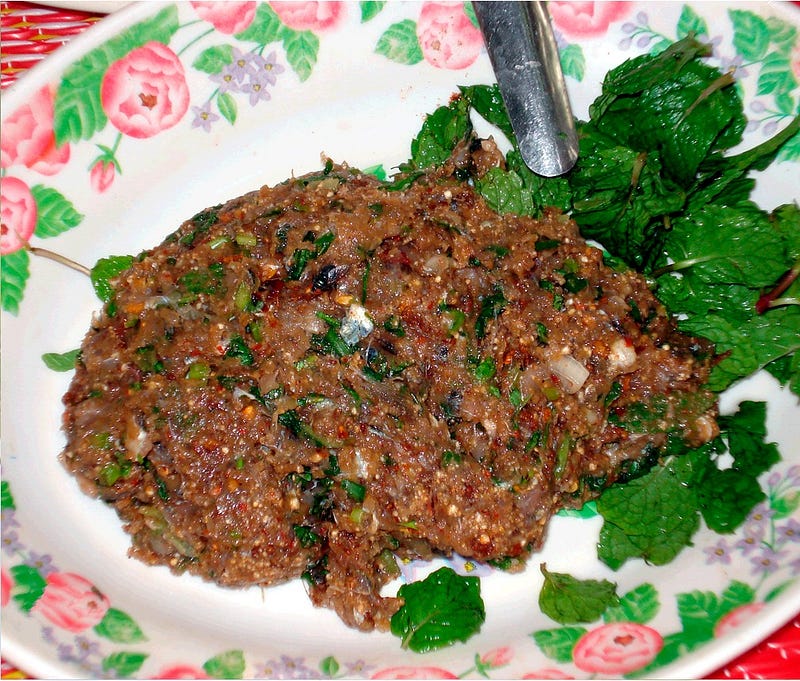
Koi Pla
Have you ever heard of it? I guess you’re not the single person, that would answer no.
Even the name is so exotic to us, maybe because of the reason we don’t speak Thai, and we don’t know what that means. So, you know already it’s a dish from Thailand. Exactly spoken, it’s a local raw fish delicacy from north-east Thailand, prepared from raw fish, live red ants, herbs and lime juice. Many different variations of this salad are supposed to be popular in Thailand, Lao PDR, Vietnam, and Cambodia.
Kuai/Yusheng
And heard of them? They sound even more exotic.
Kuai is a dish from China, made with finely cut strips of raw fish and served with sauces prepared from scallions or mustard seeds. This dish was supposed to be very popular in early Chinese dynasty. Yusheng, however, is popular these days. It is also a Chinese dish, prepared with strips of raw fish, shredded vegetables and a variety of sauces and spices. Yusheng is usually eaten as an appetizer and often considered as a symbol of good luck. This is why it’s a famous dish for celebrating the Chinese new year.
I guess, everyone is waiting for the big disclosure. Don’t worry, that will eventually happen. But let me share you some interesting facts about a simple green leafy vegetable considered as a superfood, watercress. Yes, the regular watercress.
In a study conducted by the Center for Disease Control and Prevention aka CDC in 2014, watercress has been awarded the perfect nutrient density score. Although it’s 95% water, it has a significant amount of Vitamins K, A, C, B2, B6, and calcium. It is said, that Hippocrates built his first “hospital’ near a stream, where he grew watercress to treat his patients with it. But make sure you wash it properly before you eat.
Let’s hear an interesting story before getting to our medical topic of the part. A 64-year-old male Chinese male presented with a 3-week history of jaundice and abdominal pain. His GP referred him to the hospital for the treatment of his jaundice. During a thorough history, he also complained about recurrent fever for more than a month. Tests showed he had gall stones in the common duct, which was surgically removed. Furthermore, the pathological report showed chronic inflammation of the gall bladder. Pathology report also mentioned something, which I’m going to mention later. The patient was treated and he did a full recovery. This case could have been completely different if the person didn’t have jaundice as his other symptoms were vague and on-off. After some years, he would have the same symptoms but the complete different diagnosis, not a chronic gall bladder inflammation with stones but a bile duct cancer. Sorry if you’re completely lost right now. If you’re devastated right now, I guess my plan was successful. Disclosure is about to follow very soon.
I guess, everyone is waiting for the link between all these different topics. I mentioned two different exotic foods, a common aquatic vegetable and a case where a Chinese patient had a simple cholecystectomy, where I tried to gain attention by mentioning the cancer risk. The word ‘Cancer’ on its own is very appealing and gains thorough attention. That is actually not a bad thing, as the incidence of most of the cancers are increasing and the population needs to get educated. Well, all of the things have a common link, trematodes.
Oops, sorry if you’re disappointed. But yes trematodes, commonly known as flukes are the turning point here. Yes, all this drama for the common flukes. The exotic raw fish dishes and watercress are among the most common ways of the transmission of these flukes, here exclusively the liver flukes. There are many species of liver flukes, the three most common are: Fasciola hepatica (common liver fluke), Clonorchis sinensis (Chinese liver fluke)and Opisthorchis felineus (cat liver fluke). As they are commonly transmitted through food, the infection with these flukes is commonly referred to as food-borne trematode infections.
Along with Paragonimiasis (lung fluke infection, I mentioned in the first article), these food-borne trematode infections cause about 200,000 cases annually including more than 7,000 deaths. Well, that’s a fascinating high number for the disease, which is not even known to all the medical doctors. Fascioliasis is a global disease while Clonorchiasis and Opisthorchiasis are rather limited to Asia. While the transmission of Fascioliasis occurs usually through the consumption of raw watercress and other water plants contaminated with larvae, Clonorchiasis and Opisthorchiasis are usually transmitted mostly through consumption of raw or undercooked fish, crabs or crayfish, even salted, pickled or smoked.
Most of the people have no symptoms. Others have mild symptoms during the migration of flukes such as abdominal pain, diarrhea or constipation. Chronic infection can cause inflammation and obstruction of the bile ducts. Without sufficient treatment, the infection may persist for years. Chronic infection increases the risk of cancer, especially Cholangiocarcinoma or CCA (bile duct cancer). It is one of the rare cancers worldwide but one of the most common cancers in Thailand. While the incidence of CCA is increasing everywhere in the world, the incidence in Thailand is dramatically high in the present. Currently, it’s incidence in western countries is less than 1 per 100,000 but in northern Thailand, it’s as high as 85 per 100,000.

There may be other reasons behind the high numbers of CCA in Thailand but what we know, are liver flukes definitely one of them. I guess we need to play our part in patient education as this number could be easily lowered. This can be easily prevented by avoiding raw or undercooked freshwater fish and aquatic vegetables. The Food and Drug Administration (FDA) recommends cooking fish to at least 145° F [~63° C] or freeze for at least 7 days at -4°F (-20°C) or below. For more information, please visit CDC’s web page and stay tuned for another exotic and exciting article.
Anish Lamichhane is a medical doctor from Germany. He has his interests in medical oncology (cancer medicine), psychiatry (mental health medicine), palliative care and digitalization of health care. He likes to present health stories in a non-traditional way with poetry and health education pieces. Subscribe if you don’t want to miss out a monthly newsletter with new selected stories.