
Execs care about revenue. How do we get them to care about outcomes?
This post was originally published to my newsletter subscribers (40k of them now). If you’d like to get these in your inbox sign up here.
Hey folks -
If there’s one metric that matters to all executives, it’s revenue. The amount of money the company is generating is core to it being able to do pretty much everything else. Revenue is an impact metric. It is a high-level measure of business health. Other impact level metrics include Net Promoter Score (NPS), customer retention rate and many others. Impact metrics give a sense of how the company is trending towards its strategic goals. To be clear, revenue on its own (as with any other impact metric) is not a strategic goal.
Impact metrics change as a result of specific customer behaviors. The problem is that most impact metrics are lagging indicators of a collection of customer behaviors. This makes attributing which customer behavior(s) had the biggest impact on revenue (or other impact metrics) difficult if not impossible.
For example, revenue could change because of customer demand for a specific product only you carry. Or, it could change because using your system is easier than using a competitor’s. Or it might change because you added a highly desired feature. Each one of these changes affected customer behavior which ultimately impacted revenue. So when your Chief Revenue Officer demands you increase revenue by 15%, on which one of these (or the infinite set of options you have) do you choose to focus your limited time and teams?
This is where outcomes come in. Outcomes are the measures of these different customer behaviors. They are activities like “the number of items put in the cart per visit per customer” or “the frequency with which a customer launches your app.” Start a conversation with an executive this far in the weeds though and they’ll usually tune out faster than a Star Wars fan at a Star Trek convention. How do we connect impact metrics and outcomes so that we can strategically plan our product portfolio efforts?
Impact to Outcome Mapping
There’s an exercise that I run with the leaders I work with that does just this. Here’s how it works:
- Gather the executive team and the product leads into a meeting room
- On a whiteboard, ask the highest paid person in the room to write down the current strategic goal for the year at the top
- Below that ask that same person (or another executive) to list out the measures of success for that strategy (hint: these should be the impact metrics)
- Below each impact metric start to draw lines protruding away from each one (like you’re building an org chart)
- Ask the execs in the room to fill out the line below the impact metrics with customer behaviors that drive those metrics. Use post-its and have everyone work individually on an initial brainstorm.
- Now have the team do another row below the last one showing the customer behaviors that drive the initial set of outcomes
At this point, your whiteboard should look like this:
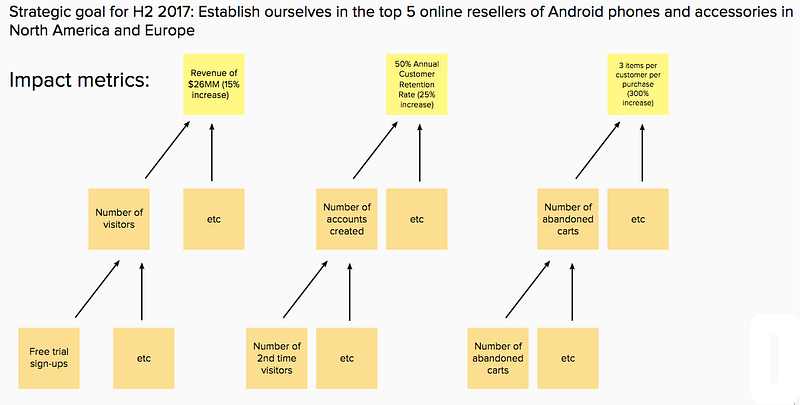
If you’ve made it this far, you should have dozens of post-its on the board indicating a variety of customer behaviors (outcomes) that will help your company hit its strategic goal and impact targets. Also at this point, your executive team should be overwhelmed. Most times I’ve run this exercise it had never occurred to the leadership that there were so many ways to potentially drive positive change.
Now, the tough part. Through a round of dot voting (or other facilitated selection exercise) ask the execs to pick the 10 outcomes they think the company should focus on first. If your company has fewer than 10 product teams, have the execs vote on a number that matches the number of teams you do have.
What you’ve done here is create a direct connection between outcomes (customer behaviors) and impact metrics (the thing execs care about) and forced them to choose where your teams should focus for the next cycle. The last step is to create a baseline for each of these outcomes (i.e., where they are today) and a goal (i.e., where we’d like them to be at the end of the cycle) and assign them to product teams as goals for their next cycle.
Now, each time a team reports progress on their specific outcome the exec will have a clear sense of *why* the team is working on that and *how* it affects the impact metrics they care most about.
Have you done something like this before? How did it work? I’d love to hear from you.
[Jeff] @jboogie [email protected]
— — — — — — — — — — — — — — — — — — — — — — — — — — — — — — — Book News
Sense & Respond continues its 100% 5-star review streak. Once you’ve had a chance to read it we’d be grateful for your reviews on Amazon.
Research Archive Made Public: Head on over here and find over 1000 links to primary and secondary research we collected over the 2 years we spent writing Sense & Respond. — — — — — — — — — — — — — — — — — — — — — — — — — — — — — — — Upcoming Events Join me this fall in Europe (and San Francisco):
Zurich — 1 day Lean UX in the Enterprise Workshop — August 30, 2017 (part of FrontEnd Conference)
Manchester UK — Lean UX in the Enterprise 1 Day Workshop, part of NUX — October 25, 2017
London — 2 Day Certified Scrum Product Owner Course with Jeff Patton — November 13–14, 2017 (this workshop is 80% sold out, don’t wait)
Berlin — 2 Day Certified Scrum Product Owner Course with Jeff Patton — November 15–16, 2017 (this workshop is 50% sold out, don’t wait here either) — — — — — — — — — — — — — — — — — — — — — — — — — — — — — — —
As always, if you want me to work directly with your teams and executives on training, coaching, retreats, keynotes or workshops on the topics of organizational agility, digital transformation, product discovery and agile leadership, don’t hesitate to reach out.
You can also now hire me for short, remote consultations 30 minutes at a time. Pick a time here that works for you. I look forward to speaking with you.


