avatarGain Java Knowledge

Summary

This tutorial explains how to handle exceptions in Spring Webflux by adding two classes to an existing project, which will automatically translate exceptions into HTTP statuses with JSON error bodies.

Abstract

The article provides a guide on implementing exception handling for functional endpoints in Spring Webflux. It outlines the necessity of adding only two classes to an existing project to ensure that any exceptions thrown by handler functions are converted into appropriate HTTP statuses along with JSON error responses. The tutorial highlights the use of DefaultErrorAttributes and AbstractErrorWebExceptionHandler classes, which can be extended and overridden to customize error attributes and handle global exceptions. It includes examples of how to customize error attributes to include error messages, API paths, and specific error values, as well as how to define exception handling for all or specific APIs using RouterFunctions.route. Additionally, the article provides a link to a YouTube video for a visual demonstration and a GitHub link to access the source code for the demonstrated implementation.

Opinions

  • The author suggests that extending DefaultErrorAttributes and overriding its getErrorAttributes(-,-) method is a straightforward approach to customize API response error attributes.
  • The use of AbstractErrorWebExceptionHandler is recommended by the author for implementing global exception handling in a Spring Webflux project.
  • The author emphasizes the flexibility of defining exception handling for all APIs or for specific endpoints, indicating a preference for tailored error handling based on project requirements.
  • By providing a video tutorial and source code link, the author implies that visual and hands-on learning can enhance the understanding of exception handling in Spring Webflux.

Exception Handling in Spring webflux

In this tutorial we will learn How to handle Exception for functional endpoint in spring webflux.

To do this only we need to add only two classes in already created project. After that any exception that our handler function throws will be automatically translated to an Http status and a JSON error body will be get in response.

These two classes already available 1. DefaultErrorAttributes and 2. AbstractErrorWebExceptionHandler. So we can override these classes in our project according to our requirement.
To customize error attributes that we are getting in API response. We can customize these attributes, To customize these we can simply extend the DefaultErrorAttributes class and override its getErrorAttributes(-,-) method.
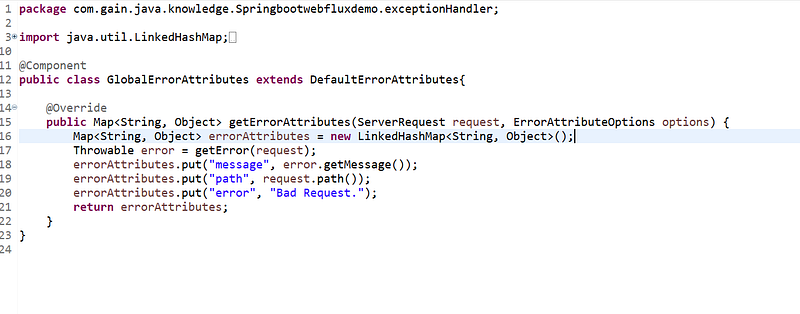
GlobalErrorAttributes.java

Here, we want to return error message that we are getting from exception, API path and error value Bad Request as part of the Error Attributes when an exception occurs.

Next Lets implement the Global Exception Handler. For this spring provides a convenient AbstractErrorWebExceptionHandler class for us to extend and implement in handling global exception.
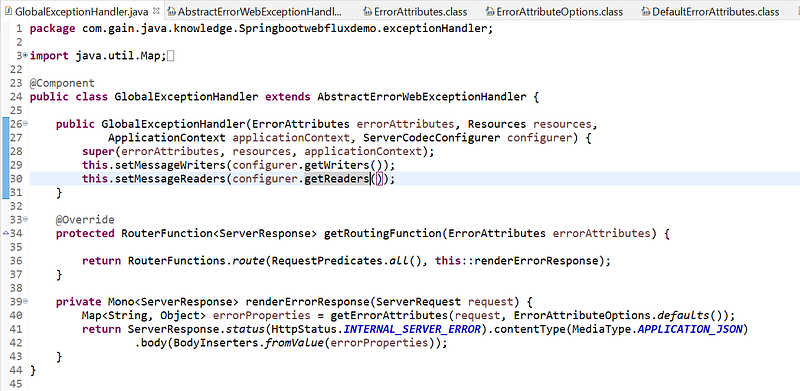
GlobalExceptionHandler.java

Here we are overriding getRoutingFunction(ErrorAttributes errorAttributes) to handle exception for our functional endpoint. Here we have defined the RouterFunctions.route(RequestPredicates.all(), this::renderErrorResponse); so this method will take care of all API if exception occurred in any API it will handle.

If we want to define for any specific API then we need to define API path in getRoutingFunction(ErrorAttributes errorAttributes) like this : return RouterFunctions.route().GET(“/get/students”, this::renderErrorResponse).build(); Now it will handle exception for only specific API “/get/students”.

Handling exception for specific api.

Watch Video Here :

Github link to download the source code :

Exception Handling
Spring Webflux
Functional Programming
Gain Java Knowledge
Spring Boot
Recommended from ReadMedium